Juncker Juggles. Slovenia Nominates Violetta Bulc

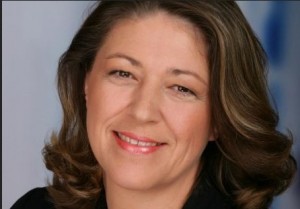
After days of intense speculation, Prime Minister Miro Cerar announced that he had chosen Bulc, a liberal.

The Slovenian government followed with a statement announcing that it “authorized Ambassador Rado Genorio, the Permanent Representative of the Republic of Slovenia to the European Union to refer the proposal to the competent EU institutions”.

Bulc will in theory inherit the Energy Union Vice-Presidency from Bratušek, who was rejected by the European Parliament on Wednesday (8 October).

But Juncker might need to rethink the allocation of portfolios in his team. Indeed, Bulc has neither the political experience, nor the policy background to lead a team of Commissioners on this matter.

Instead, the Energy Union Vice-Presidency could go to Kristalina Georgieva, who was initially allocated the Budget and Human Resources portfolio, Parliament sources told EurActiv. Georgieva’s responsibilities would then be given to Maroš Šefčovič, the Slovak who is currently nominated for Transport and Space.

As a result, Bulc would take the Education, Culture, Youth and Citizenship portfolio from Hungary’s Tibor Navracsis, who was rejected by Parliament because of his track record serving in a populist government, which has adopted restrictive media laws and launched a crackdown on NGOs.

Violetta Bulc, No Energy

Will the US Fed React to Slowing Economic Growth in the EU?

Recent Federal Reserve Open Markets Committee meeting noted the following: ?“Some participants expressed concern that the persistent shortfall of economic growth and inflation in the euro area could lead to a further appreciation of the dollar and have adverse effects on the U.S. external sector. Several participants added that slower economic growth in China or Japan or unanticipated events in the Middle East or Ukraine might pose a similar risk. At the same time, a couple of participants pointed out that the appreciation of the dollar might also tend to slow the gradual increase in inflation toward the FOMC’s 2 percent goal.?

Strong DollarNote:  Remarks from the US Federal Resevre on the Global Economy are highly unusual.  The Wall Street Journal editorializes on the reaction to a downturn in Europe, with Germany losing its mojo.  “Everyone is looking to the European Central Bank to save the day, but there’s only so much Mario Draghi can do.”

Netfix Streaming Movies Home. Movie Chains Survival?

Does Netflix new deal to make movies and stream them to home entertainment centers threaten movie chains?

Netflix has just inked a four-movie deal with Adam Sandler that threatens to shake up the big theater chains by radically altering the way movies are distributed and viewed. It will allow Netflix to produce movies and to stream them directly to customers’ home entertainment centers and computers, completely bypassing exhibit houses. The online Washington Post put this ominous headline on the story: ‘Why the Adam Sandler deal with Netflix could doom theaters…’ Exhibitors, especially big chains like Regal Cinemas, Cinemark and AMC, are understandably upset.

But  huge investment in digital projection systems will give the exhibitors the ability to transform the movie business even more radically than Netflix has transformed it already. At a cost of about $65,000 per projector, movie houses have installed digital systems that have all but eliminated Kodak prints. The savings to distributors have been enormous – on the order of a billion dollars a year in mailing and insurance costs alone. Now, instead of making and shipping 1,200 prints to open a blockbuster movie “wide,” the studios send out ultra-high-definition discs that cost just a few dollars to create and ship. Digital projection systems have also allowed theaters to broadcast special “live” events, such as performances by the Bolshoi Ballet, the London Philharmonic Orchestra and the New York Metropolitan Opera. The theaters have a big advantage over home systems here, since such performances benefit greatly from giant screens (including IMAX) and spectacular sound systems that far outclass even the best home entertainment systems. And there’s yet one more very important factor that will continue to favor theaters over home entertainment systems: the eagerness of all but die-hard couch potatoes to get out of the house on a Friday or Saturday night.

Netflix Streaming to Home

Putin Faces the Russian Economy?

Putin spent his birthday alone in the SIberian forests.

Though the crisis with Ukraine has been reduced to a simmer, Russia has seen a strategic reversal in its critical borderland. In addition, the crisis moved the West to enact sanctions on Russia and loosen many financial and economic ties to the country. Now the Kremlin is in the midst of an economic crisis that is every bit as serious as the Ukraine situation. In the past two days, Russia’s central bank used $1.6 billion of its currency reserves to shore up the Russian ruble. Since the start of 2014, the central bank has injected $51 billion in currency reserves to keep the currency stable. The Russian economy is projecting flat growth for 2014, while foreign investment into Russia has fallen by 50 percent. The Kremlin may have $630 billion in its reserves, but these funds are being used quickly in an attempt to fill the cracks.

Concerns over Russia’s financial stability have erupted into public battles between the various Kremlin factions. On Tuesday, Russian Finance Minister Anton Siluanov, a key figure in the liberal economic clans, publicly called on Putin to cut Russia’s ambitious defense spending program.

While Siluanov’s argument against defense spending is financial, Putin also has to consider the security and political ramifications of such a decision. Russia’s continued struggles in its borderlands will require a robust military. Moreover, Putin is using the defense budget to appease Russia’s various security and defense circles.

Though Putin has ruled Russia for 15 years in a centralized and autocratic fashion, like any other leader he must balance various factions within the country. His ability to manipulate the various political clans is what brought him to power. The lack of that ability is what caused the downfall of Boris Yeltsin in the 1990s, and many leaders before him. Yeltsin was unable to manage the competition between his own loyalists, the more liberal circles of economists and the security and defense circles. Yeltsin wildly shifted policies in order to retain a grip on power, such as his economic shock policies and the restructuring of the Federal Security Services. Such erratic moves contributed to the Russian economic crash, the breakdown of the security services and the erosion of Russia’s military as it fought a savage war in the North Caucasus.

Putin’s grasp on power is not easy to gauge from outside the Kremlin. The decision for new leadership is made within the Kremlin walls, not among the people. Previous Russian leaders, from Nikita Khrushchev to Leonid Brezhnev to Yeltsin, were removed or pushed aside by the ones closest to them. Thus, it seems fitting that the current Russian leader chose to celebrate his birthday far from the Kremlin and its clans.
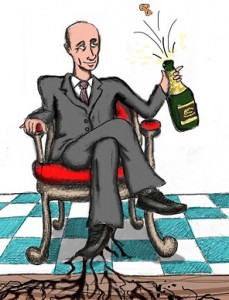
Putin's Birthday

Beware Social Media: You Could Get Canned


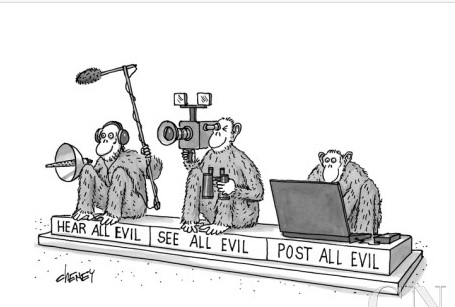
Schmupeter writes:  Thanks to the digital revolution, chief executives now live in glass houses. An ill-judged remark can be broadcast to the world in an instant. An unwise “reply all” can provide sensitive information to a competitor. An exasperated complaint in the midst of a crisis can seal your doom. Tony Hayward, who was boss of BP during the oil spill in the Gulf of Mexico, never recovered from his plea that “I want my life back”.The digital revolution has dramatically shifted the balance of power from companies to their critics. Although big firms deploy armies of PR flacks, anyone with a smartphone and a socialmedia account now has the same power to reach a global audience. Whistleblowers once had to photocopy documents and smuggle them out in their underpants. Now they can be shared with the world in a trice, by e-mail or instant messaging.

By contrast, companies have failed to adapt. The biggest of businesses with the slickest of publicity operations, from McDonald’s to JPMorgan Chase, British Gas to Qantas, have found that when they tried engaging with tweeters on their home turf, they were drowned in a sea of sarcasm. British Gas’s attempt at an online discussion about its price rises was met with a barrage of tweets mentioning “death” and “greed”. Presumably they will get better eventually. But in “Glass Jaw: A Manifesto for Defending Fragile Reputations in an Age of Instant Scandal”, Eric Dezenhall, an American crisis-management consultant, points to two big reasons why companies are condemned to play catch-up.

The first is the nature of the internet. It is a beast that feeds on scandal and particularly delights in the flesh of the powerful and privileged.

The second is the nature of companies. They are designed to stay in business rather than to be good at defending their bosses from scandal. No matter what PR resources they throw at killing a story, NGOs and prosecutors will always have more stamina. In America no sensible firm will risk gambling on a jury trial when a negative verdict could bar them from doing business with the government.

The best defence in this age of instant global scandal may be  to be brilliant at your job. A couple of years after the crisis that almost destroyed his career, Tiger Woods was chosen for a Nike advertising campaign with the slogan, “Winning takes care of everything”. Unfortunately, for CEOs it may not: if you are an ace golfer mired in personal scandal you can redeem yourself on the greens. But a boss brought down by a baying social-media mob does not always get a second chance.

Social Media

Tanya Fajon to Represent Slovenia in EP

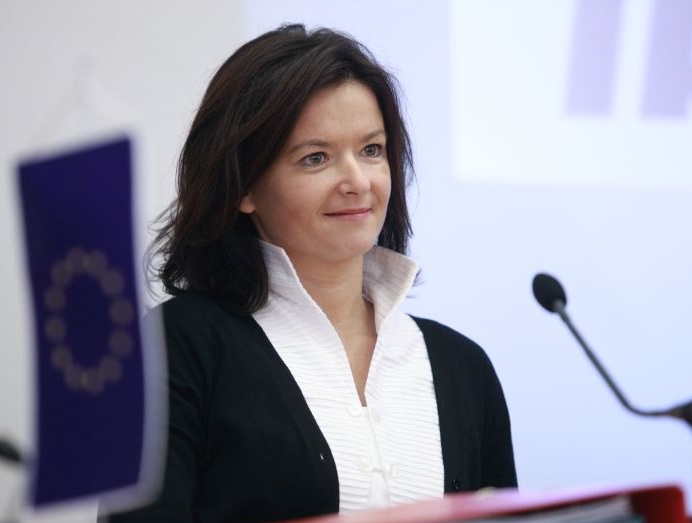
Fajon’s chances will be bolstered because she is a woman. The biggest political parties in the European Parliament have repeatedly warned they will vote down Juncker’s team if it has less than nine women. Without Bratušek, there are only eight.

After Juncker confirmed Bratušek had quit, the two biggest political parties in the parliament, the S&D and the majority European’s People’s Party (EPP), came out to support Fajon.

The Chairman of the EPP Group in the European Parliament, Manfred Weber, also said in a statement that Fajon was already one of the candidates presented by the Slovenian government last summer. She perfectly fits the bill to become Slovenia’s Commissioner, he said.

Party of the European Socialists President Sergei Stanishev said that Fajon has experience, skills and the energy to be the right candidate. “Tanja has my support and that of the PES Presidency,” he said.  Fajon, a former journalist, was elected for the first time to the European Parliament in 2009. She sits in the Civil Liberties, Justice and Home Affairs Committee.

Tanya Fajon

Public and Private Debt Considered

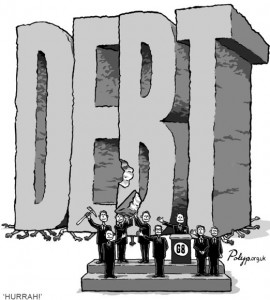
Frances Coppola writes:  The debt is still growing, but the world’s GDP growth is slowing. Indeed as aggregate debt figures are usually quoted versus GDP, the two are connected. The debt pile grows faster as growth slows, simply because the denominator is falling.

The report looks at total debt/GDP – not just sovereign debt. This is refreshing: unrelenting media focus on sovereign debt as the principal problem misses the fact that in many countries the bigger burden is PRIVATE debt. However, it makes the figures even worse. Global debt, it seems, is a terrible problem.

None of this will come as a surprise to anyone, except perhaps the news that the world as a whole is actually accumulating debt rather than deleveraging. The deleveraging efforts by developed countries are being more than offset by the increasing debt of emerging markets, particularly China.

Who are the owners of all this debt?  Debt

Debt

IMF Sees Uneven Global Recovery

Despite setbacks, an uneven global recovery continues. Largely due to weaker-than-expected global activity in the first half of 2014, the growth forecast for the world economy has been revised downward to 3.3 percent for this year, 0.4 percentage point lower than in the April 2014 World Economic Outlook (WEO). The global growth projection for 2015 was lowered to 3.8 percen

Despite setbacks, an uneven global recovery continues. Largely due to weaker-than-expected global activity in the first half of 2014, the growth forecast for the world economy has been revised downward to 3.3 percent for this year, 0.4 percentage point lower than in the April 2014 World Economic Outlook (WEO). The global growth projection for 2015 was lowered to 3.8 percent.

Downside risks have increased since the spring. Shortterm risks include a worsening of geopolitical tensions and a reversal of recent risk spread and volatility compression in financial markets. Medium-term risks include stagnation and low potential growth in advanced economies and a decline in potential growth in emerging markets.

Given these increased risks, raising actual and potential growth must remain a priority. In advanced economies, this will require continued support from monetary policy and fiscal adjustment attuned in pace and composition to supporting both the recovery and longterm growth. In a number of economies, an increase in public infrastructure investment can also provide support to demand in the short term and help boost potential output in the medium term. In emerging markets, the scope for macroeconomic policies to support growth if needed varies across ountries and regions, but space is limited in countries with external vulnerabilities. And in advanced economies as well as emerging market and developing economies, there is a general, urgent need for structural reforms to strengthen growth potential or make growth more sustainable.

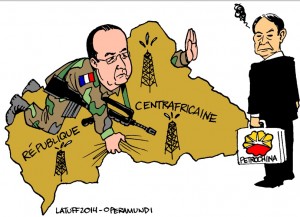
China’s Midde Man in Africa

Tom Burgis writes:  On his way home from Nelson Mandela’s memorial service in December, Ernest Bai Koroma, the president of Sierra Leone, stopped off in Angola to discuss an investment in his war-scarred nation. Fellow guests in the dining room of a golden skyscraper in the centre of Luanda, one of the towering edifices that an oil boom has raised above the slums of Angola’s capital, observed Koroma in rapt conversation with the Chinese man seated to his right.
The short 56-year-old had a receding hairline and a neat goatee beard. He wore a black suit, a red tie and rectangular spectacles. He goes by at least seven names and keeps a lower profile than the Chinese dignitaries who have visited African capitals to trumpet Beijing’s burgeoning alliance with a continent whose oil and minerals have helped feed China’s phenomenal economic growth. Most commonly, he is known as Sam Pa.  China’s Middleman in Africa

China in Africa


Left Wing Parties Join with Business to Solve Problems

Can the left parties in Italy and france succssfully embrace business?  In an effort to imprvee eocnomic conditions, both countries are trying to do this.

Beginning in the 1990s with the notion that governmnets are more the problem than the solution we have seen parties and polliticiians of all stripes trying different allliances to make economies strong and stable.  This is particularly true in France and Italy today.

Business and government join to takle problems