Italian Prime Miister Renzi Faces Confidence Vote over Labor Reforms

Italian Primte Minister Renzi faces a confience vote over labor reforms.

Renzi called the vote in order to cut short debate over his broad proposal to change labor laws that many economists say have stifled job creation and scared off foreign investors in a country whose economy has stagnated for the past two decades.

“We want to eliminate the poison that kills investment,” Labor Minister Giuliano Poletti said in a speech to the Senate.

The government’s proposals are still very broad-brushed, however, and it remains to be seen how far Renzi’s proposed reform will go.

In particular, it is unclear how the government plans to change a measure that currently makes it very difficult for companies with more than 15 employees to fire workers with open-ended contracts. Also, based on official comments thus far, none of the changes are expected to apply to Italy’s bloated public sector.

Renzi

Why Don’t Men Listen to Women?

Amanda Bennett writes:  What happens when a man’s casually assumptive, visceral reflex that nothing said by the woman sitting next to him could possibly be as interesting as anything said by the man sitting across the table extends — as it still does — to the absence of women’s voices in decision-making?

What do we lose?

Well, at the very least, I think the guys seated next to me lost a chance to have a more interesting evening. I’m not famous. I’m not important. But I do have ideas about things, and I am cheerfully willing to banter. And just imagine what was lost to the guys who years ago droned on to a certain woman who later novelized the experience of being “seated forever, trapped between two immensely powerful men who think it’s your function as their dinner partner to draw them out. You ask them about the SALT talks. You ask them about the firearms lobby. You ask them about their constituencies. You ask them about the next election.” Uh, that was Nora Ephron, guys. “Sleepless in Seattle” Nora Ephron. “When Harry Met Sally” Nora Ephron.

The SALT talks? Really?

What if NFL Commissioner Roger Goodell had thought well enough of the voices of women when it counted? Would a woman have said: Hey, hold on a minute. Let’s think about the 45 percent of our fans who are women and might be able to picture how they would feel if they were cold-cocked in an elevator?

Well, he’s hearing those opinions now. And he’s hearing them because women are telling them. Only he’s having to hear it on places like ESPN, from women such as Hannah Storm, who spoke recently of the effect of the Ray Rice video on her three daughters: “I spent this week answering seemingly impossible questions about the league’s biggest stars,” she said last month. “Mom, why did he do that? Why isn’t he in jail? Why didn’t he get fired?”

There’s nothing new about the fact that a woman like Storm is a sports anchor with a powerful platform. There’s nothing new about the fact that women take issue with the decisions of men in power. What is new is that many more women like Storm are becoming increasingly confident and, yes, feeling entitled to say: You didn’t ask for my opinion, but I have one. And it’s worth something. Would it save some anguish if we skipped some steps and moved them a bit further up the decision-making chain?

In any case, I’m grateful to Storm for showing me something. At the end of another D.C. event, I turned to my table-mate in mild exasperation and said, “We’ve been at dinner for two hours, and I know everything about you. I know where you went to school, how you got into business. I know your views on the nonferrous metals industry (not his real business) that is your passion. But you don’t know one single thing about me. Why not?”

His matter-of-fact answer: “I talked. You listened.” He didn’t deny he wasn’t listening. But neither was I speaking. I had a voice. I just wasn’t using it.


Do Men Listen to Women?

Egyptians Optimistic About Future?

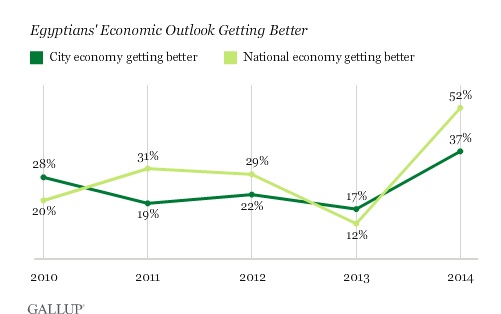
Mohamed Younis writes:  After a tumultuous year of political turmoil, violence, and at times international isolation, Egyptians seem to be turning a corner. The percentage of Egyptians who rate their lives poorly enough to be considered “suffering” has been cut in half, dropping to 16% this June, one year after hitting a record high of 34%. At the same time, the percentage who rate their lives highly enough to be considered “thriving” has nearly doubled over the same time period, rising from 9% to 17%.

Egypt 2

Energy Tussle over European Commission Nominees

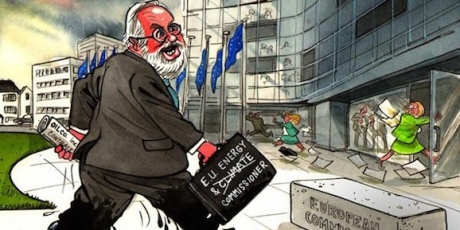
Alenka Bratušek, the Slovenian nominee to be the next European Commission vice-president for energy union, will be rejected in a vote tomorrow by the European Parliament’s environment and energy committees.  Both Bratušek and Miguel Arias Cañete, the Spanish nominee to be European commissioner for climate and energy, will be put up for a vote at the same time. Cañete has been blocked because of concerns over his ties to the oil industry. The centre-left S&D group will drop its objection to Cañete in exchange for the centre-right EPP group going along with the vote to reject Bratušek.

Once Cañete is safe, the EPP will vote to approve Pierre Moscovici, the centre-left French nominee who has been blocked because of concerns over his commitment to austerity, according to the plan.

UK nominee Jonathan Hill, who had been held over concerns about his lack of knowledge of European Union policy, will be waved through tomorrow following a second round of questioning today. Véra Jourová, the Czech nominee who saw confirmation withheld last week over her vague answers, was waved through today.

Who will replace Bratušek? That is the million-dollar question. There are three possible scenarios:

1) Bratušek is replaced by Tanja Fajon, a centre-left MEP. Fajon does not have enough experience to be a vice-president, so she becomes commissioner for transport. Maroš Šefčovič, the commissioner from Slovakia who was given the transport portfolio, becomes vice-president for energy union.

2) Bratušek is replaced by Tanja Fajon. Fajon is given the education, culture, youth and citizenship portfolio from Hungarian nominee Tibor Navracsics (the culture committee voted yesterday that Navracsics cannot have citizenship in his portfolio because of Hungary’s human rights abuses). Navracsics gets transport, and Šefčovič gets energy union.

3) Bratušek is replaced by Janez Potočnik, the current Slovenian commissioner (for the environment). Potočnik keeps the vice-president for energy union position for Slovenia. Navracsics has only citizenship take out of his portfolio, given to Dimitris Avramopoulos the Greek commissioner for migration and home affairs.  In any event, new confirmation hearings will have to be held. According to Parliament sources, the aim is to keep the final confirmation vote on 22 October in Strasbourg and quickly hold the two new hearings next week.

Canete

Credit Crunch in Russia After Sanctions

Russia companies face a looming credit crunch unless sanctions imposed by the west are relaxed and access to international capital markets is regained, according to Moody’s, the rating agency.

Debt issuaance by Russian companies in July when EU and US tightened sanctions.  Analysts said crunch would hit metals and mining, real estate and construction sectors could suffer most.

High quality global journalism requires investment. Please share this article with others using the link below, do not cut & paste the article. See our Ts&Cs and Copyright Policy for more detail. Email ftsales.support@ft.com to buy additional rights. http://www.ft.com/cms/s/0/70a578b4-4d70-11e4-9683-00144feab7de.html#ixzz3FTF3JfMb

Central bank statistics show that of $220bn in loans disbursed to non-banking corporates and households in Russia last year, almost $93bn came from jurisdictions that are home to large numbers of Russian offshore holdings but are not typical sources for large amounts of bank lending, including Cyprus, Ireland, Luxembourg and the British Virgin Islands.

Credit Crunch


Is Germany Running Out of Steam?

In August, German industrial outputplunged at its steepest rate since the height of the financial crisis.  Industrial orders are also declining.  What does this mean for Germany?

The year started strong in Germany but contraction has been steeady.  Domestic demand is not growing.

German Chancellor Angela Merkel’s government says it has little wiggle room for stimulus given its promise to balance the federal budget next year, and has attempted to move the focus to private investment. But the IMF said Berlin needed to do more.

Should Germany boost public spending and can it?

German Economy

Little Guys Strike Back in Subprime Mortgage Case

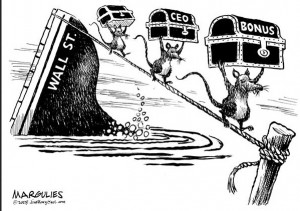
As Michael Hiltzik wrote in the Los Angeles Times, “Given the government’s failure to bring criminal cases against bankers and other Wall Street figures for collapsing the US economy in 2008, it’s been left to the little guy to strike back.” And the “little guy” did just that, in a case in Sacramento, where a federal jury acquitted four mortgage holders charged with fraud after hearing testimony that bank executives had pulled out all the stops to seduce them into taking out those toxic loans.

William K. Black, a key witness, says: This is the first time that a jury has ever got to hear what actually caused the crisis. And the jury was horrified. Because it was the lenders who deliberately made massive amounts of fraudulent loans and then sold these massive amounts of fraudulent loans through additional frauds to the secondary market and eventually brought down the global financial system.

And the testimony that came out in the case is that the agents, the FBI agents and the IRS agents simply assumed that the banks were the victims and the bankers were the victims and simply assumed that the little people, the mice, were the problem in all of this. So they never even investigated the banks and the bankers.

EMC, the mortgage arm of Bear Sterns issued mortgages to people who had no income and no assets.  Only West Virginia stopped them when they wanted to issue credit cards to these people.  Is the playing field level when a highly trained employee of EMC offers a mortgage to someone who wants a house and never has been able (and still is not able) to buy one?

The question everyone asks is why has no one paid the price for this fraud?

Too Big to Jail?

Korea Ranks One in Internet Speed

What this mean outside high speed trading and market advantage is hard to determine.

Korea’s internet users surfed at an average speed of 24.6 Mbps in the second quarter.

Korea is trailed by Hong Kong, Switzerland and Japan who each saw average speeds around 15 Mbps. The United States ranked 14th with an average connection speed of 11.4 Mbps, which is still way above the global average of 4.6 Mbps. To add a little perspective on what these speeds mean: At 10 Mbps it takes around 50 minutes to download a 2-hour movie in HD quality.

Fastest Internet Speeds

Ada Lovelace, the Woman Who Wrote the First Computer Algorithm

Walter Isaacson’s new book not only includes “the women that tech forgot”, but it also starts and ends with the story of Ada Lovelace who wrote the first computer algorithm and, according to Isaacson, “defined the digital age.” Her story, like that of so many other women, has been ignored in too many histories of the technology industry. Kudos to Walter Isaacson and his daughter, who raised Lovelace’s story to his attention.


Ada Lovelace