Entrepreneurial Invention and Economies of Scale

In-n-Out has to watch growth, becuase people prefer it to McDonald’s because the food is fresh.  You have to stay close to the food supply and forget freezing and shipping.

Megan McArdle writes:    We are the heirs of the Industrial Revolution, and, of course, the Industrial Revolution was all about economies of scale. Its efficiencies and advances were made possible by banding people together in larger and larger amalgamations, and we invented all sorts of institutions — from corporations to municipal governments — to do just that.

This process continues to this day. In its heyday, General Motors employed about 500,000 people; Wal-Mart employs more than twice that now. We continue to urbanize, depopulating the Great Plains and repopulating downtowns. Our most successful industry — the technology company — is driven by unprecedented economies of scale that allow a handful of programmers to make squintillions selling some software applications to half the world’s population.

In-n-Outt doesn’t think it can deliver the same level of quality as a far-flung mass-market operation. Not to mention the effect of expanding beyond easy trucking range of top-notch California produce. McDonald’s solved this problem by relying on frozen products machine-prepared to exact written specifications. Which is why so many people prefer In-N-Out to McDonald’s.

Sometimes entrepreneurs can compete by delvering the same goods in a different way.  Fresh versus frozen in this case.
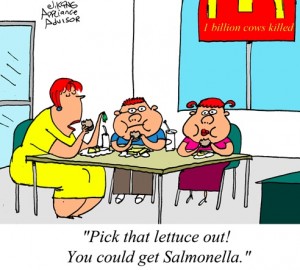
Fresh lettuce?

Security Breaches in Computer Systems of US Banks and Department Stores

Katie Benner writesL

Was Round 1 only a set-up? Photographer: Ron Antonelli/Bloomberg

When hackers broke into JPMorgan Chase’s computer systems they nabbed name and contact information for 83 million households and small-business account.

But it seems like they didn’t take more sensitive data like account numbers, passwords and Social Security numbers, the stuff that someone can use to steal your money or your identity. The bank says that the breach hasn’t given way to an uptick in fraudulent activity.

This sounds like very good news — burglars entered, looked around, took some family photos and left the cash and jewelry behind.

Unfortunately that’s not quite how cyber breaches work. Talk to enough people in the security field and you’ll hear some version of this story: Once the attackers knew they had been discovered, they went into hibernation for months or a year and then they started moving around and doing damage. It’s more like the robbers hid when the cops arrived, only to emerge months later when you thought they were all gone.

Is the US ready for a series of re-breaches of seurity next year?

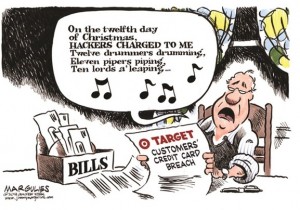
Security Breaches

Food Prices Rise in Russia after Counter-Sanctions

Sanctions are taking their toll on Russia.  When Russia announced counter-sanctions against the European Union, USA, Canada and Australia banning imports of food items from those countries, it was clear there would be imminent consequences. But just how those are playing out isn’t as some had expected.

Gennadi Kaakevitch writes: Russia imports 39% of food.  The immediate result of restrictions on imports should be a considerable increase in prices. It is incorrect to suggest, like various commentators in Russia do, that price increases should only affect luxury imported foods, such as exclusive sorts of French cheese and Spanish ham. They have argued locally produced basic items, such as meat and milk, would not be affected and, therefore, ordinary people consuming ordinary food should not feel the impact.

On the contrary, shoppers facing increases in prices for imported products inevitably switch to domestically supplied alternatives. This results in the price of domestic alternatives being pushed up.  Ordinary people in Russia think that banning imports will help local farmers and the food industry to develop domestic production and keep prices down. But to what extent is the substitution of imports with increasing local produce possible?

Is it possible for Russia to replace imports from the countries subjected to counter-sanctions with products from other countries? Meat can be sourced from Brazil and Argentina, but South American exporters have already increased their prices for Russia, blaming sanctions.

Prices for food items jumped by 30-40% in August alone.

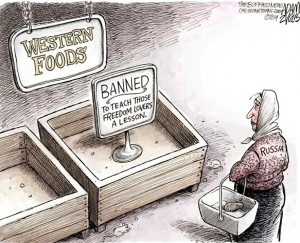
Food in Russia


Are Foreign Nurses Replacing Domestic Ones in US?

The Boston Fed reports on the displacement of local nurses by foreign imports.  Importing foreign nurses has been used as a strategy to ease nursing shortages in the United States. The effectiveness of this policy critically depends on the long-run response of native-born nurses. It was examined how the immigration of foreign-born registered nurses (RNs) affects the occupational choice and long-run employment decisions of native RNs. Using a variety of empirical strategies that exploit the geographical distribution of immigrant nurses across U.S. cities, evidence was found of large displacement effects – over a 10-year period, for every foreign nurse that migrates to a city, between one and two fewer native nurses are employed in that city.  Foreign Nurses in US

Nurses Needed?

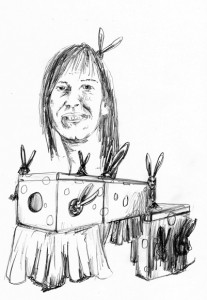
Women Chefs Don’t Get as much Press as Men

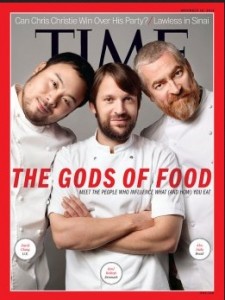
Following the release of its “Gods of Food” issue last November, TIME found itself in hot water. Not a single female chef made the list of tastemakers or placed on its lineage chart of culinary influencers. When pressed about it, TIME’s former news editor Howard Chua-Eoan explained it to Eater this way: “I think it reflects one very harsh reality of the current chefs’ world, which unfortunately has been true for years: It’s still a boys’ club.”

Riverfront News interviewed women chefs in St. Louis and here is their take:  Women Chefs Talk

Women Chefs?

Anja Hazekamp of the Netherlands

A new face in the EU: Anja Hazekamp
Nationality: Dutch
Party: Party for the Animals
European Parliament Group: GUE/NGL
Birthdate: 21 January 1968
Birthplace: Vlagtwedde, Netherlands
Committees:
• Committee on Agriculture and Rural Development (Member)
• Committee on Fisheries (Substitute)
• Committee on Petitions (Substitute)
Delegations:
• Delegation for relations with Japan (Member)
• Delegation for relations with Switzerland and Norway and to the EU-Iceland Joint Parliamentary Committee and the European Economic Area (EEA) Joint Parliamentary Committee (Substitute)

She is an anti-corporate activist.

Anti-corporate activists hold that the influence of big corporations is a detriment to the public good and to the democratic process. It should be recognized, however, that the EU legislates in many ways that restrict the actions of corporations and lawbreaking companies are usually punished in the form of monetary fines. In addition, from the perspective of business ethics, the point should be made that corporations are not, inherently more evil than any other groups and are no more likely to attempt unethical or illegal activity than other interest representatives.

52% of EU citizens think that the overall influence of companies in society is positive, while 41% think that it is negative. Influence of companies is positive for 85% of citizens in Denmark, 83% in Finland, 74% in the Netherlands, 72% in Sweden, 70% in Estonia and Luxembourg, 67% in Austria and Ireland, 65% in Portugal, 61% in Cyprus, 60% in Latvia, 59% in Malta, 58% in Poland, 56% in Belgium, 54% in Germany and the United Kingdom, 52% in Lithuania and Spain, 50% in France, Slovakia, Romania, 49% in Bulgaria, 43% in Czech Republic, 42% in Hungary, 37% in Greece, 36% in Italy and Slovenia.

The main positive effects of companies on society include: creating jobs, contribution to economic growth, providing training to employees, developing innovative products and services, paying taxes, providing financial or material support to local people, providing return to investors.

MEPs taking a stand against the ‘excessive influence of banks and multinational corporations lobbies in the EU in order to help European institutions which 1) are free from conflicts of interest; 2) do not offer privileged access to decision-making to corporations and their lobbyists; 3) have strong ethics rules for politicians, officials and lobbyists; 4) are open and transparent in the way they work; 5) always operate in the public interest.

Anja Hazekamp

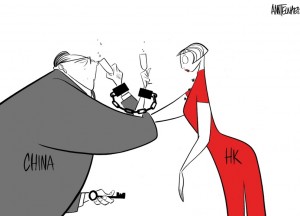
Hong Kong Asks the Question: Has China Modernized?

William McGurn writes:  Even with news the Hong Kong government will hold talks with those occupying the city’s streets, protesters will likely not succeed in their two stated goals: the resignation of Hong Kong chief executive C.Y. Leung, and rules guaranteeing honest elections for future chief executives, starting in 2017.

What the students have achieved, however, is something far more alarming for any regime lacking the security of political legitimacy: They’ve made that regime’s leaders look ridiculous.

There are many symbols of a modernizing China — gleaming skyscrapers, state-of-the-art infrastructure, a record IPO on the New York Stock Exchange — whenever Beijing finds itself challenged by ordinary Chinese, it opts for a response right out of Communist central casting like this week’s tear-gassing of the most gentle, law-abiding citizens you’ll find. In so doing, authorities elevated the humble umbrella into a democratic icon, used by protestors to shield themselves from sun and rain and, now, their own police force firing tear gas.

This Wednesday, the entire holiday celebrating Mao’s regime was up-ended by a local pro-democracy councilman, Paul Zimmerman. During the official ceremony, a smiling Zimmerman unfurled a bright yellow umbrella.  The photograph of that yellow umbrella — standing out sharply against the sea of grim black suits and red flags — went around the world, just another of the many highly public embarrassments not only for Leung but for his masters in Beijing.

Leung must be getting used to it. Today, no one in Hong Kong refers to Leung by either his name or his office. In a city of more than 7 million people, he’s referred to as “689,” a reminder of the number of votes in the Beijing-appointed committee that selected him as Hong Kong’s leader.

To put it another way: The emperor has no votes!

It must be maddening for Xi Jinping, China’s relatively new premier. Xi hails from the We’ll Show Them Who’s Boss school of governance, and in the short time he’s been in office he’s sent a message of zero tolerance for dissent.

Those targeted include Xu Zhiyong, a mainland lawyer who led a movement for transparency and fairness and was jailed this year after being convicted in a sham trial — for the high crime of “gathering a crowd to disrupt public order.”

So Xi fancies himself a tough guy. And as a man who has made his way up the Communist Party of China, he likely shares the mainland stereotype of Hong Kongers as rich, spoiled and soft.

But here’s the reality: A 17-year-old Hong Kong kid with thick black glasses and a bowl haircut is making a monkey out of Xi before the entire world.

The kid’s name is Joshua Wong, an evangelical Christian and first-year university student. Wong is very young, too young. He’s made a few mistakes, and he’ll make more. But guess what? This teenager has set the leadership in both Beijing and Hong Kong back on their heels.

How do you think that sits with Xi — or the hard men in the Politburo when they calculate whether Xi and Leung are up to their jobs?

Yes, authorities could send in the People’s Liberation Army troops to clear the streets, and no one ought to rule it out. That, however, would instantly invite comparisons with Tiananmen Square in 1989.

Is this the face of China Xi really wishes to present to the world just before President Obama and other heads of state come to Beijing for the Asia Pacific Economic Forum in November?
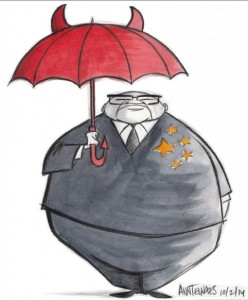

Hong Kong Umbrella

Hong Kong Peaceful Demonstrations

Chris Patten writes:   It is not wholly true to say that the eyes of the entire world are on Hong Kong. They would be, of course, if people in mainland China were allowed to know what is happening in their country’s most successful city. But China’s government has tried to block any news about the Hong Kong democracy demonstrations from reaching the rest of the country – not exactly a sign of confidence on the part of China’s rulers in their system of authoritarian government.

 It is a slur on the integrity and principles of Hong Kong’s citizens to assert, as the Chinese government’s propaganda machine does, that they are being manipulated by outside forces. What motivates Hong Kong’s tens of thousands of demonstrators is a passionate belief that they should be able to run their affairs as they were promised, choosing those who govern them in free and fair elections.

Others outside of Hong Kong have a legitimate interest in what happens in the city. Hong Kong is a great international center, whose freedoms and autonomy were guaranteed in a treaty registered at the United Nations. In particular, the United Kingdom, the other party to this Sino-British declaration sought and received guarantees that the survival of Hong Kong’s autonomy and liberties would be guaranteed for 50 years.

So it is ridiculous to suggest that British ministers and parliamentarians should keep their noses out of Hong Kong’s affairs.

The biggest problems have arisen because of a dispute about where Hong Kong’s promised path to democracy should take it, and when. No one told Hong Kongers when they were assured of universal suffrage that it would not mean being able to choose for whom they could vote.

As early as 1993, China’s chief negotiator on Hong Kong, Lu Ping, told the newspaper People’s Daily, “The [method of universal suffrage] should be reported to [China’s Parliament] for the record, whereas the central government’s agreement is not necessary. How Hong Kong develops its democracy in the future is completely within the sphere of the autonomy of Hong Kong. The central government will not interfere.” The following year, China’s foreign ministry confirmed this.

The British Parliament summarized what had been said and promised in a report ion Hong Kong in 2000. “The Chinese government has therefore formally accepted that it is for the Hong Kong government to determine the extent and nature of democracy in Hong Kong.”

The peaceful demonstrators in Hong Kong, with their umbrellas and refuse-collection bags, will not themselves be swept off the streets like garbage or bullied into submission by tear gas and pepper spray. Any attempt to do so would present a terrible and damaging picture of Hong Kong and China to the world, and would be an affront to all that China should aspire to be.

The Hong Kong authorities have gravely miscalculated the views of their citizens. Like the bad courtiers against whom Confucius warned, they went to Beijing and told the emperor what they thought he wanted to hear, not what the situation really was in the city. They must think again.

Under the existing plans, there is supposed to be a second phase of consultations on democratic development to follow what turned out to be a counterfeit start to the process. Hong Kong’s government should now offer its people a proper second round of consultation, one that is open and honest. Dialogue is the only sensible way forward. Hong Kong’s citizens are not irresponsible or unreasonable. A decent compromise that allows for elections that people can recognize as fair, not fixed, is surely available.

The demonstrators in Hong Kong, young and old, represent the city’s future. Their hopes are for a peaceful and prosperous life in which they can enjoy the freedoms and rule of law that they were promised. That is not only in the interest of their city; it is in China’s interest, too. Hong Kong’s future is the main issue; but so, too, is China’s honor and its standing in the world.

Hong Kong

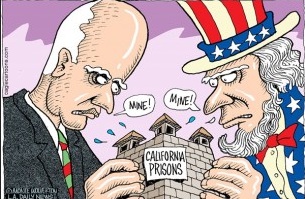
Private Banking May Make Jail Services More Expensive

In 12 years, JPay Inc. has taken over much of the market for sending money to prisoners — it’s now the only option for 450,000 inmates.   JPay shares its profits with prison systems, boosting the costs paid by families and forcing them to choose between sending money and paying their bills.

Some people arrive in jails with negative account balances thanks to fees assessed by the prison system. This forces families to pay large sums before their locked-up relative receives any money to spend.

To get funds to incarcerated relatives, families once relied on mailing money orders, a low-cost option. Since JPay took over financial services in many prisons, money orders are slower and families feel pressured to use a higher-fee option offered by JPay.  Prison Finance

Prison Finance


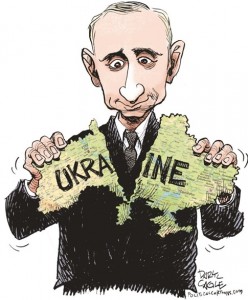
Putin Plays the Economy in Ukraine

Paul Roderick Gregory writes about Putin’s new type of war in the Ukraine and points to an economic aspect.  Take advantage of the local economic misery — unemployment, delayed wages, falling living standards — which you have helped create by cancelling Russian contracts and by other forms of economic subversion. Unemployed, unpaid and frustrated workers and their families can be lured into occupying buildings and taking part in protests, sometimes for a small payment. They become part of the human shield, not because they hate Ukraine or love Russia, but out of economic desperation.

Putin’s own timetable gives him only a short time to decide. His rubber-stamp Federation Council has “peacekeeping forces” on its Tuesday agenda. Putin’s operatives and surrogates in southeastern Ukraine have set the date of the “independence referendum” for May 11, and the Ukrainian presidential election is scheduled for May 25. An astute Ukrainian observer identifies the May 9 World War II victory anniversary as the ideal patriotic setting for returning (by force) New Russia back into Mother Russia’s embrace. Both May 9 and May 11 are approximately two weeks off.Putin’s own timetable gives him only a short time to decide. His rubber-stamp Federation Council has “peacekeeping forces” on its Tuesday agenda. Putin’s operatives and surrogates in southeastern Ukraine have set the date of the “independence referendum” for May 11, and the Ukrainian presidential election is scheduled for May 25. An astute Ukrainian observer identifies the May 9 World War II victory anniversary as the ideal patriotic setting for returning (by force) New Russia back into Mother Russia’s embrace. Both May 9 and May 11 are approximately two weeks off.

Putin and Ukraine