Draghi Proposes Buying Junk Bonds of Greece and Cyprus

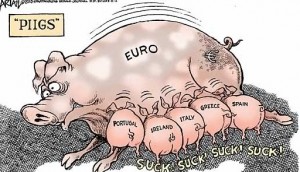
European Central Bank President Mario Draghi is set to push the ECB to buy junk-rated Greek and Cypriot bank loans, a move that may increase tensions betweenGermany and the bank.

The central bank’s executive board will propose that current requirements on the quality of assets accepted by the bank be relaxed to allow the ECB to buy repackaged debt, or safer slices of Greek and Cypriot asset-backed securities, the FT reported, citing people familiar with the matter.

If the proposal is accepted by a majority of the ECB’s governing council, the central bank will be able to buy investment instruments from all 18 euro zone member states, the newspaper reported.

As part of its stimulus, the ECB plans to buy top tranches of certain asset-backed securities. The central bank said it would also ‎buy riskier tranches if governments guaranteed them, an idea swiftly rejected by France and Germany.

Draghi unk Bonds


De Guindos of Spain, Financial Reformer

De Guindos is a favorite of Angela Merkel because he has guided Spain’s recorvery from economic crisis.  His future in Spain, however, is uncertain.

De Guindos has pushed through tough structural reforms.

Spain’s economy has returned to growth and its economy minister, Luis de Guindos, has earned plaudits from the country’s eurozone partners for pushing through tough structural reforms. Yet with national elections to take place in twelve months, de Guindos’s political future on the domestic front is far from certain.

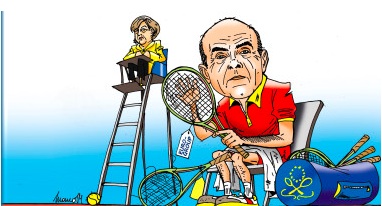
When Mariano Rajoy, Spain’s prime minister, put together his first cabinet in December 2011 he split in two the economic portfolio that had previously been occupied by the socialist Elena Salgado. De Guindos, 54, was made minister for the economy, while Cristóbal Montoro became minister of finance. Rajoy thus rewarded two men who had assiduously advised him on economic matters when in opposition.   De Guindos of SpainDe Guindos, An Avid Tennis Player

32 CEOs Fight for Gender Pay Equity in Australia

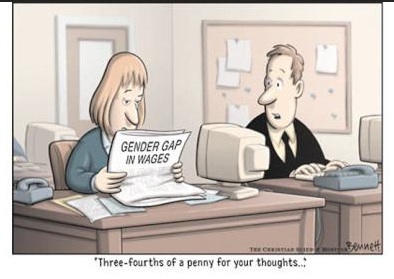
Australia’s gender pay gap is 18.2%,  the largest it’s been in twenty years. But according to new research from the Workplace Gender Equality Agency released today, 73.7% of organisations have not yet done a gender pay gap analysis, a step it believes could help to significantly address pay inequity.

So WGEA is separating those who appear to be accepting the gender pay gap if a problem within their organisations from those who are not via a new campaign to raise awareness on the issue.

It’s named 32 chief executives who’ve signed up as ambassadors to use their voice in urging all businesses to make pay equity a priority. By 30 September 2015, it hopes to have 100 chiefs involved.

One such CEO is AGL CEO Michael Fraser, who explained in a statement to Women’s Agenda why he decided to get involved:

“I decided to become a pay equity ambassador because it’s untenable to think that in the twenty-first century, we would not be paying equal pay for equal work. But I have come to realise, that unless we continually analyse our HR data and systems and validate the basis of our decisions as they relate to employees, we will continue to see gender inequity in business. AGL Energy Limited (AGL) conducts an annual pay equity analysis and did so most recently in June 2014.  Gender pay equity analytics and reporting are embedded in AGL’s remuneration systems to ensure gender equity is at the forefront of leaders’ remuneration decisions.”

Fraser added that his executive team follow up to ensure pay decisions consider the gender inequality areas that have been identified through the analysis, and the organisation monitors gender pay equity through a number of different internal forums. AGL is also developing its pipeline of female talent by offering flexible roles and career paths, while also promoting women leaders.

WGEA is sending bottles of ‘daughter water’ to more than 3,000 across the country.

A number of the above CEOs released statements to WGEA on why they’re getting involved in the campaign. See their responses below

Pip Marlow, Managing Director of Microsoft: “A country’s national competitiveness is largely defined by its workforce so it makes no sense, especially for a country with Australia’s small population, to limit or constrain the contribution of over 50% of its people.  Just as in business, we need to attract the best talent and retain the best talent so there is no room for gender bias in remuneration and performance management decisions. I call on all business leaders to commit to eliminating gender bias – it’s just good business.”

Jim Minto, CEO of TAL: “We have raised the bar for other employers that pay equity is achievable if priority is given to it. TAL has also sent a clear message to the community that we are a values-driven organisation. Being asked to become a Pay Equity Ambassador is an honour and I hope the example we have set at TAL will motivate other employers to address pay equity and produce fairer outcomes for staff.”

Steven Sewell, CEO of Federation Centres: “Recognising performance and rewarding it in an equitable manner is fundamental to creating a high-performing organisation. Eliminating gender bias is a crucial component in getting the best from all your people.”

Wayne Spanner, Managing Partner of Norton Rose Fulbright: “The CEO has to own this issue otherwise you don’t achieve change. Addressing pay equity underpins our diversity success, and understanding and addressing unconscious bias is a critical component. You need to audit the relevant data to know where the issues are and take action.”

Peter Bailey, CEO of Arup: “If we weren’t doing it we would be at odds with what we stand for. Fairness is fundamental to our business. We’d be living a lie if we didn’t act.”
Gender Pay Equity

Liquidity Risks Across the Globe

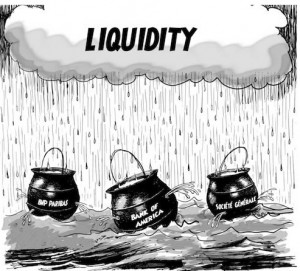
The common methodology better explains cross-sectional differences in lending by internationally active banks than lending by purely domestic banks.

The channels of transmission of liquidity shocks to bank lending differ across banks. Deposit funding matters more for the domestically oriented banks. In contrast, internal liquidity management strategies and official liquidity support matter more for the banks with foreign affiliates.

The common empirical model explains more of the cross-sectional and time-series variation in domestic lending than in net-due-to (such as intrabank lending) or foreign lending. This finding suggests higher stability of domestic lending. At the same time, we see cross-border lending growth is more sensitive to liquidity risk in relation to the balance sheet characteristics of the banks. An interpretation is that cross-border lending tends to be subordinated to domestic lending activity as stress conditions change.  Liquidity Risk

 Cross Country Liquidity Risk

Events in Germany Post Bail-outs

This anti-ECB sentiment in Germany has swelled during 2014, as Draghi’s attempts to increase the eurozone’s low inflation have departed further and further from economic orthodoxy. German conservatives have greeted each new policy with displeasure. The German media has called negative interest rates “penalty rates,” claiming they redistribute billions of euros from German savers to Southern European spenders. On Sept. 25, German Finance Minister Wolfgang Schauble spoke in the Bundestag of his displeasure with Draghi’s program to buy asset-backed securities. Judging from the German hostility to even “quantitative easing-lite” measures, the ECB’s attempts to rope Germany into further stimulus measures could prove troublesome indeed.

All of the measures the ECB has announced so far, however, are mere appetizers. Financial markets have been demanding quantitative easing, a broad-based program of buying sovereign bonds in order to inject a large quantity of money into the market. Up to this stage, three major impediments have existed to such a policy: the German government’s ideological aversion to spending taxpayers’ money on peripheral economies; the political conception that quantitative easing would ease the pressure on peripheral economies to reform; and the court case that has been hanging over OMT (the only existing mechanism available to the ECB for undertaking sovereign bond purchases). Notably, the OMT in its original guise and quantitative easing are not precisely the same thing. In the original conception of OMT, the ECB would offset any purchases in full by taking an equivalent amount of money out of circulation, (i.e., not increasing the money supply itself). Nonetheless, any declaration that OMT is illegal would severely inhibit Draghi’s room for maneuver should he wish to undertake full quantitative easing.

This confluence of events leaves Merkel nervously awaiting the decision of the European Court of Justice. In truth, she is in a no-win situation. If the Luxembourg court holds OMT illegal, Draghi’s promise would be weakened, removing the force that has kept many sovereign bond yields at artificially low levels and permitting the desperate days of 2011-2012 to surge back. If the European Court of Justice takes up the German court’s three suggestions and undercuts OMT to the extent that the market deems it to be of little consequence, the same outcome could occur. And if the European Court of Justice rules that OMT is legal, a sizable inhibitor to quantitative easing will have been removed, and the possibility of a fully fledged bond-buying campaign will loom ever closer, much to the chagrin of the German voter and to the political gain of the Alternative for Germany.   Germany’s Fight

Germany's Bailout

Apple (and Google) in Ireland. A US Problem?

Leonid Bershidsky writes:  US has to deal with Ireland on taxes.  The Senate Subcommittee on Investigations has tried.

in 1991 and 2007, Apple and Ireland agreed that much of the money flowing into the company’s Irish accounts had nothing to do with its operations in the country, and hence shouldn’t be taxed as profit in Ireland. Instead, the two sides negotiated a deal in which Apple paid tax on a certain percentage of its Ireland-related costs. The deal stood for 15 years, much longer than most European countries would allow such tax rulings to remain in force. Even after some amendments, Apple Sales International paid taxes on less than $80 million in 2011, a year in which the Ireland-incorporated entity recorded $22 billion in pretax income, according to the U.S. Senate’s Permanent Subcommittee on Investigations.

In most countries, such revelations would have led to a corruption scandal. Why would a government pass up a chance to levy taxes on billions of dollars in income? In Ireland’s case, the situation is more complicated: It defines a company’s domicile as the location of its central management and control operations, which in the case of Apple’s subsidiaries would be the U.S. By contrast, the U.S. defines domicile as the place of incorporation. So Apple’s Irish subsidiaries don’t really have a home for tax purposes.

Should Ireland care? The Cupertino, California-based company has 4,000 employees at its Cork facility, where it still assembles some computers but mostly handles sales and user support. That’s less than 5 percent of Apple’s total workforce, but a big deal for the depressed city. The taxes calculated on the basis of the small operation’s costs are not a major consideration for the Irish authorities — they are just nice to have.

The EC’s letter says that the deal appears to constitute illegal state aid: Because the tax base is negotiated, rather than calculated according to some predetermined formula, it provides unfair, selective advantages to Apple. Theoretically, the EC could recover billions of dollars in taxes that Ireland has failed to charge since 2003. To do that, the eurocrats would have to prove that Apple had been singled out for tax advantages. The Irish government isconfident it hasn’t violated state-aid rules. If the government in Dublin can show it treats other companies similarly — as Google and other beneficiaries might confirm — it will be difficult for the bureaucrats in Brussels to act.

Ireland is happy to have Apple and the other tech giants invest in its economy. There is no reason why it should pressure a U.S. company to pay more taxes. If the U.S. wants to make its companies pay their fair share, it has the power to do so — either by coercing them or by enticing them with improved corporate tax legislation.

Modi’s State-Led Capitalism

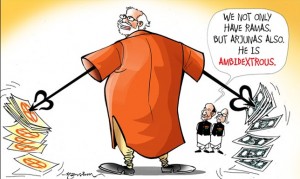
Nisid Hajari writes:  As a campaigner, Indian Prime Minister Narendra Modi has drawn comparisons to U.S. President Barack Obama. The U.S. president with whom Modi would seem to have the most in common, though, is not the 44th but the 40th: Ronald Reagan. Like the Gipper, Modi was elected at a time of malaise and drift, with an economy hobbled by high inflation and slowing growth. He came to office promising to lead a national revival, in part by eliminating excessive state intervention in the economy.

In fact, Modi is no more Reagan than he is Obama. The U.S. doesn’t even seem to be Modi’s role model for economic policy. His decisions thus far lean more toward the Chinese and Japanese models of state-led capitalism.

Modi  has made it clear that he prefers to give them more managerial autonomy and allow them to reform themselves rather than sell them off outright. His administration’s first budget made no concessions on tax rates.  While some attempt was made to trim spending, the budget included no high-profile initiatives to end wasteful subsidies or dole programs.

On monetary policy, Finance Minister Arun Jaitley has repeatedly favored lowering interest rates, despite persistent inflation.  His priority is clearly infrastructure — whether roads, power, ports or railways. All these sectors require massive investments and involve considerable risk in terms of returns. These are not areas where private companies traditionally rush to invest.

On the other hand, companies backed by state-funding or cheap finance from state-owned banks and financial institutions can more safely assume these huge risks. This is precisely why Modi returned from a bilateral visit to Japan with commitments worth $35 billion for infrastructure. When Chinese President Xi Jinping visited India a few weeks later, he pledged another $20 billion. Modi will bring home no such promises from the U.S.

The prime minister is more statist in his approach than leaders in Beijing. Where China has largely liberalized foreign direct investment across all sectors, Modi has been reluctant to raise FDI caps above 49 percent in sectors such as defense and insurance.

While this approach worked well for Japan and China, it’s far from guaranteed to achieve similar results in India. The Indian state, which is dysfunctional at several levels, is never likely to be even half as efficient as China’s or Japan’s. India’s largely government-owned defense companies have not produced world-class products in six decades. Government-owed insurance companies have not delivered either.

On the other hand, India’s private-sector companies have already shown that they can be as efficient as U.S. corporations. What they need are technology, investment and expertise.

Modi's Economics

Why the Markets Don’t Respond to Geopolitical Crises

Nouriel Roudini writes: Global markets have not reacted for several reasons. For starters, central banks in advanced economies (the United States, the eurozone, the United Kingdom, and Japan) are holding policy rates near zero, and long-term interest rates have been kept low. This is boosting the prices of other risky assets such as equities and credit.

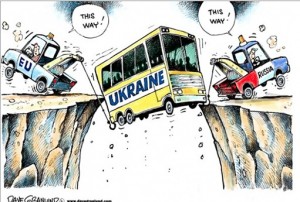
Second, markets have taken the view that the Russia-Ukraine conflict will remain contained, rather than escalating into a full-scale war. So, though sanctions and counter-sanctions between the West and Russia have increased, they are not causing significant economic and financial damage to the European Union or the US. More important, Russia has not cut off natural-gas supplies to Western Europe, which would be a major shock for gas-dependent EU economies.

Third, the turmoil in the Middle East has not triggered a massive shock to oil supplies and prices like those that occurred in 1973, 1979, or 1990. On the contrary, there is excess capacity in global oil markets. Iraq may be in trouble, but about 90% of its oil is produced in the south, near Basra, which is fully under Shia control, or in the north, under the control of the Kurds. Only about 10% is produced near Mosul, now under the control of the Islamic State.

Finally, the one Middle East conflict that could cause oil prices to spike – a war between Israel and Iran – is a risk that, for now, is contained by ongoing international negotiations with Iran to contain its nuclear program.

So there appear to be good reasons why global markets so far have reacted benignly to today’s geopolitical risks.   Why the Markets Have not Responded to Geopolitical RIsks

Geopolitical Risk