Islamic Finance to Benefit Women and Everyone Else

Christine Lagarde speaks about possibilities for Islamic finance.

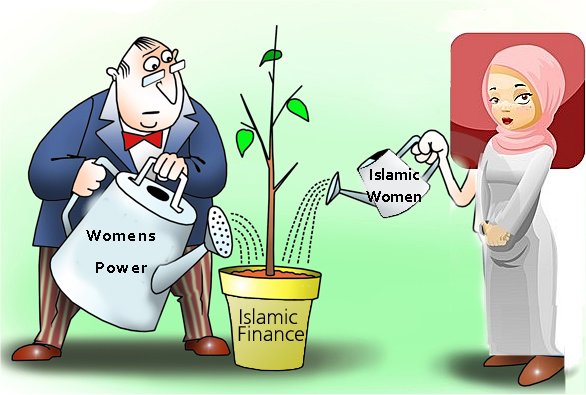
Lagarde, the head of the International Monetary Fund, says Islamic finance offers the possibility of extending banking services to many who are underserved in the Muslim world.

Lagarde told an audience in Kuwait City that only a quarter of Muslim adults have access to a bank account.

Lagarde said on Wednesday that “Islamic finance has the potential to contribute to higher and more inclusive economic growth by increasing access of banking services to underserved populations.”

Lagarde took no questions at the end of her speech.

She has recently said that Kuwait should consider imposing taxes on commercial profits and address the massive subsidies the oil-rich tiny country offers its citizens in the wake of low global oil prices.   Lagarde Speech 11/11/2015

Possibilities for Islamic Finance

Anti Austerity in Portugal

Anti-austerity backlash

Anti-austerity lawmakers forced Portugal’s center-right government to resign Tuesday by rejecting its policy proposals at the start of what was supposed to be a second consecutive term in office — and four more years of cutbacks and economic reforms.

The government’s dramatic collapse came less than two weeks after it was sworn in and raised questions about debt-heavy Portugal’s commitment to the fiscal discipline demanded of countries sharing the euro currency.

The moderate Socialist Party forged an unprecedented alliance with the Communist Party and the radical Left Bloc to get a 122-seat majority in the 230-seat Parliament, which it used to vote down the proposals. The defeat brought the government’s automatic resignation.

The government’s fall was also a political setback for the 19-nation eurozone’s austerity strategy. The policy of cutbacks was demanded by Germany and the others as a remedy for the bloc’s recent financial crisis.

Eurozone leaders had pointed to Portugal, and Ireland, as examples of how austerity paid off as their economies improved. Now, the progress Portugal made is in doubt, and some fear the country could go down the same road as Greece, which has needed three bailouts since 2010.

The triumph of the leftist alliance will likely give heart to anti-austerity forces in much bigger neighbor Spain, where a general election is scheduled for Dec. 20.

After four years in power the government lost its parliamentary majority in an Oct. 4 general election, which saw a public backlash against austerity measures adopted following an $84 billion bailout in 2011.

Socialist leader Antonio Costa is expected to become prime minister in coming weeks, supported by the Communists and Left Bloc.

Costa criticized the government for being “submissive” in its dealings with the rest of Europe and making more cutbacks than those demanded by the bailout creditors. “The Portuguese want change,” he said.

Outside Parliament, demonstrators at an anti-austerity protest by labor groups shouted “Victory!” as the news of the vote spread.

The leftist alliance intends to reverse cuts in pay, pensions and public services, as well as tax increases that have brought widespread hardship, street protests and strikes in recent years. Some 400,000 Portuguese left to seek work abroad.

Mario Centeno, the Socialist Party’s leading economic expert, sought to soothe eurozone and market fears about the next government’s plans, saying it would “abide by its European responsibilities and honor all its commitments.”

Centeno, who has a PhD in Economics from Harvard University and is a special adviser at the Bank of Portugal, is widely expected to be the country’s next finance minister.

The current political upheaval has its roots in years of low growth and borrow-and-spend policies that weakened Portugal and compelled it to ask for the 2011 bailout amid the eurozone’s debt crisis.

Portugal’s budget deficit in 2010 was more than 10 percent but the European Union estimates it will be around 3 percent by the end of this year. Unemployment, which surged to a record 17 percent after the bailout, has fallen to 12 percent.

“Portugal today is incomparably better than it was four years ago,” outgoing Finance Minister Maria Luis Albuquerque told Parliament during the debate.

Among the measures planned by the leftist alliance are giving back government workers cut pay; unblocking pension increases; spending more on the national health service; providing free nursery schools for all 3-year-olds and free school books for all; reducing sales tax at restaurants from 23 percent to 13 percent; and restoring four public holidays that were scrapped to improve productivity.

The three parties in the alliance have in the past had hostile relations, however, and will be watched closely for any signs of friction.

The speaker of Parliament was due to inform President Anibal Cavaco Silva of the vote later Tuesday. The head of state, who has no executive power but oversees the government, will then consult the political parties in coming days before deciding whether to invite Costa to form a government. Cavaco Silva could choose to appoint a caretaker government, but analysts believe that is unlikely.

Anti Austerity Portugal

WalMart Profits Up After Raising Wages

Wal Mart has surprising result after raising wages.

Retailers quickly responded to Wal-Mart’s announcement of a higher minimum wage this spring. They were concerned that higher wages would mean lower profits.

Those retailers don’t appear to be hurting.

Here’s a report from the 1920s in the US.

The money was all appropriated for the top in the hopes that it would trickle down to the needy. Mr. Hoover didn’t know that money trickled up. Give it to the people at the bottom and the people at the top will have it before night, anyhow. But it will at least have passed through the poor fellows hands – Will Rogers

Trickle Up!

Devil’s Financial Dictionary: More True than Devilish?

A Credit Suisse banker flew all over the place to meet with clients. He reported:

“Never have we seen so many clients who just do not know what is happening and have cashed up.”

People cash out now because they want to wait until things are “clearer.”  What’s odd is that the market is just a few percent off its all-time high. It would be a strange bull market where so many people cashed out at the top. Normally, people rush to cash out at the bottom.

Jason Zweig’s The Devil’s Financial Dictionary makes fun reading and may be more useful than we know: it recommends speaking plainly and listening to those who speak plainly.

Here’s what it says about uncertainty:

“Certainty, n. A state of clarity and predictability in economic and geopolitical affairs that all investors say is indispensable – even though it doesn’t exist, never has and never will… Whenever turmoil or turbulence becomes obvious, pundits proclaim again for the umpteenth time that ‘Investors hate uncertainty’… “Uncertainty is the most fundamental attribute of financial markets… hating the unknowable is a waste of time and energy. You might as well hate gravity or protest against the passage of time.”

“Cynic, n. A blackguard whose faulty vision sees things as they are, not as they ought to be.”

A broker:  “a negotiator between two parties who contrives to cheat both.”

“Day trader, n. See IDIOT.”

An anecdote about an English proverb“to sell the bear’s skin before one has caught the bear,” which is an apt description of selling a stock short. (You sell the stock first and hope to buy it back later at a lower price.

“PAREIDOLIA, n. The compulsive human tendency to see patterns or meaningful trends in random events and images.”

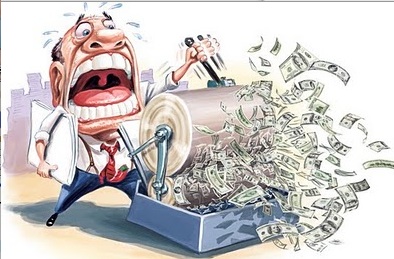
Fancy words may be a coverup. They hide thefts, lies, cons and ulterior motives. Speak plainly and seek those who speak plainly to you.  Quantitative easing, we now know, is printing money.Skinning a Bear?

Decline in Chinese Manufacturing?

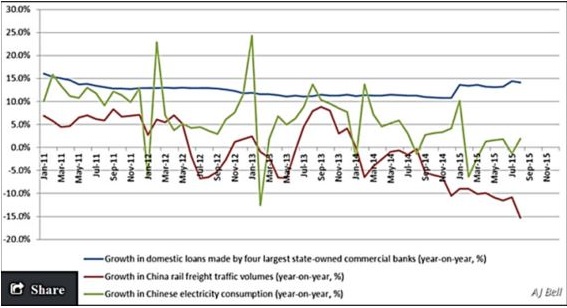
Ken Dohmen warns about the dire consequences of a broken real estate bubble followed by an overbuilding of the manufacturing sector.  The decline in manufacturing is illustrated by the decline in electricity consumption and rail freight traffic.

China Growth?


Alibaba Singles Day Smashing Success

Alibaba’s singles day a smashing success, up 5 billion from last year.

Alibaba Group Holding Ltd. logged a record 91.2 billion yuan ($14.3 billion) in sales on Singles’ Day, turning a sweethearts’ holiday dreamed up two decades ago into a major online shopping event.  Transactions had passed last year’s record of $9.3 billion before midday in China, according to the company. The top-selling items by retailers using Alibaba’s platform included baby-related and nutritional products, Nike sneakers and Levi’s jeans, the company said.  Noteworthy: 69% of transaction came fromm mobile phones.

Big Sales on Mobile Phones

Should Investors Look At Changes in Monetary Conditions?

Interest rates and currency manipulation impact economies around the world.

Barry Eichengreen writes: For much of the year, investors have been fixated on when the Fed will achieve “liftoff” – that is, when it will raise interest rates by 25 basis points, or 0.25%, as a first step toward normalizing monetary conditions. Markets have soared and plummeted in response to small changes in Fed statements perceived as affecting the likelihood that liftoff is imminent.

But, in seeking to gauge changes in US monetary conditions, investors have been looking in the wrong place. Since mid-August, when Chinese policymakers startled the markets by devaluing the renminbi by 2%, China’s official intervention in foreign-exchange markets has continued, in order to prevent the currency from falling further. The Chinese authorities have been selling foreign securities, mainly United States Treasury bonds, and buying up renminbi.

Emerging-market countries receiving capital inflows did the same. These countries’ foreign reserves, mainly held in US securities, topped $8 trillion at their peak last year.

The effects of these purchases attracted considerable attention. In 2005, US Federal Reserve Chair Alan Greenspan pointed to the phenomenon as an explanation for his famous “conundrum”: interest rates on Treasury bonds were lower than market conditions appeared to warrant.

Now this process has gone into reverse. Although no one outside official Chinese circles knows the exact magnitude of China’s foreign-exchange intervention, informed guesses suggest that it has been running at roughly $100 billion a month since mid-August. Observers believe that roughly 60% of China’s liquid reserves are in US Treasury bills.

Recall that the Fed began its third round of quantitative easing (QE3) by purchasing $40 billion of securities a month, before boosting the volume to $85 billion. Monthly sales of $60 billion by China’s government would lie squarely in the middle. Estimates of the effects of QE3 differ. But the weight of the evidence is that QE3 had a modest but significant downward impact on Treasury yields and a positive effect on demand for riskier assets.

Foreign sales at a rate of $60 billion per month raise yields by ten basis points. Given that China has been at it for 2.5 months, this implies that the equivalent of a 25-basis-point increase in interest rates has already been injected into the market.

Some would object that the renminbi is weak because China is experiencing capital outflows by private investors, and that some of this private money also flows into US financial markets. This is technically correct, but it is already factored into the changes in interest rates described above. Recall that capital also flowed out of the US when the Fed was engaged in QE, without vitiating the effects.

Another objection is that QE operates not just through the so-called portfolio channel – by changing the mix of securities in the market – but also through the expectations channel. It signals that the authorities are seriously committed to making the future different from the past. But if Chinese intervention is just a one-off event, and there are no expectations of it continuing. The impact should be smaller than QE.

The problem is that no one knows how long capital outflows from China will persist or how long the Chinese authorities will continue to intervene. From this standpoint, the Fed’s decision to wait to begin liftoff is eminently sensible. And, given that China holds (and is therefore now selling) euros as well, the European Central Bank also should bear this in mind when it decides in December whether to ramp up its own program of quantitative easing.

Printing Money

Handling Global Debt?

Richard Kozul Wright writes:  Over the last few months, a great deal of attention has been devoted to financial-market volatility. But as frightening as the ups and downs of stock prices can be, they are mere froth on the waves compared to the real threat to the global economy: the enormous tsunami of debt bearing down on households, businesses, banks, and governments. If the US Federal Reserve follows through on raising interest rates at the end of this year, as has been suggested, the global economy – and especially emerging markets – could be in serious trouble.

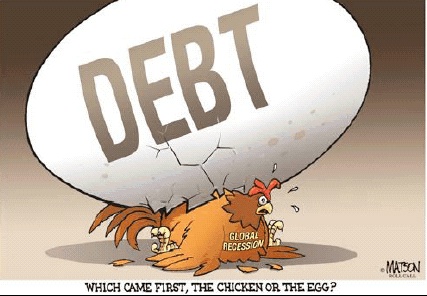
Global debt has grown some $57 trillion since the collapse of Lehman Brothers in 2008, reaching a back-breaking $199 trillion in 2014, more than 2.5 times global GDP.  Servicing these debts will most likely become increasingly difficult over the coming years, especially if growth continues to stagnate, interest rates begin to rise, export opportunities remain subdued, and the collapse in commodity prices persists.

Much of the concern about debt has been focused on the potential for defaults in the eurozone. But heavily indebted companies in emerging markets may be an even greater danger. Corporate debt in the developing world is estimated to have reached more than $18 trillion dollars, with as much as $2 trillion of it in foreign currencies. The risk is that – as in Latin America in the 1980s and Asia in the 1990s – private-sector defaults will infect public-sector balance sheets.

That possibility is, if anything, greater today than it has been in the past. Increasingly open financial markets allow foreign banks and asset managers to dump debts rapidly, often for reasons that have little to do with economic fundamentals. When accompanied by currency depreciation, the results can be brutal – as Ukraine is learning the hard way.

It is important to note that indebted governments are both more and less vulnerable than private debtors. Sovereign borrowers cannot seek the protection of bankruptcy laws to delay and restructure payments; at the same time, their creditors cannot seize non-commercial public assets in compensation for unpaid debts. When a government is unable to pay, the only solution is direct negotiations. But the existing system of debt restructuring is inefficient, fragmented, and unfair.

Sovereign borrowers’ inability to service their debt tends to be addressed too late and ineffectively. Governments are reluctant to acknowledge solvency problems for fear of triggering capital outflows, financial panics, and economic crises. Meanwhile, private creditors, anxious to avoid a haircut, will often postpone resolution in the hope that the situation will turn around. When the problem is finally acknowledged, it is usually already an emergency, and rescue efforts all too often focus on propping up irresponsible lenders rather than on facilitating economic recovery.

To make matters worse, when a compromise is reached, the burden falls disproportionately on the debtor, in the form of enforced austerity and structural reforms that make the residual debt even less sustainable.

As consensus grows regarding the need for better ways to restructure debt, three options have emerged. The first would strengthen bond markets’ legal underpinnings, by introducing strong collective-action clauses in contracts and clarifying the pari passu (equal treatment) provision, as well as promoting the use of GDP-indexed or contingent-convertible bonds.

A second approach would focus on building a consensus around soft-law principles to guide restructuring efforts. The core principles include sovereignty, legitimacy, impartiality, transparency, good faith, and sustainability principles – currently would apply to all debt instruments.

The third option would attempt to resolve this coordination problem through a set of rules and norms agreed in advance as part of an international debt-workout mechanism that would be similar to bankruptcy laws at the national level.

The mechanism would include provisions allowing for a temporary standstill on all payments due, whether private or public; an automatic stay on creditor litigation; temporary exchange-rate and capital controls; the provision of debtor-in-possession and interim financing for vital current-account transactions; and, eventually, debt restructuring and relief.

Evidence from Ghana, Greece, Puerto Rico, Ukraine, and many other countries shows the economic and social damage that unsustainable debts can cause when they are improperly managed.

Global Debt

Sovereign Debt. A UN Solution?

The the rocky road to globalization how individual coutries handle sovereign debt is still problematic.  The UN has come up with the a solution, but the US, Canada, Germany, Israel, Japan, and the United Kingdom are not in agreement.

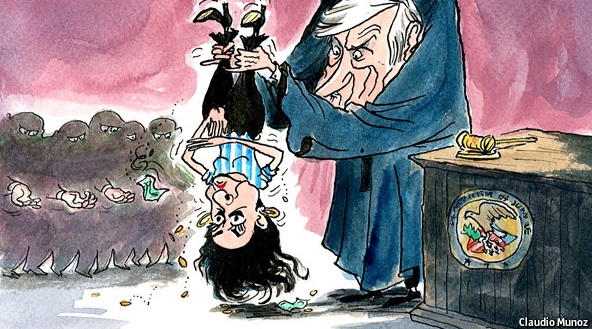
Joseph E. Stiglitz and Martin Guzman write:  Every advanced country has a bankruptcy law, but there is no equivalent framework for sovereign borrowers. That legal vacuum matters, because, as we now see in Greece and Puerto Rico, it can suck the life out of economies.

In September, the United Nations took a big step toward filling the void, approving a set of principles for sovereign-debt restructuring. The nine precepts – namely, a sovereign’s right to initiate a debt restructuring, sovereign immunity, equitable treatment of creditors, (super) majority restructuring, transparency, impartiality, legitimacy, sustainability, and good faith in negotiations – form the rudiments of an effective international rule of law.

The overwhelming support for these principles, with 136 UN members voting in favor and only six against (led by the United States), shows the extent of global consensus on the need to resolve debt crises in a timely manner. But the next step – an international treaty establishing a global bankruptcy regime to which all countries are bound – may prove more difficult.

Recent events underscore the enormous risks posed by the lack of a framework for sovereign debt restructuring. Puerto Rico’s debt crisis cannot be resolved. Notably, US courts invalidated the domestic bankruptcy law, ruling that because the island is, in effect, a US colony, its government had no authority to enact its own legislation.

In the case of Argentina, another US court allowed a small minority of so-called vulture funds to jeopardize a restructuring process to which 92.4% of the country’s creditors had agreed. Similarly, in Greece, the absence of an international legal framework was an important reason why its creditors – the troika of the European Commission, the European Central Bank, and the International Monetary Fund – could impose policies that inflicted enormous harm.

But some powerful actors would stop well short of establishing an international legal framework. The International Capital Market Association (ICMA), supported by the IMF and the US Treasury, suggests changing the language of debt contracts. The cornerstone of such proposals is the implementation of better collective action clauses (CACs), which would make restructuring proposals approved by a supermajority of creditors binding on all others.

But while better CACs certainly would complicate life for vulture funds, they are not a comprehensive solution. In fact, the focus on fine-tuning debt contracts leaves many critical issues unresolved, and in some ways bakes in the current system’s deficiencies – or even makes matters worse.

For example, one serious question that remains unaddressed by the ICMA proposal is how to settle conflicts that arise when bonds are issued in different jurisdictions with different legal frameworks. Contract law might work well when there is only one class of bondholders; but when it comes to bonds issued in different jurisdictions and currencies, the ICMA proposal fails to solve the difficult “aggregation” problem (how does one weight the votes of different claimants?).

All six countries that voted against the UN resolution (the US, Canada, Germany, Israel, Japan, and the United Kingdom) all refuse to accept that the rationale for a domestic rule of law.

Respect for the nine principles approved by the UN is precisely what’s been missing in recent decades. The 2012 Greek debt restructuring, for example, did not restore sustainability, as the desperate need for a new restructuring only three years later demonstrated. And it has become almost the norm to violate the principles of sovereign immunity and equitable treatment of creditors, evidenced so clearly in the New York court’s decision on Argentine debt.

The irony is that countries like the US object to an international legal framework because it interferes with their national sovereignty. Yet the most important principle to which the international community has given its assent is respect for sovereign immunity: There are limits beyond which markets – and governments – cannot go.

Incumbent governments may be tempted to exchange sovereign immunity for better financing conditions in the short run, at the expense of larger costs that will be paid by their successors. No government should have the right to give up sovereign immunity, just as no person can sell himself into slavery.

Debt restructuring is not a zero-sum game. The frameworks that govern it determine not just how the pie is divided among formal creditors and between formal and informal claimants, but also the size of the pie.

A system that actually resolves sovereign-debt crises must be based on principles that maximize the size of the pie and ensure that it is distributed fairly. We now have the international community’s commitment to the principles; we just have to build the system.

Sovereign Debt Problems?

Uprooting Corruption in Romania?

Romanians are protesting systemic state corruption.

Thousands of demonstrators returned to the streets of Romania for a fourth night running on Friday to pursue their campaign for a cleansing of the political class in the wake of a deadly nightclub fire.

Having already brought down a government this week, the protesters are saying ‘no’ to more of the same and demanding a root and branch shake-up of a political system and public administration they claim is rife with corruption.

University Square in the capital, Bucharest, was again the centre of their rally.

“We are here to show them we don’t want things to continue the same way – for some politicians to leave and then the same to come back,” said one demonstrator.

“We don’t want the same lies. We will not be tricked by one or two resignations.”

“The problem is that the square, the street, cannot be represented through a few people,” another said.

“President Iohannis and the political figures should come here…and speak to the people.”

Romania’s President Klaus Iohannis has said he will meet protesters on the ground.

In the meantime he has appointed an interim prime minister to replace Victor Ponta, who is facing trial for corruption and quit as premier amid the demonstrations triggered by last Friday’s nightclub fire in Bucharest which killed 32 people and injured nearly 200 more.

Political Protests in Romania