Draghi Lets the Politicians Take Over

Sometimes politicians have to take unpopular yet necessary decisions that run counter to the promises they made to their electorates. As a result, their popularity drops, but problems do get solved – or so one hopes.

Sometimes, politicians stick to their promises even though they know that doing so could make matters worse. Re-election is then deemed more important.

And sometimes the opportunity presents itself to dump the choice on someone else’s lap.

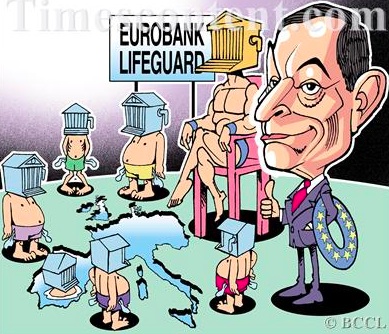
Enter Mario Draghi and his European Central Bank.

Politicians in many European capitals heaved a sigh of relief when Draghi announced that he would do “whatever it takes” to safeguard the euro. That took some heat out of the discussion about whether to continue austerity policies or start spending.

Now, however, it seems Draghi has decided he has stepped in enough to save the eurozone’s political leaders. On Thursday, while Greek Finance minister Yanis Varoufakis was in the midst of a European goodwill tour to raise support for his plans to save Greece, Draghi pulled the plug on the ECB’s credit facility to the country.

For several years, Greek banks have been able to sell certain bonds to the ECB, no matter what the bonds’ credit rating, and receive money in return. Athens was cut out of that program on Thursday, immediately putting Greece into an even more difficult position.

Now the pressure is on the elected politicians, especially those of northern Europe. These leaders must decide whether they will cut Greek debt – a highly unpopular move, as they promised their voters that Greece would pay back every last cent lent to them – or effectively push Greece into default.

Draghi

China Starting Currency Wars?

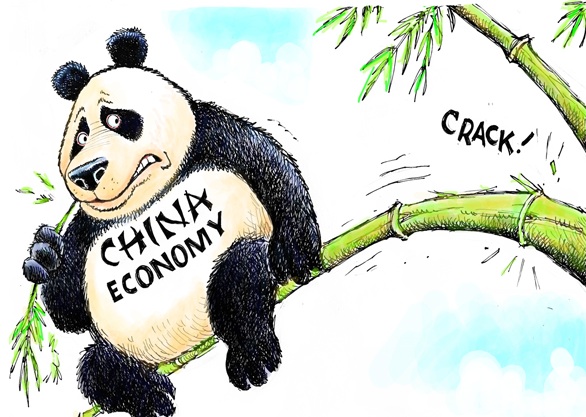
William Pesek writes:  China has entered the global monetary-easing fray, along with more than a dozen other economies, after its central bank surprised investors by cutting reserve requirements 50 basis points to spur lending and combat deflation. But Beijing may be raring for an even bigger and more perilous fight in the currency market.

Reducing the amount of cash that banks are required to set aside (to 19.5 percent), as China has just done, is largely symbolic.  Still, the move is also an inflection point. China is in all likelihood about to loosen monetary policy considerably to support economic growth. If global conditions worsen, China’s one-year lending rate, now at 5.6 percent, could head toward zero.

The central bank is devising measures to widen the band in which its currency trades. People’s Bank of China officials say it’s about limiting volatility as capital zooms in and out of the economy.

As China grapples with its slowest growth in 24 years, President Xi Jinping is under pressure to stimulate the economy. Yet that would run afoul of his pledges to curb runaway debt and credit (the latter jumped about $20 trillion from 2009 to 2014). What better way to gin up growth without adding to China’s bubbles than by sharply weakening the exchange rate?

Any significant drop in the yuan would prompt Japan to unleash another quantitative-easing blitz. The same goes for South Korea, whose exports are already hurting. Singapore might feel compelled to expand upon last week’s move to weaken its dollar. Before long, officials in Bangkok, Hanoi, Jakarta, Manila, Taipei and even Latin America might act to protect their economies’ competitiveness.

China may be feeling increased urgency as it looks around the Asia-Pacific region.

For China, Japan represents the biggest provocateur. The 30 percent drop in the yen under Prime Ministwe ShinzoAbe is slamming Chinese industry. Key beneficiaries of the policy such as Toyota and Sony (both projected huge profits this week) are lowering prices to gain market share abroad, effectively exporting deflation. Abe also gives Beijing political cover to devalue.

There’s obvious danger in so many economies engaging in this race to the bottom. It will create unprecedented levels of volatility in markets and set in motion flows of hot money that overwhelm developing economies, inflating asset bubbles and pushing down bond rates irrationally low.

Asia’s currency rivalries may be self-defeating. As Raghuram Rajan, governor of the Reserve Bank of India, said,  “If you’re not increasing domestic activity but depreciating your exchange rate, you’re essentially drawing demand from the rest of the world.”

A competition to ease monetary policy is one thing. A currency war with the world’s biggest trading nation could turn into a crisis.

Is Currency Manipulation the Answer in China?

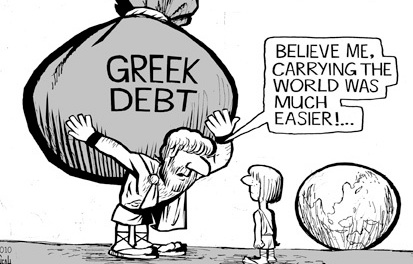
Any Easy Way to Solve Greek Debt?

Former German finance minister Peer Steinbruck (Social Democrat) comments on Greece:

Steinbrück, when asked the first time if a (partial) debt cancellation for Greek would not be on the agenda, answered: “No, they already hat two cuts“. He also complains that a cut in Greek debt would hit European tax payers.

The case for not accepting a Greek hair cut rests on two pillars:

  1. The ruling coalition government of Germany would lose votes;
  2. European tax payers lose money

The second reason is something which can be circumvented if the ECB buys sovereign bonds and then accepts the losses on those bonds by letting equity fall into negative territory. Whereas private banks with negative equity are closed down, this is not the case for central banks. They can always create new deposits for participating banks because they are running the accounting system. Marking up the deposits that a bank has at a central bank is not dependent on the equity position of the ECB.

The Federal Reserve Bank, for instance, has bought up lots of treasury bonds. The effect is that the treasury pays interest to the Fed, which books this as a profit. Central bank profits usually are returned to the Treasury, hence the Fed will transfer the money back to the Treasury. Sovereign debt problem solved, interest rates under control. This is modern sovereign money. The ECB, by the way, can do the same and does so with quantitative easing (although for different reasons). This does not create inflation, because money is moved from the governments account to the central bank and back (it’s not the same money, by the way). No goods are purchased, no services bought.

So, the only reason why the German government does not accept another debt cut for the Greek government is political.

In 2013 that 77% of the bail-out money went to the financial sector and not the general population. The Greek crisis is not about the Greeks living by spending our money. It is about the European banks lending money to the Greek government, which was not able to repay in 2009. Instead of finding a solution right then and there, politicians decided to kick the can down the road, while the Greek government bonds had two hair cuts and were moved to public institutions where now 90% of them seem to be. So, European politicians created the huge potential costs for taxpayers. Potential costs that did not exist in 2009.

Last but not least, remember that austerity was imposed on Greece through the troika, which helped to create a fall of GDP by some 25%. Of course the debt-to-GDP also went up because of the loss of output. So, to a significant extent austerity policies imposed by the troika are indeed the reason why now with the diminished output Greeks cannot repay their foreign debts.

Greek Debt

Does the Punishment Fit the Crime?

Jed. S. Rakoff reviews Too Big to Jail by Brandon L. Garrett:  So-called “deferred prosecutions” were developed in the 1930s as a way of helping juvenile offenders. A juvenile who had been charged with a crime would agree with the prosecutor to have his prosecution deferred while he entered a program designed to rehabilitate such offenders.

The analogy of a Fortune 500 company to a juvenile delinquent is, perhaps, less than obvious. Nonetheless, beginning in the early 1990s and with increasing frequency thereafter, federal prosecutors began entering into “deferred prosecution” agreements with major corporations and large financial institutions. In the typical arrangement, the government agreed to defer prosecuting the company for various federal felonies if the company, in addition to paying a financial penalty, agreed to introduce various “prophylactic” measures designed to prevent future such crimes and to “rehabilitate” the company’s “culture.”

Speaking of corporate culture in an even broader way, it is worth remembering that any reasonable shareholder wants his or her company’s executives to be highly energetic, characterized by initiative, competitiveness, innovativeness, and even aggressiveness, all in a quest for profitability. It may be that these lauded qualities, essential to success in any competitive company, may in some cases encourage questionable behavior.

At bottom, corporate fraud amounts to little more than executives lying for business purposes, and prosecution depends on proving that the lies were intentional.

The preference for deferred prosecutions reflects some less laudable motives, such as the political advantages of a settlement that makes for a good press release, the avoidance of unpredictable courtroom battles with skilled, highly paid adversaries, and even the dubious benefit to the Department of Justice and the defendant of crafting a settlement that limits, or eliminates entirely, judicial oversight of implementation of the agreement.

When it comes to criminal violations involving corporations, “neither individuals nor corporations should be left off the hook.” One might argue that the two should not be equated and that the prosecution of high-level individuals for high-level crimes is a far more appropriate use of the criminal law than prosecution of the companies that served as their fields of operation.  For the past decade or more, as a result of the shift from prosecuting high-level individuals to entering into “cosmetic” prosecution agreements with their companies, the punishment and deterrence of corporate crime has, for all the government’s rhetoric, effectively been reduced.  Deferred Prosecution

Deferred Prosecution


Greece and the EU

Kenneth Rogoff writes: Financial markets have greeted the election of Greece’s new far-left government in predictable fashion. But, though the Syriza party’s victory sent Greek equities and bonds plummeting, there is little sign of contagion to other distressed countries on the eurozone periphery. Spanish ten-year bonds, for example, are still trading at interest rates below US Treasuries. The question is how long this relative calm will prevail.

Greece’s fire-breathing new government, it is generally assumed, will have little choice but to stick to its predecessor’s program of structural reform, perhaps in return for a modest relaxation of fiscal austerity. Nonetheless, the political, social, and economic dimensions of Syriza’s victory are too significant to be ignored. Indeed, it is impossible to rule out completely a hard Greek exit from the euro (“Grexit”), much less capital controls that effectively make a euro inside Greece worth less elsewhere.

Some eurozone policymakers seem to be confident that a Greek exit from the euro, hard or soft, will no longer pose a threat to the other periphery countries. They might be right; then again, back in 2008, US policymakers thought that the collapse of one investment house, Bear Stearns, had prepared markets for the bankruptcy of another, Lehman Brothers. We know how that turned out.

True, there have been some important policy and institutional advances since early 2010, when the Greek crisis first began to unfold. The new banking union, however imperfect, and the European Central Bank’s vow to save the euro by doing “whatever it takes,” are essential to sustaining the monetary union.   The European Stability Mechanism, which, like the International Monetary Fund, has the capacity to execute vast financial bailouts, subject to conditionality.

And yet, even with these new institutional backstops, the global financial risks of Greece’s instability remain profound.

In any scenario, most of the burden of adjustment will fall on Greece. Any profligate country that is suddenly forced to live within its means has a huge adjustment to make, even if all of its past debts are forgiven.

Once the crisis erupted and Greece lost access to new private lending, the “troika” (the IMF, the ECB, and the European Commission) provided massively subsidized long-term financing. But even if Greece’s debt had been completely wiped out, going from a primary deficit of 10% of GDP to a balanced budget requires massive belt tightening.  Europe needs to be much more generous in permanently writing down debt and, even more urgently, in reducing short-term repayment flows.

Let’s face it: Greece’s bind today is hardly all of its own making.

First and foremost, the eurozone countries’ decision to admit Greece to the single currency in 2002 was woefully irresponsible.

Second, much of the financing for Greece’s debts came from German and French banks that earned huge profits by intermediating loans from their own countries and from Asia.

Third, Greece’s eurozone partners wield a massive stick that is typically absent in sovereign-debt negotiations. If Greece does not accept the conditions imposed on it to maintain its membership in the single currency, it risks being thrown out of the European Union altogether.

Sooner rather than later, other periphery countries will also need help. Greece, one hopes, will not be forced to leave the eurozone, though temporary options such as imposing capital controls may ultimately prove necessary to prevent a financial meltdown. The eurozone must continue to bend, if it is not to break.
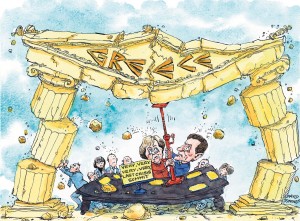

The Greek Problem


Will a Shared Economy Make the World Flat?

Navi Radjou and Jaideep Prabhu write:  In a famous 1937 essay, the economist Ronald Coase argued that the reason Western economies are organized like a pyramid, with a few large producers at the top and millions of passive consumers below, is the existence of transaction costs – the intangible costs associated with search, bargaining, decision-making, and enforcement. But with the Internet, mobile technologies, and social media all but eliminating such costs in many sectors, this economic structure is bound to change.
Indeed, in the United States and across Europe, vertically integrated value chains controlled by large companies are already being challenged by new consumer-orchestrated value ecosystems, which allow consumers to design, build, market, distribute, and trade goods and services among themselves, eliminating the need for intermediaries. This bottom-up approach to value creation is enabled by the horizontal (or peer-to-peer) networks and do-it-yourself (DIY) platforms that form the foundation of the “frugal” economy.

Two key factors are fueling the frugal economy’s growth: a protracted financial crisis, which has weakened the purchasing power of middle-class consumers in the West, and these consumers’ increasing sense of environmental responsibility. Eager to save money and minimize their ecological impact, Western consumers are increasingly eschewing individual ownership in favor of shared access to products and services.

As it stands, nearly 50% of Europeans believe that, within a decade, cars will be consumed as a “shared” good, instead of privately owned, and 73% predict the rapid growth of car-sharing services. BlaBlaCar, Europe’s leading car-sharing service, now transports more passengers monthly than Eurostar, the high-speed rail service connecting London with Paris and Brussels. And the better-known service Uber is causing panic among taxi companies worldwide. Despite recent controversy, the company, founded in 2009, is valued at more than $40 billion.

This shift in consumer attitudes extends far beyond transport. The peer-to-peer home-sharing service Airbnb now rents more room-nights annually than the entire Hilton hotel chain. And the peer-to-peer lending market, which bypasses banks and their hefty hidden fees, surpassed the $1 billion mark in early 2012.

The global market for shared products and services is expected to grow dramatically, from $15 billion today to $335 billion by 2025, without requiring any major investment.

The nature of horizontal networks supports this prediction. Such networks begin working long before they reduce transaction costs. By enabling ordinary people to do at home what, a decade ago, only scientists in large labs could do, the Internet economy is lowering the costs of research and development, design, and production of new goods and services in many sectors.

The transition to a frugal economy is happening. Traditional companies must get on board – or risk becoming obsolete.

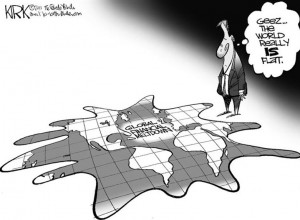
Is the World Flat?

Putin and Tsipras Making Nice

Russian President Vladimir Putin invited newly elected Greek Prime Minister Alexis Tsipras to visit Moscow as a gesture of good will after the two leaders discussed expanding ties between their economically deflated countries in a phone call Thursday. Greece’s controversial anti-austerity prime minister is expected to visit Russia May 9.

The leaders’ discussion focused partly on possible routes to send Russian natural gas through Greece into the rest of the European Union, the state-owned news service Sputnik reported. Russia previously sent a large proportion of its gas through Ukraine to Europe, but the conflict between the Ukrainian government and Russian-backed rebels has put that arrangement on hold.

Russia wants to build a new gas route through Turkey that would carry 50 billion cubic meters of fuel to Europe every year. Russian and Turkish officials are reportedly working out the technical aspects of the ambitious project, which would see gas pumped between the countries under the Black Sea. The gas could then potentially be pumped through Greece.

“The Russian president and the prime minister emphasized the need for substantial improvement of the cooperation between Greece and Russia — countries with deep and historic ties — especially in the sectors of economy, energy, tourism, culture and transport,” Tsipras’ office said in a statement Thursday, Reuters reported.

Tsipras, who came to power through his anti-austerity Syriza party’s comfortable victory in snap elections Jan. 25, promised voters he would restructure Greece’s sovereign debt with the European Central Bank, European Commission and International Monetary Fund, which have forced Greeks to live under crippling economic measures in recent years. His defiant promises angered the EU’s core countries, including Germany, where many of Greece’s loans are financed.

Tsipras further rocked the boat when he said just days after being elected prime minister that he didn’t support expanding EU sanctions on Russia. Greece could have derailed those sanctions with its veto power within the EU, but Tsipras softened his view, and Greece went along with the rest of member states to vote in favor of new sanctions last week.

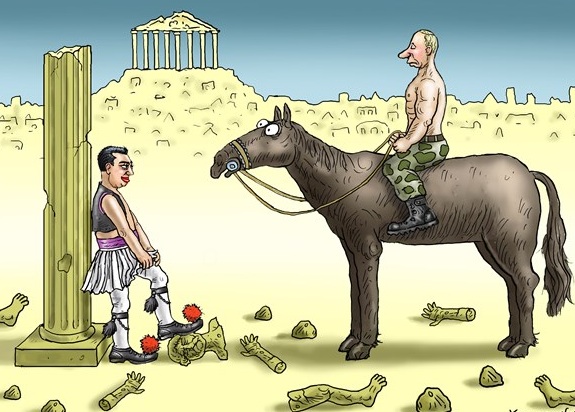
Tsipras and Putin


Liquidity and Technology

Markets will generally continue to grapple with an environment of capital superabundance. Even with moderating financial growth in developed markets, the fundamental forces that inflated the global balance sheet since the 1980s—financial innovation, high-speed computing and reliance on leverage—are still in place.

There certainly has been a great deal of liquidity in the two years.  This is likely to continue over the next several years, and maybe well into the next decade. Policies that implicitly or explicitly constrained growth in median household income relative to GDP are more to blame than the changes in the financial system because these plosives tended to force up the savings rate. The financial system changes are much more likely to be consequences rather than causes of abundant liquidity, although there is plenty of historical evidence to suggest that the two come together, and that they are mutually reinforcing.

Technology “revolutions” tend to take place when a huge amount of risk-seeking capital flows into very risky and often capital-intensive high-tech investments, generating large network benefits and creating tremendous rewards for successful technology ventures. Particularly for those technology projects that benefit from growing networks — railroads, telephones, video, the internet — there is a strong element of pro-cyclicality, in that early successes spur greater visibility and faster adoption, which of course creates further success.

What today we call economic globalization — a combination of rapid technological progress, large-scale capital flows, and burgeoning international trade — has happened many times before in the last 200 years. During each of these periods (including our own), engineers and entrepreneurs became folk heroes and made vast fortunes while transforming the world around them. They exploited scientific advances, applied a succession of innovations to older discoveries, and spread the commercial application of these technologies throughout the developed world. Communications and transportation were usually among the most affected areas, with each technological surge causing the globe to “shrink” further.  As a historical rule it was primarily commerce and finance that drove globalization, not science or technology, and certainly not politics or culture.

Are we in such a period? We certainly were before the 2007-08 crisis, but every globalization period has been followed by a contraction which, too, has certain characteristics in common.

This disruption has already occurred to some extent. After 2007-08, global GDP growth dropped sharply, the growth in global trade dropped even more sharply, we have seen soaring unemployment, and I expect that we will soon see a wave of sovereign defaults.

But this time may be different in one important way. The 2007-08 crisis may well be the first global crisis that has occurred in a period of credible fiat currency.  The Liquidity Issue

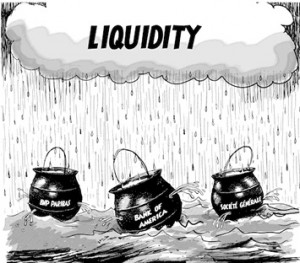
Liquidity


Women’s Rights Conference For Men Only

Saudi Arabia’s prestigious Univeristy of Qassim played host to one of the biggest women’s rights conferences in the Arab world in 2012. Ironically, the institution managed to hold the event without the advice or attendance of a single woman.

Themed around the topic of “Women in Society” the conference, originally intended to be held annually at the University, is supposed to set a benchmark for tolerance and progress in the region. Delegates and speakers from more than fifteen countries showed up.

As is to be expected from Saudi Arabia, a country firmly under the grip of its own twisted interpretation of Sharia Law, zero women attended the event. At least not in the same building as the men. Perhaps more hypocritically, a woman is yet to lecture to men at a University of Qassim summit.

The picture below was pubished by Okaz, an Arabia newspaper, but it has just recently surfaced in the European press.

Saudi Arabia is still ranked 127th out of 136 countries for gender parity.

All Men at Women's Rights Conference in Saudi Arabia