Is Greek Wealth Going to Gold?

Mark O’Byrne writes:  Recent official soundings from the UK and German governments saying that exposure to Greece is limited only underscores the depth of denial, ignorance and lack of consensus in hte Euro area.  A Greek exit from the euro would profoundly weaken the euro experiment and create a dangerous precedent for all future crises in the region.

The European economy is the largest middle class economy in the world. With over 400 million relatively affluent consumers it represents a massive portion of the net global economy and as such a breakup of part of it would be felt across the world in credit spreads and capital decisions for years to come.

This would not have been because of Greek exit, but rather because of the inability of the authorities to manage the crisis as risks initially built up, then as bail outs were designed and implemented and then as these efforts surely failed.

We are witnesses to an epic failure of planning, statecraft and social justice. Regardless of where your politics lie, these elements are critical for a modern globally connected economy to function.

The geopolitical backdrop is one of suspicion and hostility in the form of a festering proxy war between western and Russian interests in Ukraine and regional crisis and humanitarian catastrophe in the middle east as Syria and Iraq descend into stateless anarchy. These factors reduce the odds of a successful solution in Greece being found in time.

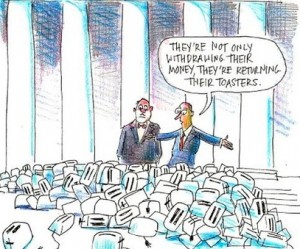
The share value of Greek banks has cratered.  In what is probably the worst performance for the sector on record, the shares of all four major banks have crashed.

Forbes list five main causes for the collapse:

  1. Deposit flight has accelerated.
  2. ECB liquidity could be cut off.
  3. Potential public and private debt restructuring.
  4. Low profitability.
  5. Reliance on deferred tax assets – Forbes explains it as an over-reliance by Greek banks on liquidity from the state.

The real danger is that the Greeks themselves lose confidence. There are tentative signs that money is again being sent abroad, as it was in mid-2012. Nikolaos Panigirtzoglou at JPMorgan points out that €350m was sent from Greece to Luxembourg money funds since the start of last week.

Concerns about bank holidays and also a return to the drachma have returned and Greeks are looking for ways to prevent further destruction of their wealth.  Gold is ebing bought.  For Greeks, Storage in Switzerland remains a favoured way of owning gold.
 

From Human Waste to Energy

Heinz-Peter Mang is obsessed with turning human waste into gold. As millions of Chinese move to cities, the German engineer is convinced the country is on the way to hitting the jackpot.

A growing portion of China’s toilet waste is converted into fertilizer and biogas. In Beijing, 6,800 tons of human excrement are treated each day by some estimates: enough to fill almost three Olympic-size swimming pools.

Over the past decade, China’s economic ascent has driven millions of rural workers into its cities in the largest migration in human history. In 2013, the number of urban dwellers crossed 731 million, overtaking the rural population by more than 100 million. Some fallouts: water shortages in the North and toilet waste routed into rivers in the south.

That’s forcing city planners to get creative in dealing with toilet refuse, and drawing engineers like Mang to help refine models. The push to re-purpose feces into energy resources or fertilizer is expanding across China, and Mang is advocating for the model to be copied in other parts of the world.

Globally, a variety of techniques are used to handle human waste: some cities dump it in rivers, others choose to incinerate, and still others bury it in ditches. United Utilities Group Plc, Britain’s largest publicly traded water company, handles the sewage of 1.2 million people in Manchester and operates a sludge recycling center that runs on enough human waste to power 25,000 homes.

The world’s most populous nation scaled up a model used in farms. Originally used to keep humans from doing their business in pig troughs, today 40 million farm homes across China have a holding tank for human and animal waste that is partly sanitized by depriving the solids of oxygen. What’s left is then converted to liquid fertilizer for the farms.

What’s happening in Beijing is an industrialized, scaled-up version of that model, said Mang, who has lived in the capital for a decade. Across the city, which has seen its population double to 21 million in the past decade, the average annual amount of human waste processed will increase by 200 to 300 tons a day, said Zhang Jiang, general manager of Beijing Century Green Environmental Engineering & Technology Ltd., which operates night-soil treatment plants. Treating waste is set to be a growing area of business, Zhang said.


The catch-up of waste treatment from low penetration rates in China is driving “a waste revolution,” with key treatment operators likely to grow 200 to 400 percent in volume in the next five years.

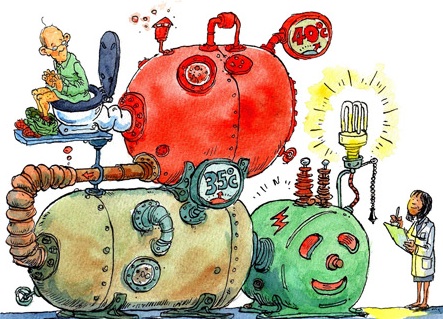
Recyclig for Energy


Enigma: Women in Science Not Represented in Popular Art

The Bechdel Tests requires a movie to have three basic elements to pass. A film must include: 1) two prominent female characters 2) who have a conversation 3) that is not about a man.

Why do relatively few women  occupy high-profile science or technology positions?  The problem may not be so much a lack of qualified women, but a question of representation instead.

Joan Clarke, the code-breaker depicted in the recent film The Imitation Game, was just one of numerous female mathematicians who worked at the U.K.’s World War II lab known as Bletchley Park. Women’s contributions to the development of the Mac were been scrubbed from the movie Jobs, and from the space mission in Apollo.

The upshot is that a perceived dearth of women in STEM professions can be partly addressed by ensuring the proper depiction of those who are already working in them.

Code Breaker Knightley in the Imitation Game

Women in Silicon Valley?

U.S. citizens create world-beating tech sites like Amazon, Facebook and Twitter — so why can’t agencies like the IRS or Veterans Affairs do the same? The White House’s chief technology officer, Megan Smith, suggested it’s possible, provided the government can attract enough people with a high TQ, or technology quotient, to work there.

Smith points to the emergence of “innovation labs” within agencies as evidence that the government can foster the same sort of skunkworks-style thinking found in Silicon Valley, where Smith made her name as a senior Google executive.

Echoing a mantra of executives at Google X, Smith wants to find ways for the government to exhibit the sort of technological prowess that normally occurs only in wartime. She also emphasized that she and her deputy, former Twitter lawyer Alex Macgillivray, want to reduce the sort of regulatory morass that can inhibit innovation.

But while Smith’s words will be welcome to the tech sector, where she and Macgillivray are held in very high regard, there is still the stubborn reality of government. Even as Smith cited issues like patents, copyright and net neutrality as top priorities, a visit to the websites for those topics feels like tumbling into an internet time warp. If the arrival of the smartest minds from Silicon Valley can’t help the Patent Office implement a rational search function, what hope is there of remaking the rest of the federal bureaucracy.

Women in Tech:  Megan Smith is an entrepreneur, tech evangelist, engineer, and connector. At Google[x], Smith works on a range of projects including co-creating/hosting SolveForX. For nine years prior she led Google’s New Business Development team managing early-stage partnerships, pilot explorations, and technology licensing for Google’s global engineering and product teams. She led the acquisitions of Keyhole (Google Earth), Where2Tech (Google Maps), and Picasa, and also led the Google.org team transition to add more engineering with Google Crisis Response, GoogleforNonprofits, Earth Outreach/Engine, and increased employee engagement. Prior to joining Google, Smith was CEO and, earlier, COO of PlanetOut, the leading LGBT online community, where the team broke through many barriers and partnered closely with AOL, Yahoo!, MSN, and other major web players, and was early at General Magic and Apple Japan.

Women in High Tech

Subprime Loan Bundling, Again?

Is securitizing sub-prime auto loans a disaster in the making?  Across the country, there is a booming business in lending to the working poor — those Americans with impaired credit who need cars to get to work. But this market is as much about Wall Street’s perpetual demand for high returns as it is about used cars. An influx of investor money is making more loans possible, but all that money may also be enabling excessive risk-taking that could have repercussions throughout the financial system, analysts and regulators caution.

In a kind of alchemy that Wall Street has previously performed with mortgages, thousands of subprime autoloans are bundled together and sold as securities to investors, including  insurance companies and hedge funds. By slicing and dicing the securities, any losses if borrowers default can be contained, in theory.

Led by companies like Santander Consumer; GM Financial, and Exeter Finance, such securitizations have grown 302 percent, to $20.2 billion since 2010.  And even as rising delinquencies and other signs of stress in the market emerged last year, subprime securitizations increased 28 percent from 2013. The returns are substantial in a time of low interest rates. In the case of the Santander Consumer bond offering in September, which is backed by loans on more than 84,000 vehicles, some of the highest-rated notes yield more than twice as much as certain Treasury securities.

Now questions are being raised about whether this hot Wall Street market is contributing to a broad loosening of credit standards across the subprime auto industry. Companies are increasingly enabling people at the extreme financial margins to obtain loans to buy cars.

The intense demand for subprime auto securities may also be fueling a more troubling development: a rise in loans that contain falsified income or employment information.

Ms. Payne, a former administrative assistant in the New York Police City Department, has not made a single payment on a $30,770 Santander loan that was taken out to buy a 2011 BMW 328xi. Ms. Payne, who has no driver’s license, said she took out the loan so her daughter, who lives in New Jersey, could have a car. The loan has an interest rate of 11.89 percent.

Still, some credit analysts have questioned whether the market has grown too much, too fast.  Some rating firms that faced criticism after the mortgage crisis for blessing shaky investments with top ratings are taking a critical approach to subprime auto deals.

Mr. Gillock, the financial adviser in Chicago, said that no bond made up of subprime auto loans should ever receive a triple-A rating — a designation that only three blue-chip companies receive on their debt offerings.

The financial crisis provided an opportunity for subprime auto loan securitizations.

With the once-enormous market in mortgage-backed securities largely frozen, investors looked for new opportunities. One bright spot was auto lending. Even in the depths of the recession, people needed cars and were willing to pay steep rates for a loan.

Sub-prime bundled auto loans may be the perfect example for anyone who thinks a big fine changes the culture of an investment firm.  It has all the problems the subprime mortgage loans had in 2005.

.

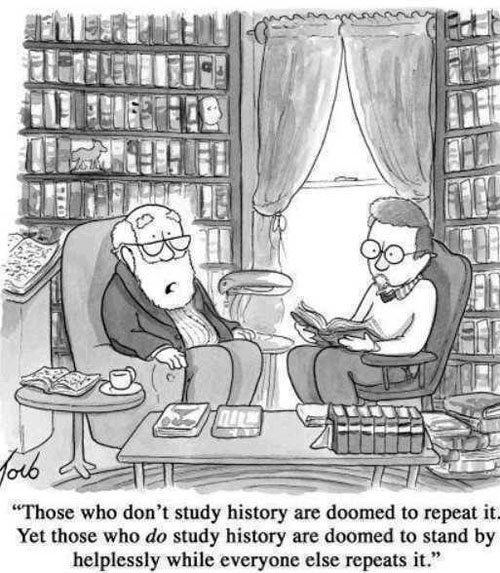
Doomed to Repeat History?


Compromise on Greece?

DIrk Kurbuweil:  Angela Merkel, it is often said, has a terrific feel for her people. That’s why she is revered by German voters and that’s why she wins elections. But what is true in Germany does not apply in Greece. The Tsipras in elections one week ago is also a defeat for the German chancellor. The Greeks have elected a radical government in order to free themselves from German pressure.

Merkel, of course, could simply say that she’s not responsible for the Greek people. German interests are her top priority: keeping the currency strong and ensuring that Berlin’s coffers don’t take a hit. But that’s old thinking, nation-state thinking. Merkel herself played a role in the renationalization of politics in Europe. She thought she could get by without paying too much regard to sentiment in Greece. Now, though, the Greek people are out to settle a score.

The fact is that there is a political union in Europe, even if it lacks strong institutions. It is a union being created by the people.   Greece and Germany


So Goes Greece, Then Spain and Italy?

Patrick Smith writes:  t took a mere six days for the election victory of the anti-austerity Syriza party in Greece to start ricocheting around Europe like a stray bullet in a concrete bunker. And already the fight between northern Europe’s austerians and their populist opponents to the south takes on a political dimension that could transform Europe.

This is an economic confrontation only in part. Debt terms, budget ceilings, privatizations, and the like now emerge as theaters in a larger war. At bottom Europeans are in a fight over (1) the fate of their democracies and (2) the kind of democracy they want—popular or elite, Jeffersonian or Hamiltonian.

it’s a return to politics charged with class-conscious parties who think it’s time to confront political and economic elites rather than “triangulate,” as Bill Clinton famously put it and as every one of Europe’s social-democratic parties have tried to do.

The huge mass of Spaniards may look like a turning point in the months to come. Those interviewed may as well have spoken Greek when they explained to correspondents why they were there.

Spain’s weekend demonstration was the strongest manifestation yet for Podemos, the out-of-nowhere left party that is Syriza’s Spanish equivalent. Podemos (“We Can”) put its crowd count at 300,000; the police’s number was a third of that, but either way this was a very big demo.

The two parties share a common theme, and this is the key to their significance. Both dwell consistently on the question of dignity and humiliation, as in the remark of Angeles Buj, a 61-year-old who spoke to The Times in Puerta del Sol, a politically symbolic square in central Madrid. “It’s time to give some dignity back to the Spanish people,” Buj said.

The truth underlying this too-long-running crisis is this: Entrenched political cliques, often (if not usually) corrupt, and bureaucracies in Brussels and Frankfurt have drastically overplayed their hand in imposing counter-crisis strategies that effectively supersede political rights long beyond question in the industrialized nations. Nobody wins, not even creditors, unless this is corrected..

The pols to watch in the months to come are Pedro Sánchez, who leads Spain’s Socialists, François Hollande, France’s president and a mainstream Socialist, and Matteo Renzi, Italy’s premier, who, for many Italians’ money, professes left and too often governs right.

Podemos, you may recall, burst into the room with an utterly unexpected show of strength in elections to the European parliament last spring; it won 1.25 million votes and took five of Spain’s seats. The momentum since has been astonishing.

The same was said not long ago about Alexis Tsipras, Syriza’s leader, and whatever one may think of his politics he is no dope, has enviable political nous, and has put some accomplished thinkers in key cabinet positions.

From Syriza to Podemos to who knows where next—the spirit of this Mediterranean movement for a political shift leftward in Europe is spreading at ground level. As in Athens, so in Madrid and Rome?

Anti-Austerity Spain?

Small Bank Regulation in the US

Frank Keating, president and CEO of the American Banker’s Association:  I constantly hear from hometown bankers that their examiners—the government officials who visit their banks every year to make sure they make safe loans and follow the rules—are recommending actions suited for banks many times their size. They call it “trickle-down regulation.”

Here’s an example: I recently heard from the CEO of a community bank with $1 billion in assets. His examiner urged him to conduct a “stress test” that is only required for banks with $10 billion or more in assets. On the one hand, a stress test is expensive and time-consuming to conduct—not to mention completely unnecessary for a hometown bank with a traditional business model. But on the other hand, if my friend rejects his examiner’s suggestion, he might risk getting a poor regulatory rating that could hurt his bank. In this context, the suggestion really isn’t a suggestion at all.

You may have a hard time getting worked up about the costs of trickle-down regulation on banks. That’s understandable, because it’s hard to see the costs of excessive regulation. Rules from Washington, D.C., don’t directly come with a price tag. But their cumulative weight requires banks to hire more staffers and consultants to understand and follow them—just as you might hire an accountant to help with your taxes if the IRS required you to pay at a higher bracket. These staff members don’t make loans or sell financial products that serve bank customers, but they often must be paid well because of their specialized expertise.

The result, according to researchers at the Federal Reserve Bank of Minneapolis, is that when a small hometown bank hires additional staff to follow extra regulations, that bank’s already-slim profits shrink by anywhere from 11 to 37 percent. Those shrinking profits have real-world consequences for the bank’s town and the people who live there: less lending for small businesses and entrepreneurs, fewer mortgage loans and fewer investments in the financial technologies of the future.

But beyond the shadow costs that trickle-down regulation imposes on everyday Americans is the basic unfairness of arbitrarily making people follow rules they’re not required to follow. You’d be furious if the DMV failed your daughter for not knowing how to drive an 18-wheeler, and you’d be steaming if the IRS charged you a tax rate for a higher bracket. Bank examiners shouldn’t be allowed to make up their own rules, either.

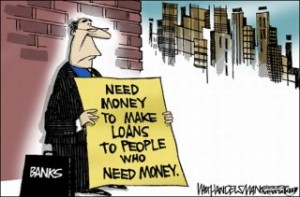
Small Banks

Misogyny in Silicon Valley?

Computer programmer Lauren Mosenthal and her partner, Eileen Carey, came to California attracted by possibility.   The only problem with their dream is that Silicon Valley has never produced a female Gates, Zuckerberg or Kalanick. There are a few high-profile female entrepreneurs in the Bay Area, but despite the very visible success of corporate titans Meg Whitman, Sheryl Sandberg and Marissa Mayer, who signed up with companies after they took off—their numbers are relatively minuscule.

Despite that discouraging fact, the two women spent their 20s deep inside the valley’s bro community—a culture that has been described as savagely misogynistic. In inverse ratio to the forward-looking technology the community produces, it is stunningly backward when it comes to gender relations. Google “Silicon Valley” and “frat boy culture” you’ll find a financing system that rewards young men and shortchanges women.

Shanley Kane is a young tech industry observer and founder of Model View Culture, an acid-penned, widely read website on which she routinely exposes and excoriates the white brogrammer establishment. In an interview with MIT Technology Review in December, she said venture capitalists talk about the need to get 10-year-old girls into science in order to bring up the numbers of women they will fund, but don’t fund the ones already in the industry. “We are not getting hired, and we are not getting promoted, and we are being systematically driven out of the industry,” she said.  Women in Silicon Valley

Where Are the Women in Silicon Valley

Equity Capital Requirements for Banks?

The New York Federal Reserve comments:  Do riskier banks have more capital?  Banking companies with more equity capital are better protected against failure because they can absorb more losses without becoming insolvent.  How has the relationship between capital and risk evolved over time?

There is not question that banks’ capital policies have become more precautionary in recent years. The Federal Reserve has implemented annual supervisory stress tests which are explicitly designed to remain well-capitalized even under severe macroeconomic downturns.  Improved risk management, greater awareness of downside risks and changes in supervisory practices have also had an impact. Equity capital should be the focus.

Banking