Sharp Drop in Prices in the EU

The eurozone experienced negative inflation for the second month in a row, according to a flash estimate published today (30 January) by Eurostat, the European Union’s statistical office. Inflation is expected to be at -0.6%, with consumer prices falling further than economists had forecast.

The fall represents the biggest decline in prices in the history of the euro. It is down from -0.2% in December. Economists had expected a -0.5% drop. A separate paper published today recorded eurozone unemployment at 11.4% in December, compared with 9.9% across the EU as a whole.

The drop was driven by the fall in energy prices (-8.9%, compared with -6.3% in December). Prices are expected to fall for food, alcohol and tobacco (-0.1%, compared with 0.0% in December) and non-energy industrial goods (-0.1%, compared with 0.0% in December). Only prices for services are expected to increase (1.0%, compared with 1.2% in December).

The deflationary spiral comes as Mario Draghi, the president of the European Central Bank (ECB), is trying to tackle deflation with a policy of quantitative easing. Last week he announced a bond-buying plan that will inject €60 billion a month into the economy from March this year until September 2016.

The ECB’s target rate for inflation is close to, but below, 2%.

Core inflation, which excludes volatile energy and unprocessed food prices, was at 0.6% in January, down from 0.7% over the previous three months. The ECB has characterised any rate below 1% as a “danger zone”.

Headline inflation has also been in what the ECB calls the “danger zone” below 1% since October 2013. The ECB aims to keep inflation just under 2% over the medium term.

Bond Buying in EU

Elizabeth, the Feminist Queen

Great Britain’s Queen Elizabeth II is known to have a wicked sense of humor, and some mean driving skills. One day back in 1998, she deployed both spectacularly to punk Saudi Arabia’s late King Abdullah bin Abdullah Abdulaziz.   Back then, Abdullah was a Saudi crown prince visiting Balmoral, the vast royal estate in Scotland. The Queen had offered him a tour of the grounds—here’s what happened next,

The royal Land Rovers were drawn up in front of the castle. As instructed, the Crown Prince climbed into the front seat of the Land Rover, with his interpreter in the seat behind. To his surprise, the Queen climbed into the driving seat, turned the ignition and drove off. Women are not—yet—allowed to drive in Saudi Arabia, and Abdullah was not used to being driven by a woman, let alone a queen. His nervousness only increased as the queen, an Army driver in wartime, accelerated the Land Rover along the narrow Scottish estate roads, talking all the time. Through his interpreter, the Crown Prince implored the Queen to slow down and concentrate on the road ahead.

Royal custom discourages repeating what the Queen says in private, Cowper-Coles explained, but the anecdote was corroborated by Abdullah, and became, in the diplomat’s words, “too funny not to repeat.”

Women still can’t drive in Saudi Arabia.

Women Don't Drive in Saudi Arabia

Venezuela, a Narcocracy?

Mac Margolis writes:   Venezuela is on its way to becoming Latin America’s reigning narcocracy.

Leamsy Salazar Villafana was a former security guard for Diosdado Cabello, president of the Venezuelan National Assembly, widely regarded as Chavismo’s most powerful figure after Maduro himself. After his safe arrival in the U.S., Salazar  told the Spanish daily ABC that his former boss not only moonlighted by trafficking cocaine but doubled as ringleader of Cartelo de Los Soles, the Suns Cartel, a shadowy racket allegedly run by Venezuelan brass.

Salazar said he personally witnessed Cabello dispatch overseas shipments of cocaine, occasionally bundling them onto aircraft owned by the Venezuelan oil company, Petroleos de Venezuela. Cabello’s brother, Jose David Cabello, ran the cartel’s finances, he said, with the aid and cover of Cuban officials.

Tales of drug dealings in Chavismo’s inner circle are hardly new, but Salazar’s defection stung. He used to head security for Chavez himself: a “humble, great marine,” the Comandante once called him. That loyalty won Salazar a job riding shotgun for Cabello after Chavez died in 2013.

If Salazar can back his claims, not only would he nail an alpha Chavista, but he would help narcotics sleuths connect the dots on the potent Caracas connection that is changing the face of international drug trade.

Though never a major drug producer, Venezuela has become a thriving ecosystem for footloose global criminals. Its lawless borders and an unfettered black market make the country an ideal way station to launder drug money and funnel cocaine and marijuana from Venezuela’s drug-producing neighbors and consumers in Europe and the U.S. In recent years, the United Nations International Narcotics Control board has reported an upsurge in airborne cocaine shipments from Venezuela to West Africa and onward to Europe, as well as to Honduras, a major trans-shipment point to the U.S. Last year’s annual report by  the U.S. State Department’s Bureau of International Narcotics and Law Enforcement Affairs put it more baldly: “The vast majority of suspected narcotics trafficking flights departing South America originate from Venezuela.”

In Venezuela, as in Central America, drugs flourish due to a deadly combination of bent officials and feeble government institutions. The Cabello case, however, points to something larger: bent government.  Venezuela’s ranking officials are not just on the take but, as Salazar appears ready to testify, occult partners in charge of thriving drug franchises.

U.S. officials have pursued Venezuelan generals, diplomats and judges on trafficking charges with mixed results. Chavez’s former military intelligence chief, Hugo Carvajal Barrios, was arrested last July in Aruba on charges of running drugs and peddling arms to Colombian insurgents. After brandishing newly-minted diplomatic credentials, and a rescue mission by Venezuelan lawmakers, Carvajal escaped extradition to the U.S. and flew back to Caracas to a hero’s welcome.

Whether Maduro can, or will, do the same for Cabello is another matter.

Yet if Numero Dos faces international criminal charges, Bolivarian spin may not be enough to rescue the revolution from itself.

Drugs in Venezuela

Currency Manipulation and Trade

Has currency manipulation had been raised in the TPP talks?  Although Congress has been pushing the administration to bring up currency provisions in the negotiations for years, doing so would significantly alter, and perhaps torpedo, the deal with Japan.

Of course, currency manipulation is difficult to combat with a domestic law — since unlike trade pacts, domestic laws are not agreements with other nations that include internationally binding enforcement mechanisms. The bill would require the Department of Commerce to include currency manipulation subsidies in its calculations of unfair trade practices prohibited under other trade pacts, making it easier for the U.S. government to win trade cases against other countries, and to secure heftier judgments.

Both Republicans and members of the Obama adminsitration stress that they are seeking a “high-standards” agreement that would counter the power of China to weaken global regulations.   Three of the countries involved in the talks — Malaysia, Brunei and Vietnam — are serial human rights abusers.  They simply do not have the institutional infrastructure in place to enforce strong protections.

Is there a strong intellectual property proivision  included in TPP. Those copyright, patent and other provisions, however, are the subject of hot debate, with many tech experts warning they will crimp the development of new digital applications.

By granting pharmaceutical companies long-term monopolies on prescription drugs, moreover, those policies dramatically inflate the cost of medicine. The Indian government, for instance, recently authorized a generic version of a patented cancer medicine for $157 a month.

Doctors Without Borders, a humanitarian group that won the Nobel Peace Prize in 1999, points out the human cost of these provisions.

A fast-track bill would not only apply to TPP talks, but also to another pending deal with the European Union and any other future trade pacts covered by the timeframe of the bill. Any EU deal must include a financial services chapter. European negotiators have pressed U.S. regulators to loosen financial regulations for years in other international forums. Meanwhile, Republicans seeking to roll back the 2010 Dodd-Frank bank reform law have crafted bills to help banks dodge U.S. oversight by substituting weaker European rules and overseers.

Froman, Obama’s representative who worked at Citigroup before joining the Obama administration in 2009, pushed back against Hatch on that issue, saying USTR did not support a bank regulatory chapter in the EU deal.

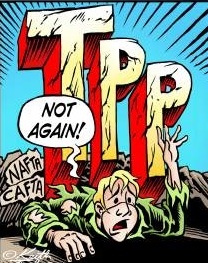
TPP?

Is Devaluation Hurting Putin?

No says Leonid Bershidsky. Russia’s central bank lowered its key interest rate from 17 percent to 15 percent today in a move few had predicted, causing the ruble to dip. This sequence of events shows the Kremlin still sees devaluation as its best friend and is eager to help banks and companies weather the crisiis.

As for the Russian people, who face double-digit inflation as a result, they are just expected to be patient while their government does its best to deal with a Western attack on Mother Russia.

The central bank had hiked the rate to 17 percent from 10.5 percent on December 16, as the ruble more or less tracked the free-falling price of oil. Meanwhile, the central bank’s 17 percent policy rate remained, and it made no one happy. Banks and companies said it was stifling all lending activity. On Jan. 13, former Prime Minister Yevgeny Primakov, one of the most respected figures among Russian conservatives, particularly the military-industrial lobby, was sharply criticical of the central bank.

Russian business lobbied hard  to have the rate lowered. It was only a matter of time before the central bank would react; the bank’s high lending rate wasn’t serving a useful purpose anyway, because the ruble kept falling. This month it is the world’s second worst-performing currency after the Belarussian ruble.

The tricky part was lowering the rate without triggering panic. The central bank said that it estimated 2014 economic growth at 0.6 percent.

In the first six months of 2015, the central bank expects the devaluation to be insufficient to avoid negative growth of 3.2 percent. That may be because it’s underestimating the ruble’s downside potential.

There is no political will in the Kremlin to prop up the currency. Even at the current oil price, Russia will still have a healthy current account surplus, which — so long as reserves aren’t used up trying to defend the ruble — will enable Russia to handle the $105 billion in foreign debt payments due this year. With that and the ruble-based needs of Putin’s relatively poor electorate taken care of, all the government has to worry about is preventing a banking crisis and keeping industrial investment from falling too steeply, after a 2.9 percent contraction in 2014. Societe Generale predicts a 6.5 percent year-on-year investment decrease for this year, but lowering the central bank rate should theoretically ameliorate that. So expect more interest rate cuts in the coming months.

The continuing devaluation will only hurt the Russian middle class, which regularly travels overseas and buys a lot of imported goods.

There are enough people who subscribe to this kind of thinking for Putin to be confident that things will work out fine for him.  55 percent of Russians believe the country is on the right path. It’s a drop from the August high of 66 percent, but still a comfortable enough majority.

As for Putin’s personal support, it has been frozen at 85 percent for the last three months. Russia’s president is surviving sanctions and a decimated oil price just fine.

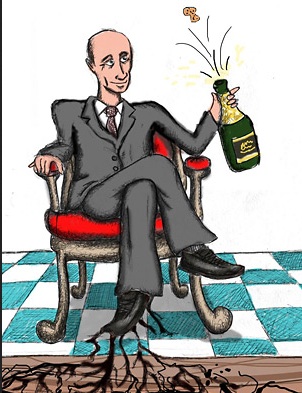
 Putin's Popularity in Russia

Chinese Men Looking Worldwide for Brides

Rather than dwelling on the fact that sex-selective abortions continue despite a government ban, Chinese media interpreted the sex ratio as a threat to men, not women. On Jan. 21, web giant Sina’s arm in Henan, China’s most populous province wondered aloud on social media platform Weibo whether the news was “heart-stopping” and exhorted bachelors to “start making an effort!”

Meanwhile, a Beijing statistician sharing the latest figures to his Weibo account wrote, “Tomorrow I am going to get my son to hurry up and find a girlfriend at his elementary school.” Beijing News even suggested that Ukrainian women could be a solution to China’s problem. The story kicked off with a question: “Just how hard is it for a diaosi,” slang for young bachelors of modest means, “to find a wife?”

After explaining the severe imbalance that the ratio represents, it added that Chinese brides are a popular “export” to many countries such as Japan, South Korea, and the United States, a trend it said had depleted China’s supply of eligible women still further. It offered a chart of the best destinations around the globe for Chinese men to find spouses. Japan and South Korea were particularly promising, the paper said, claiming that 26 percent of South Korean women who took foreign spouses in 2012 chose Chinese men. The trend is bound to grow, the argument went, since popular Korean television actress Park Chae-rim married her Chinese actor beau, Gao Ziqi, in September 2014.

Chinese Brides

China Tops in Foreign Investment

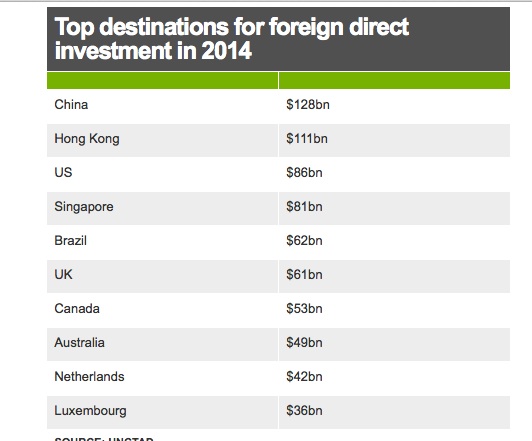
China has overtaken the US as the top destination for foreign direct investment (FDI), for the first time since 2003.

Last year, foreign firms invested $128bn (£84,8bn) in China, and $86bn in the US, according to the United Nations Conference of Trade and Development.

The growth in China’s foreign investment benefitted the services sector as manufacturing slowed.

Globally, foreign investment fell by 8% to a total of $1.26tn last year.

That was the second lowest level since the start of the financial crisis, partly due to the “fragility” of the global economy last year amid geopolitical risks.

Top Direct Foreign Investment

US investment drop

“FDI flows to developed countries dropped by 14% to an estimated $511bn, significantly affected by a large divestment in the United States,” the report said.

US investment fell by two-thirds last year, mainly due to US firm Verizon buying back $130bn worth of shares in a joint venture from Vodafone in the UK.

The US is now third in the world for foreign investment, behind China and Hong Kong.

Its foreign investment fell by 63% last year, compared to 2013.

However, the UN agency said the strengthening of the US economy and the pick up in demand from lower oil prices would “favourably” affect foreign investment this year.

Business Blind Spots

Estelle Metayer writes:  Businesses can have blind spots and they can be costly, causing companies to overinvest in risky ventures or to fail to take advantage of emerging opportunities. Successful leaders are careful to identify their company’s blind spots and introduce mechanisms to ensure that no harm will come from them.

One common source of businesses’ blind spots is judgment bias.  A good example of a company that suffered from this kind of blind spot is Nestlé. For decades, the Swiss multinational defined itself strictly as one the world’s leading food companies. In 2010, however, the company’s CEO, Paul Bulcke, redefined Nestlé as a “nutrition, health, and wellness” company. It was a brilliant strategic decision, allowing the firm to offer dozens of new product lines and services.

Many financial institutions are inadequately prepared to confront the new players entering their markets. Google, which is quietly testing the car-insurance waters, holds a banking license. Meanwhile, Square, Paypal, and the start-up company Affirm are already processing a large share of online payments.

In today’s fast-paced world, it takes only a single technological improvement, price advantage, or great viral advertising campaign for a competitor to leap ahead. New players can materialize seemingly out of nowhere. The taxi company Uber did not exist five years ago; it is now valued at more than $40 billion. The rapid expansion of Alibaba threatens Western retailers who never expected to face a Chinese competitor. Driverless cars and pilotless planes will soon transform many industries.

Another frequent cause of companies’ blind spots is historic bias, or what psychologists call an “anchoring bias” – the assumption that something that was true in the past will continue to be true in the future. A long track record of success can warp executives’ analysis, distort their decision-making, and leave them blind to incipient paradigm shifts or rapid changes in a market.

Overcoming historic biases requires questioning an industry’s taboos. For example, if the creators of television series like Game of Thrones, the most pirated show in history, stopped fighting copyright infringement, they could seize an opportunity. Advertisements directly embedded in the show would reach five million additional – illegal – viewers, in effect doubling their audience.

Guarding against blind spots takes careful thought, but executives and boards can put processes in place to protect against them. For starters, companies should diversify their talent pool.

Executives should make special efforts to break taboos, examine unchallenged assumptions, and question their businesses’ most sacred rules. Even simple methods, like writing down and challenging every assumption on which a company has based its strategy, can yield valuable insights. Every company should assign someone to play the role of “dissenter.” Sometimes called the “China breaker,” this person should be given time during board meetings to throw the good dishware against the wall and see what can be made of the pieces.

Industries are becoming increasingly complex and global competition is mounting. The companies that will be best placed to survive will be those that took the proper precautions to avoid being run off the road.

blind%20spot

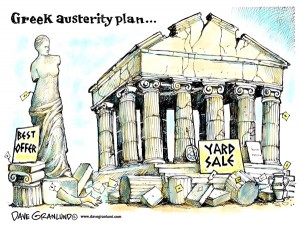
The End of EU Austerity?

Joschka Fischer writes:  Not long ago, German politicians and journalists confidently declared that the euro crisis was over; Germany and the European Union, they believed, had weathered the storm. Today, we know that this was just another mistake in an ongoing crisis that has been full of them. The latest error, as with most of the earlier ones, stemmed from wishful thinking – and, once again, it is Greece that has broken the reverie.

Austerity – the policy of saving your way out of a demand shortfall – simply does not work. In a shrinking economy, a country’s debt-to-GDP ratio rises rather than falls, and Europe’s recession-ridden crisis countries have now saved themselves into a depression, resulting in mass unemployment, alarming levels of poverty, and scant hope.

Warnings of a severe political backlash went unheeded. Shadowed by Germany’s deep-seated inflation taboo, Chancellor Angela Merkel’s government stubbornly insisted that the pain of austerity was essential to economic recovery; the EU had little choice but to go along. Now, with Greece’s voters having driven out their country’s exhausted and corrupt elite in favor of a party that has vowed to end austerity, the backlash has arrived.

The euro, as the Swiss National Bank’s recent  move implied, remains as fragile as ever.  The subsequent decision by the European Central Bank to purchase more than €1 trillion ($1.14 trillion) in eurozone governments’ bonds, though correct and necessary, has dimmed confidence further.

If negotiations between the “troika” (the European Commission, the ECB, and the International Monetary Fund) and the new Greek government succeed, the result will be a face-saving compromise for both sides; if no agreement is reached, Greece will default.

Though no one can say what a Greek default would mean for the euro, it would certainly entail risks to the currency’s continued existence. Just as surely, the mega-disaster that might result from a eurozone breakup would not spare Germany.

A compromise would de facto result in a loosening of austerity, which entails significant domestic risks for Merkel.  Given the impact of the Greek election outcome on political developments in Spain, Italy, and France, where anti-austerity sentiment is similarly running high, political pressure on the Eurogroup of eurozone finance ministers – from both the right and the left – will increase significantly. It does not take a prophet to predict that the latest chapter of the euro crisis will leave Germany’s austerity policy in tatters.

There is no indication that she does. So, regardless of which side – the troika or the new Greek government – moves first in the coming negotiations, Greece’s election has already produced an unambiguous defeat for Merkel and her austerity-based strategy for sustaining the euro.

The question now is not whether the German government will accept it, but when. Will it take a similar debacle for Spain’s conservatives in that country’s coming election to force Merkel to come to terms with reality?

Nothing but growth will decide the future of the euro. Even Germany, the EU’s biggest economy, faces an enormous need for infrastructure investment. If its government stopped seeing “zero new debt” as the Holy Grail, and instead invested in modernizing the country’s transport, municipal infrastructure, and digitization of households and industry, the euro – and Europe – would receive a mighty boost.

The eurozone’s cohesion now depends on whether it can overcome its growth deficit. Germany has room for fiscal maneuver. The message from Greece’s election is that Merkel should use it, before it is too late.

Color-Greece-austerity-WEB

Solar in Africa

Almost 4 billion people around the world are off the grid or underelectrified.  They have on the average connection to one light bulb for three hours a day.  In teh absence of electicity, kerosene is used. Cokin with kerosene is very expensive.

Three revolutionary trends may change the distribution potential of light.  Solar power is getting cheaper.  LED lamps are more efficient and storage techniques are improving.

SAles of devices approved by the IFC/World Bank’s Lighting Africa program are doubling annually.  Lights are just the beginning.  Radios and even bigger systems like schools can run on solar power.

Three main problems have yet to be resolved.  Poor consumers have to be sure their investment makes sense.  Makers of mass market products have been slow to re-jig their products for solar.  Working capital is scarce.   But solar is a sensible way to provide elecricity in underserved Afirca.

Here is a Luci lamp available from https://www.mpowerd.com/

LuciContribute one to your chairty of choice.