Wall Street and US 2016 Election

Simon Johnson writes:   America’s presidential election is still nearly two years away, and few candidates have formally thrown their hats into the ring. But both Democrats and Republicans are hard at work figuring out what will appeal to voters in their parties’ respective primary elections – and thinking about what will play well to the electorate as a whole in November 2016.

The contrast between the parties at this stage is striking. Potential Republican presidential candidates are arguing among themselves about almost everything, from economics to social issues; it is hard to say which ideas and arguments will end up on top. The Democrats, by contrast, are in agreement on most issues, with one major exception: financial reform and the power of very large banks.

The Democrats’ internal disagreement on this issue is apparent. On Dodd-Frank, Democrats differ on the extent to which they should stick up for their own reforms. In December, the White House agreed to a Republican proposal to repeal a provision of Dodd-Frank that would have limited the risk-taking of the country’s largest banks (in fact, the proposal’s language was drafted by Citigroup).

More recently, however, Obama has threatened to veto any further attempts to roll back financial reform.  He a proposing a small tax on the largest banks’ liabilities, which he hopes will encourage “them to make decisions more consistent with the economy-wide effects of their actions, which would in turn help reduce the probability of major defaults that can have widespread economic costs.”

In contrast, the Center for American Progress report devoted very little space to financial-sector reform.

But a serious challenge to all of these views has now emerged, in proposals by Senator Elizabeth Warren, a rising Democratic star who has become increasingly prominent at the national level.  In her view, the authorities need to confront head-on the outsize influence and dangerous structure of America’s largest banks.

Warren’s opponents like to suggest that her ideas are somehow outside the mainstream; in fact, she draws support across the political spectrum.

Warren’s message is simple: remove the implicit government subsidies that support the too-big-to-fail banks. That single move would go a long way toward reducing, if not eliminating, crony capitalism and strengthening market competition in the financial sector.

The big Wall Street banks have enormous influence in Washington, DC, in large part because of their campaign contributions. They also support – directly and indirectly – a vast influence industry, comprising people who pose as independent or moderate commentators, edit the financial press, or produce bespoke “research” at think tanks.

The Democrats need to figure out their policy on Wall Street. In the past, they have simply gone for the campaign contributions, doling out access and influence in exchange. It is now obvious that this is not consistent with defending what remains of Dodd-Frank.

Warren offers a plausible, moderate alternative approach to financial-sector policy that would attract a great deal of support in the general election. Will the Democrats seize the opportunity?  Hillary Clinton is on Wall Street’s payroll.
Who Sides with Wall Street?

Public Libraries in Lebanon

Melissa Tabeek writes:  The historic creation of municipal public libraries in Lebanon’s capital city happened at the end of  a 15-year civil war.  The evolution of their idea coincided with the first municipality elections in over 30 years, in 1998. The government did not know how to manage a municipal public library network, but signed a renewable three-year contract with NGO ASSABIL. To start, the municipality provided the group with a free-of-charge space and minimal funding — ASSABIL has largely relied on private funding — and only two years after becoming an official nonprofit organization, Beirut’s first municipal public library opened in Bachoura in 2000.
Since then, two other public libraries have opened in the Beirut districts of Geitawi and Monot. A fourth is planned to open this year in Tarik al-Jdeideh, and consultations have started for a fifth library in Sassine. Every library’s collection is roughly 60% Arabic and 40% French and English, according to Boulad. Even the organization of the books in each space is meant to be nonsectarian, organized not by language, but by subject.

Additionally, a mobile library, the “Kotobus,” transports books to Beirut’s northern and southern suburbs where there are no libraries. The ASSABIL office in Ras al-Nabeh doubles as a resource and training center. The whole public network is privately managed by the organization.

Privatization of the public sector is not an entirely new concept in Lebanon, according to Karim Mufti, a political analyst and public policy expert. Though it existed before Lebanon’s civil war, it grew much more prevalent afterward. Even today, the backgrounds of municipal leaders — who are also businessmen, engineers and private sector managers — foster a natural connection with the private sector and its management of public missions and space, according to Mufti.

Since the first library opened in Bachoura, the budget of ASSABIL grew from $12,000 in 1998 to $620,000 in 2011. In addition to managing the Beirut network, the organization also supports about 25 public libraries throughout Lebanon with resources, training and evaluations, among other things.

For the fourth library in Tarik al-Jdeideh, the Beirut municipality has agreed to contribute $1 million to the project, but the struggle to maintain the network remains. The municipality has massive resources — a surplus of about $800 million — and Boulad hopes that more money will be invested in Beirut’s library network moving forward.

Though Boulad is passionate about ASSABIL, he added, “It should be that someday ASSABIL will vanish. It would be a good thing, except that we know how to make the place dynamic. We would be a consultant only.”
Boulad, who is also a poet, said that providing a diversity of books and therefore ideas, is not only a right of the people, but a profound need in these troubled times in Lebanon. Whether the public or private sphere is managing it is not important to him, but rather that it continues to exist and grow.

“Promoting public libraries is promoting spaces where critical thinking and free thinking are valued. Since our societies are threatened, they are in need as much as bread and love. This is our survival.”

Public libraries

Women Backing Women

When Amy Norman and Stella Ma started “Little Passports,” a website that invites parents to teach their children geography in an interesting way, they were turned down over and over again as they made presentations to venture capitaists

Today “Little Passports” makes $5 million a year and is a success by any standard.  They were funded by Golden Seeds, a venture capital group that has about 77% female members.

The basic argument about women’s money being available is that they make only 72 cents to every dollar a man makes.  But clearly women are stepping up with money, and focusing on women entrepreneurs is a worthy cause. Word is out among men that women are unwilling to take risks.  Simply not so.

Women entrepreneurs

Is QE the Answer?

Stephen S. Roasch writes:  Predictably, the European Central Bank has joined the world’s other major monetary authorities in the greatest experiment in the history of central banking. By now, the pattern is all too familiar.  Central banks take the conventional policy rate down to the dreaded “zero bound.”  They then embrace the unconventional approach of quantitative easing (QE).

Unable to cut the price of credit further, central banks shift their focus to expanding its quantity.  For the ECB and the Bank of Japan (BOJ), both of which are facing formidable downside risks to their economies and aggregate price levels, this is not an idle question. For the United States, where the ultimate consequences of QE remain to be seen, the answer is just as consequential.

QE’s impact hinges (1)  transmission (the channels by which monetary policy affects the real economy); (2) traction (the responsiveness of economies to policy actions); and (3) time consistency (the unwavering credibility of the authorities’ promise to reach specified targets like full employment and price stability).

In terms of transmission, the Fed has focused on the so-called wealth effect. First, the balance-sheet expansion of some $3.6 trillion since late 2008 – which far exceeded the $2.5 trillion in nominal GDP growth over the QE period – boosted asset markets. The ECB, however, will have a harder time making the case for wealth effects, largely because equity ownership by individuals (either direct or through their pension accounts) is far lower in Europe than in the US or Japan. For Europe, monetary policy seems more likely to be transmitted through banks, as well as through the currency channel, as a weaker euro – it has fallen some 15% against the dollar over the last year – boosts exports.

The real sticking point for QE relates to traction. The US, where consumption accounts for the bulk of the shortfall in the post-crisis recovery.

Japan’s massive QQE campaign has faced similar traction problems. After expanding its balance sheet to nearly 60% of GDP – double the size of the Fed’s – the BOJ is finding that its campaign to end deflation is increasingly ineffective. Japan has lapsed back into recession, and the BOJ has just cut the inflation target for this year from 1.7% to 1%.

Finally, QE also disappoints in terms of time consistency. The Fed has long qualified its post-QE normalization strategy with a host of data-dependent conditions pertaining to the state of the economy and/or inflation risks. Moreover, it is now relying on ambiguous adjectives to provide guidance to financial markets, having recently shifted from stating that it would maintain low rates for a “considerable” time to ‘paatience’ in determining whether to raise rates.

In the QE era, monetary policy has lost any semblance of discipline and coherence. As Draghi attempts to deliver on his nearly two-and-a-half-year-old commitment, the limits of his promise – like comparable assurances by the Fed and the BOJ – could become glaringly apparent. Like lemmings at the cliff’s edge, central banks seem steeped in denial of the risks they face.

To QE or Not?

Great Recession Haunts Us

J. Bradford DeLong looks at two books on the Great Recession and concludes that we acted incorrectly to solve the problems:

The first book is The Shifts and the Shocks, by the conservative British journalist Martin Wolf, who begins by cataloguing the major shifts that set the stage for the economic disaster that continues to shape the world today. His starting point is the huge rise in wealth among the world’s richest 0.1% and 0.01% and the consequent pressure for people, governments, and companies to take on increasingly unsustainable levels of debt.

The second book: Hall of Mirrors, traces our tepid response to the crisis to the triumph of monetarist economists, the disciples of Milton Friedman, over their Keynesian and Minskyite peers – at least when it comes to interpretations of the causes and consequences of the Great Depression. When the 2008 financial crisis erupted, policymakers tried to apply Friedman’s proposed solutions to the Great Depression. Unfortunately, this turned out to be the wrong thing to do, as the monetarist interpretation of the Great Depression was, to put it bluntly, wrong in significant respects and radically incomplete.    What Caused the Great Recession

China’s Growth: At Home, Abroad?

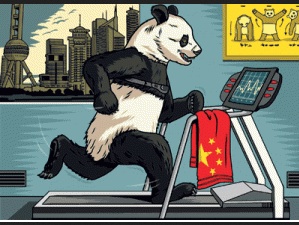
Justin Yifu Lin:  China looks like the US, Europe and Japan after the Second Wolld War, when the growth rate exploded.  In the 35 years China has been evolving into a market economy the growth rate exploed.  Now it is slowing and evening out at about %7.75.

China has the potential to maintain robust growth by relying on domestic demand – and not only household consumption. The country suffers no lack of investment opportunities, with significant scope for industrial upgrading and plenty of potential for improvement in urban infrastructure, public housing, and environmental management.

Moreover, China’s investment resources are abundant. Combined central- and local-government debt amounts to less than 50% of GDP – low by international standards. Meanwhile, private savings in China amount to nearly 50% of GDP, and the country’s foreign-exchange reserves have reached $4 trillion. Even under comparatively unfavorable external conditions, China can rely on investment to create jobs in the short term; as the number of jobs grows, so will consumption.

The external scenario, however, is gloomier. Though developed countries’ authorities intervened strongly in the aftermath of the global financial crisis in 2008, launching significant fiscal- and monetary-stimulus measures, many of their structural shortcomings remain unresolved. “Abenomics” in Japan has yet to yield results, and the European Central Bank is following in the footsteps of America and Japan, pursuing quantitative easing in an effort to shore up demand.

Employment in the US is growing, but the rate of workforce participation remains subdued and the economy has yet to attain the 6-7% growth rates usually recorded in a post-recession rebound. The US, Europe, and Japan are likely to experience continued sluggish performance, inhibiting China’s export growth.

Cihina's Growth


Can Individual EU Nations Act Alone to Do What QE Cannot?

Martin Feldstein writes:  Although the European Central Bank has launched a larger-than-expected program of quantitative easing (QE), even its advocates fear that it may not be enough to boost real incomes, reduce unemployment, and lower governments’ debt-to-GDP ratios. They are right to be afraid.

The success of QE in the United States reflected initial conditions that were very different from what we now see in Europe. Indeed, eurozone countries should not relax their reform efforts on the assumption that ECB bond purchases will solve their problems. But even if these countries cannot overcome the political barriers to implementing structural changes to labor and product markets that could improve productivity and competitiveness, they can enact policies that can increase aggregate demand.The sharp fall in long-term rates induced investors to buy equities, driving up share prices. Low mortgage interest rates also spurred a recovery in house prices. In 2013, the broad Standard and Poor’s index of equity prices rose by 30%. The combination of higher equity and house prices raised households’ net worth in 2013 by $10 trillion, equivalent to about 60% of that year’s GDP.

That, in turn, led to a rise in consumer spending, prompting businesses to increase production and hiring, which meant more incomes and therefore even more consumer spending.  QE’s success in the US reflected the Fed’s ability to drive down long-term interest rates. In contrast, long-term interest rates in the eurozone are already extremely low, with ten-year bond rates at about 50 basis points in Germany and France and only 150 basis points in Italy and Spain.

So the key mechanism that worked in the US will not work in the eurozone.

But, fortunately, QE is not the only tool at policymakers’ disposal. Any eurozone country can modify its tax rules to stimulate business investment, home building, and consumer spending without increasing its fiscal deficit, and without requiring permission from the European Commission. Consider the goal of stimulating business investment. Tax credits or accelerated depreciation lower firms’ cost of investing and therefore raise the after-tax return on investment.

Demand for new homes could be increased by allowing homeowners to deduct mortgage interest payments (as they do in the US), or by giving a tax credit for mortgage interest payments. A temporary tax credit for home purchases would accelerate home building, encouraging more in the near term and less in the future. Here, the revenue loss could be offset by an increase in the personal tax rate.

A commitment to raise the rate of value-added tax by two percentage points annually for the next five years would encourage earlier buying to get ahead of future price increases. The reduction in real incomes caused by the VAT increase could be offset by a combination of reduced personal income taxes, reduced payroll taxes, and increased transfers.

Though eurozone members cannot adjust their interest rates or their exchange rates, they can alter their tax rules to stimulate spending and demand, with the appropriate policy possibly differing from country to country. It is now up to national political leaders to recognize that QE is not enough – and to start thinking about what else should be done to stimulate spending and demand.

EU Economies

Africa Ripe for Investment?

Africa is desperately short of investment. Infrastructure alone needs $90 billion a year.  Many of the normal routes by which capital gets into economies are blocked in Africa.

Only private equity has a direct route.  Private equity raised $4 billion for Africa last year, building toothpaste factories and providing modbile phone service.  Handing cash to pioneers in Africa is often seen as less risky than putting money in underdeveloped pubic markets.

Private equity has been warmly welcomed in Africa.  But Africa needs more than these funds can provide. Often they want to sell the firms they buy in five years. Long term investment is needed.  Uganda’s privatized electric grid gets a state-guaranteed return of 20% a yaer on all dollars invested in the grid.  African economies have grown 5% or more over the past decade.  The continent’s mddle class is projected to triple (one billion people)  by 2060.

Capital restrictions are in place in the rich world which prohibit long-term illiquid investments, such as ports, railways and roads.  African governments are also to blame.  Investors have not forgotten the natioanalizations across the continent in the 1960s and 1970s.

Rich counties need to change their regulations to get capital flowing freely.  African governments need to set up large regional stock exchanges to provide liquidity, security and ease of access.  The conitnent is ripe for investment if the right climate prevails.

Investing in Africa


Women Entrepreneurs Doing Good

Tara Tiger Brown writes: Women who inspire and shape entrepreneurial thinking for profit and nonprofit work.

From Inspiration to Innovation by Tina Seelig  I have listened to every single one of Stanford Ecorner’s podcasts. The driving force behind the series is Tina Seelig. She is an entrepreneur, author and professor. Every word out of her mouth makes so much sense. She has a new entrepreneurial framework that she has been working on called the Inventure Cycle. ”It includes definitions and relationships for the process of bringing ideas to life… and provides a scaffolding of skills, beginning with imagination, leading to a collective increase in entrepreneurial activity.” I highly recommend listening to the podcast if you are an entrepreneur.

In Conversation With by Kelly Hoey  One of the loudest cheerleaders for entrepreneurial women on Twitter has to be Kelly. If she believes in what you are doing the world is going to hear about it and then some. She interviews women professionals, has been on countless entrepreneur panels and is working hard to close the gender gap. She’s also a fellow Canadian so she gets extra points for that.

STEMinist by Ann Hoang  For the past few years I have learned about a variety of women in Science Technology Engineering and Math from the STEMinist interviews. These are the women doing their thing and not the three or four that constantly get talked about in the news. This is the place to go to learn about super cool people like Erica Moulton, a female marine technologist working on an experiment called “Fish In Space.” The mission of the site is to increase the visibility of women in STEM, promote and elevate the perspective of women in these traditionally underrepresented fields, and encourage younger women and girls to pursue careers in STEM.

Why the Maker Movement is Key to America’s Future with Stephanie Santoso  I can’t express how happy it makes me that a female was appointed to the position of Chief Maker at the White House. Equally as awesome is that the CTO position is now filled by Megan Smith, but I haven’t had the pleasure of meeting her yet. It is incredibly important for young people and girls to know they are capable of being creators and not just consumers. Stephanie is one of the forward thinkers at the Office of Science and Technology Policy that coordinated the first White House Maker Faire. She gives me so much hope that we can change things at the highest level. Follow Stephanie on Twitter so you don’t miss out on what’s happening in the maker world at the federal level.

Using Lean Startup to Do Plenty with Very Little by Kimberly Bryant  Anyone in nonprofit that teaches kids about technology knows who Kimberly Bryant is. Her organization, Black Girls Code, is “the Girl Scouts of technology.” Both Kimberly and I started our nonprofits around the same time and neither one of us knew what we were doing when we started them. I really like how she is using a framework for startups with her nonprofit organization. She is a tireless leader and an inspiration to anyone that wants to make a difference.

Hack Education by Audrey Watters  The industry I work in is education technology and so obviously I have to read everything Audrey writes. She is a pragmatist, a contrarian, snarky and makes us all think really hard until it hurts about the future of education.

Women Entrpreneurs

Why Women Make the WEF Better

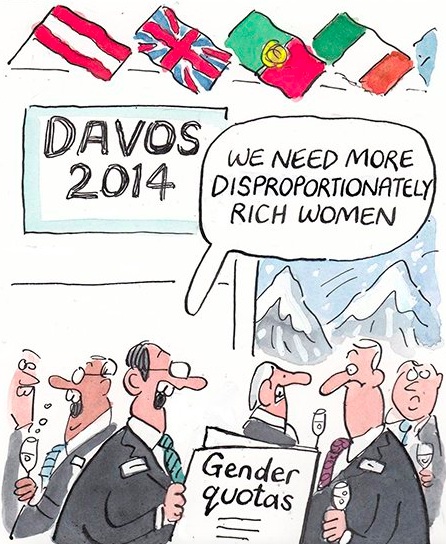
David Rothkopf writes:   Voices representing the disenfranchised may be hard to find but they are essential to addressing many of the issues being discussed at the World Economic Forum.   But most egregious in my view is the continuing failure to fairly involve the majority population of the planet in these discussions. Davos is a man’s world.

This year the WEF attendees are 17 percent women. While this is the same percentage of women as you will find in the world’s legislatures and slightly more than the percentage you will find on corporate boards, it is not just appallingly low — it is inexcusable.

It is impossible to argue that the problem is that the event is for CEOs and top government officials and because only a small percentage of big-company CEOs and political leaders are women.  According to the organizers, only 30 percent of the attendees are CEOs, and only 2 percent are top government officials. Further, look at the agenda: economics, politics, health, education, development, climate, combating extremism, stabilizing societies — you can’t have a serious discussion or effectively influence outcomes without including the perspectives of women.

But you have to start somewhere, and it seems reasonable to me to start with addressing the grossest of history’s social wrongs, the systematic repression of women by virtually all cultures.

How high-profile global gatherings like the World Economic Forum choose to act matters a lot. Bringing greater gender balance here would not only improve the discussion and the outcomes it produces, but it would send a powerful message. But it is clear that change will not happen without a concomitant effort to produce it from the event’s sponsors, its paying customers, and its keynote speakers. Companies that recognize a need for fair hiring practices and equal opportunity should send their female leaders here. Sponsors promoting great values should walk the talk. Explain that the failure to fix this issue, the failure to show real progress over the past few years, and the failure to make real balance the goal is inconsistent with who they are and sends a terrible message, and that they simply can’t be associated with this event unless change takes place. Speakers should say they won’t be on panels unless there is balance. Otherwise all are complicit — and with the attention the issue has gotten, they have to be viewed as not only being complicit, but intentionally so.

Like other elements of this strange, wonderful, perverse, and heartening event, the payoff is not in what happens here, but in how it translates into action worldwide.  It is called the World Economic Forum, and it’s time its participants looked more like the world they are supposed to be improving.

Davos Quotas