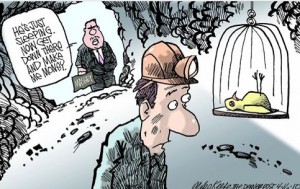
Guilty Credit Suisse Exempt?

Since the repeal of Glass Steagall in 1999, the US  government has been of the big banks, for the big banks and yes, by the big banks.  Vast sums of money have been obtained by the very few. Many citizens have been hurt. More importantly, instead of helping businesses, small and large, which drive the US economy, these banks now spend most of their time on high risk derivative plays which include owning warehouses to store commodities until their price goes up and manipulating markets.

The tide is slowly turning with the alliance in the Senate of Elizabeth Warren, Sherrod Brown and Jeff Merkley.

While US regulators and the Department of Justice have been reluctant to take American-owned banks to task, propelled by the climate of the times, they have begun to go after foreign banks.

Last spring, after a dramatic session before the Senate Subcommittee on Investigations where Senators McCain and Levin let loose on the top manamagement of Swiss-based Credit Suisse, the Department of Justice followed with the announcement of a plea bargain that at last included the acceptance of a criminal charge of aiding and abetting tax evasion in addition to a large fine.  Most observers had noted up until this point that banks were being fined, but the fines  were ‘the cost of doing business.”  Only criminal indictments would deter their behavior, it was thought.

Criminal indictments have serious consequences.  Credit Suisse managed billions of dollars in pension funds in the US. Under law, a convicted felon can not manage these funds.  Credit Suisse is a convicted felon.  But they quickly applied for an  exemption.

While it is true that the Department of Labor has regularly granted exemptions to banks over the past fifteen years, this time the route to exemption was not going to be smooth.  Congresswoman Maxine Waters, and two other representatives called for a hearing.

Waters said:”Every commenter urged the DOL to enforce the law, and not grant Credit Suisse an exemption, with one exception: Credit Suisse. The Credit Suisse letter actually asks for even greater latitude in pension management. In the face of this comment record, bolstered by letters from senior members of Congress , from committees responsible for banking and pension fund oversight, it will be a miscarriage of the regulatory process if the DOL grants Credit Suisse a pass from this penalty without a hearing. Unfortunately, the DOL habitually grants such exemptions — 23 straight times in previous cases. We hope the comment record changes this streak.”

The hearing is to be held in Washington on January 15th.  The question is: Will the bank lobby or the American people win?  Let us hope that the DOL focuses on what Credit Suisse can do that no other bank can do. (Nothing.)  Why a guilty plea to criminal activity should be over looked?  How pension funds can be protected when the administrator is not governed by American law?  When are we going to scratch firms from the “Too Big To Ban” list?
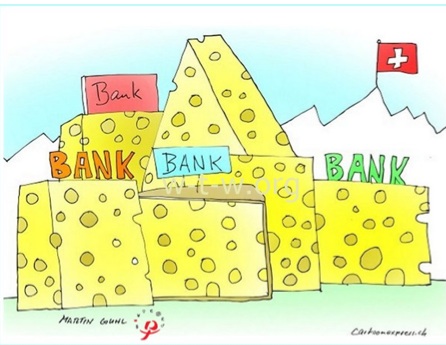
Credit Suisse by Martin Guhl


Piketty’s Ripples and Waves?

Jusstin Fox writes:  CEO of Aetna Life Insurance  Mark T. Bertolini asked executives at his company to read Thomas Piketty’s “Capital in the 21st Century.” Then he announced that the company will raise the wages of its lowest-paid workers to at least $16 an hour and cut their health-care bills

One way to look at this is as a reaction to the improving economy — and a sign that serious upward wage pressure may finally start showing up in employment statistics.  Aetna’s business is becoming more dependent on selling coverage to individuals, meaning customer service has to improve. But there’s also that Piketty thing:

It’s not just about paying people, it’s about the whole social compact. Why can’t private industry step forward and make the innovative decisions on how to do this?

Yeah, why can’t it? The standard answer for quite a while now has been that in a competitive global economy, companies can’t afford to pay workers more than they’re worth.

Earlier economists such as Adam Smith and David Ricardo depicted the setting of wages as a social decision as much as an economic one. Ricardo believed that the income distribution depended on the “habits and customs of the people.”

Most likely it’s a mix. Productivity plays an undeniable role, but so do those habits and customs, which can change. The minimum wage research of the past few years indicates ndicate that there’s at least some room on the margin for using non-market means to push incomes upward.

Then there’s the matter of whether higher wages themselves do economic good. Henry Ford’s 1914 announcement that he was going to double the wages of his assembly line workers is an oft-cited case study. The story goes that he did this so his employees could afford to buy the cars they were making.

Mainstream economists were never entirely comfortable with this reasoning, but some came up with another justification for what Ford did: the “efficiency wage.” As Daniel Raff and Larry Summers this:

These theories have in common that over some range a firm can increase its profits by raising the wage it pays its workers to some level above the market-clearing one. A variety of mechanisms, turning on the role wage increases might play in eliciting effort, reducing turnover, attracting better workers, and in improving morale, have been suggested to explain why profits might be an increasing function of wages.

The financial crisis and subsequent Great Recession have changed the tone of the discussion somewhat. As CEOs of major corporations go, Bertolini is a little different. He does yoga and believes in alternative medicine. He was the first straight board member of the National Gay and Lesbian Chamber of Commerce. He says things like, “I have enough narcotics in my cabinet at home to put families through college.” Just because he’s going in this direction doesn’t mean his CEO peers will follow. Still, it is out of steps like these that big societal shifts are made.

Piketty's Waves

Womanhood: Not a Piece of ‘Cake’

Cavan Sieczkowski writes about Jennifer Aniston, nominated for Best Actress in the film ‘Cake.’   “You’re damned if you do and damned if you don’t,” says Aniston. Physical standards in Hollywood are skewed in Hollywood.

Aniston’s role in ‘Cake’ as a woman suffering from chronic pain and depression has already earned her Golden Globe, SAG and Critics’ Choice nominations.

While promoting the film, Aniston’s had to field questions about the “likability” of the character, a question she says “men don’t get asked.” Men in her business also don’t get regularly quizzed on marriage and kids, although those inquiries hound Aniston.

“You don’t see a lot of men getting asked: ‘Why aren’t you married? Why aren’t you having children?’ You don’t get the ‘Well, they seem to play the same thing over and over again,’ and some of them do.  We’re very much a sexist society,” she said. “Women are still not paid as much as men … I’ve been up against that in negotiations myself.”

Unlike men in Hollywood, women are faced with distorted beauty standards and unfair criticism.

Aniston said, “I really do think you’re damned if you do and damned if you don’t. You either are too fat — ‘Oh my God, she’s gained weight, getting chubby, mid-40s spread!’ — or ‘She’s so skeletal, get some meat on her bones!’ I’ve been on too-thin lists. I’ve been on what-happened-to-her lists.”

Jennifer Aniston

China Financing Oil?

Colin Chilcoat writes:  As the world’s number one energy consumer China is enjoying the low prices while they last. Never one to settle however, China is finding still more ways to take advantage of the dire straits gripping several oil producers.

China’s slowdown is real but the country still has plenty of money to play with that is taking it places the World Bank and the International Monetary Fund (IMF) wouldn’t dare. Their reward? More oil of course. With tough conditions and greater access to raw commodities, China looks to turn the high risk into equal or greater returns.

Russia has turned to China for a bailout. China has obliged, agreeing to finance state-owned Rosneft’s debt in addition to opening a $24 billion currency swap program, which could expand further. For its part, China gets access to Russia’s tightly held upstream sector – in the form of the giant Vankor field – and fulfills its needs downstream with favorable long-term oil and gas deals.

China'sProductionConsumption

Source: EIA

Russia’s economic situation is by no means rosy, but the state of affairs in Venezuela is downright awful. Oil and gas revenues account for one quarter of the country’s GDP and approximately 95 percent of its export revenues. Not surprisingly, low oil prices have the country teetering on the brink of default. Since 2007, Venezuela has borrowed more than $50 billion from China – loans that prevent Venezuela from otherwise marketing about half of its current exports to the Asian nation, which total approximately 500,000 barrels per day.

While perhaps more cautious, China is ready to keep giving.  Venezuela and President Nicolas Maduro have received more than $20 billion in investment for economic, social, and oil-related projects. This arrangement precedes what Maduro hopes to be a more liquid $16 billion loan that could be more freely applied to its other debt obligations. Still, China sets the terms and it wants more oil in return – more than 100,000 bpd greater than current levels.

Elsewhere in South America, Ecuador has pinned its development hopes to the Chinese for better or worse.  In Argentina, Brazil, Peru, China is also fronting the bill and staking claim to the raw goods. The country’s high-interest, inflexible lending draws parallels to the multibillion-dollar payday loan industry in the US. In this scenario, the lender is caught in a circle of debt with no real impetus for change. That circle may continue for some as China is pledging $250 billion in investment in the region over the next decade. The country’s oil-based financing is still an unproven gamble – and lower prices increase the default risk – but it’s shrewd move for what will soon be the world’s largest consumer of oil.

China Takes Care of the Oil Price Problem

Fessing Up US Style

What happens when you ‘self-report’ improprieties?   Layne Christensen Company agreed to pay nearly $5 million in fines last year.  They self-reported employees’ bribes offered to help get business in Africa.  The fines were about half what they might have been if the companies themselves had not stepped forward.

Apparently one-third of all cases brought under the Foreign Corrupt Practices Act have been the result of self-disclosure.  Across the globe, self-reporting is becoming more common.  There are now 41 signatories to the 1999 Ant-Bribery Convention.

The Economic Cooperation and Development (OECD) has stated that over the past fifteen years, that most international bribes are paid by large companies with the knowledge of senior management.

Most cases have resulted in settlement rather than convictions.  The wrong-doing was either to blatant to fight in court, or more hopefully, companies have decided to join the fight against corruption.

 Fessing up to Bribery


Financing Community College Education

Obama’s community college plan does not mention one program that has been successful and costs the government nothing.  When a large corporation like General Electric gives money to a community college and then prepares students to work for their company.  Students are not compelled to work for GE, but they are prepared to work for GE or like companies.

While community college drop out rates are high, such programs induce students to stay.  Getting a job is big motivitation to complete an associates degree and perhaps certification.

 In 2010, President Obama stated that jobs requiring an associate degree were expected to grow at twice the rate of positions that could be obtained without any college experience in the coming years. The President also said that if community colleges could not train a sufficient number of workers to fill open positions, the jobs would have to be filled by outsourcing.   To meet the needs of the workforce and prevent outsourcing, the President has correctly emphasized the role of community colleges.  His latest announcmenet misses the mark.
Job Training and Community Colleges


Around the world, it is the unemployement rate among young people that is staggeringly high.  Part of the problem is lack of preparation for available jobs.


Rara Terra Niche for China

Adam Minter writes:  Rare earths aren’t the world’s sexiest commodity. The 17 elements are notoriously difficult to extract from the ground and have brazenly obscure names. (Don’t make the classic rookie mistake of confusing yttrium with yttribium.) But what they lack in branding, they certainly make up for in utility and ubiquity: they’re essential to products as wide-ranging as wind turbines, smartphones, high tech weapon systems and a fishing reels.

Although the United States was once a major supplier of rare earths, China has been the world’s primary source since the 1990s.

As recently as 2013 China provided 86 pecent of the world’s rare earths supply and, especially over the past several years, Chinese officials have made no secret of their plans to use their accumulating monopoly power.

In 2009, a senior official in Inner Mongolia, home to China’s most productive rare earth mine, explaind how export controls on rare earths (dating back to 1999) were designed “to attract more Chinese and foreign investors into the region.

When it comes to rare earths, China sees no reason to separate economic goals from political ones.

By 2011, several foreign users of rare earths had relocaed production to China.  Fear and speculation served to drive up prices. For example, cerium — a rare earth often used in aluminum and iron alloys rose from $6 per pound in 2008 to a record of $77 per pound in August 2011.

Alternatives to Chinese rare earths quickly began cropping up, whether via recycling, new mines, alternative materials, or even smuggling. In July 2010, the Colorado-based Molycorp raised $393.8 million in an IPO, the proceeds of which went to re-opening a rare earths mine it had closed the previous decade.

By mid-2011, the combination of conservation, new mine, and alternative materials had produced a price crash from which the rare earth market has yet to recover.  This has forced China to change course:.

Rescinding the export quotas wasn’t a very significant concession.  Demand had fallen off so significantly that the quotas had ceased to be an issue. When the WTO ruled in March 2013 that China’s export controls on rare earths and other industrial metals violated its rules, China did not complain.

China has now consolidated the industry into two state-owned companies.  This should address two main problems in China’s market;  the proliferation of private mines and wildcatters who can and do supply smugglers.

It’s an open question whether Chinese industrial policy can maintain the country’s rare earths primacy — and a return to high rare earth prices — via consolidation.  Even if China doesn’t dominate rare earth mining, it continues to dominate rare earth processing (the dirty, dangerous, energy-intensive and expensive process of turning rare earths into something useful).

Even Molycorp, the company that was meant to be America’s great rare earths hope, sends some of its rare earths to China for processing.  China’s new rare earth conglomerates — which enjoy state-backing to cover their losses — seem likely to continue their dominance for years to come.

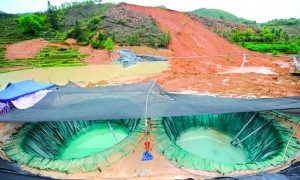
Rare Earth Mining in China

Should the EU Help Ukraine?

George Soros writes:  The sanctions imposed on Russia by the US and Europe for its interventions in Ukraine have worked much faster and inflicted much more damage on the Russian economy than anybody could have expected. The sanctions sought to deny Russian banks and companies access to the international capital markets. The increased damage is largely due to a sharp decline in the price of oil, without which the sanctions would have been much less effective.

In 1998, Russia ended up running out of hard currency reserves and defaulting on its debt, causing turmoil in the global financial system. This time the ruble has dropped by more than 50 percent, inflation is accelerating, and interest rates have risen to levels that are pushing the Russian economy into recession. The big advantage Russia has today compared to 1998 is that it still has substantial foreign currency reserves.

More than $120 billion of external debt is due for repayment in 2015. Although, in contrast to 1998, most of the Russian debt is in the private sector, it would not be surprising if, before it runs its course, this crisis ends up in a default by Russia. That would be more than what the US and European authorities bargained for. Coming on top of worldwide deflationary pressures that are particularly acute in the euro area and rising military conflicts such as the one with ISIS, a Russian default could cause considerable disruption in the global financial system, with the euro area being particularly vulnerable.

There is therefore an urgent need to reorient the current policies of the European Union toward Russia and Ukraine.   A two-pronged approach is suggested:  balance the sanctions against Russia with assistance for Ukraine on a much larger scale.

Sanctions are a necessary evil. They are necessary because neither the EU nor the US is willing to risk war with Russia, and that leaves economic sanctions as the only way to resist Russian aggression. They are evil because they hurt not only the country on which they are imposed but also the countries that impose them. The harm has turned out to be much bigger than anybody anticipated. Russia is in the midst of a financial crisis, which is helping to turn the threat of deflation in the eurozone into a reality.

By contrast, all the consequences of helping Ukraine would be positive. By enabling Ukraine to defend itself, Europe would be indirectly also defending itself. Moreover, an injection of financial assistance to Ukraine would help stabilize its economy and indirectly also provide a much-needed stimulus to the European economy by encouraging exports and investment in Ukraine. Hopefully Russia’s troubles and Ukraine’s progress would persuade President Vladimir Putin to give up as a lost cause his attempts to destabilize Ukraine.

If Europe rose to the challenge and helped Ukraine not only to defend itself but to become a land of promise, Putin could not blame Russia’s troubles on the Western powers. He would be clearly responsible and he would either have to change course or try to stay in power by brutal repression, cowing people into submission. If he fell from power, an economic and political reformer would be likely to succeed him. Either way, Putin’s Russia would cease to be a potent threat to Europe. Which alternative prevails will make all the difference not only to the future of Russia and its relationship with the European Union but also to the future of the European Union itself. By helping Ukraine, Europe may be able to recapture the values and principles on which the European Union was originally founded. That is why I am arguing so passionately that Europe needs to undergo a change of heart. The time to do it is right now. The Board of the IMF is scheduled to make its fateful decision on Ukraine on January 18. A Plan for Russia and the Ukraine 

Note: Soros has lost money in the Ukraine.

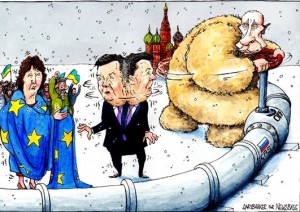
Aid to Ukraine?

No. 1 End Dependence on Coal

Summary of climate change mitigtion study by the University of London.

Policy makers have generally agreed that the average global temperature rise caused by greenhouse gas emissions should not exceed 2 °C above the average global temperature of pre-industrial times1. It has been estimated that to have at least a 50 per cent chance of keeping warming below 2 °C throughout the twenty-first century, the cumulative carbon emissions between 2011 and 2050 need to be limited to around 1,100 gigatonnes of carbon dioxide (Gt CO2)2, 3. However, the greenhouse gas emissions contained in present estimates of global fossil fuel reserves are around three times higher than this2, 4, and so the unabated use of all current fossil fuel reserves is incompatible with a warming limit of 2 °C. Here we use a single integrated assessment model that contains estimates of the quantities, locations and nature of the world’s oil, gas and coal reserves and resources, and which is shown to be consistent with a wide variety of modelling approaches with different assumptions5, to explore the implications of this emissions limit for fossil fuel production in different regions. Our results suggest that, globally, a third of oil reserves, half of gas reserves and over 80 per cent of current coal reserves should remain unused from 2010 to 2050 in order to meet the target of 2 °C. We show that development of resources in the Arctic and any increase in unconventional oil production are incommensurate with efforts to limit average global warming to 2 °C. Our results show that policy makers’ instincts to exploit rapidly and completely their territorial fossil fuels are, in aggregate, inconsistent with their commitments to this temperature limit. Implementation of this policy commitment would also render unnecessary continued substantial expenditure on fossil fuel exploration, because any new discoveries could not lead to increased aggregate production.

When scientists and policymakers talk about limiting climate change, what they’re mainly talking about is keeping more fossil fuels in the ground. The fact is, there’s no way to prevent global warming from reaching catastrophic levels if we burn up our remaining reserves of oil, gas, and coal.

Climate negotiators have agreed that warming should be limited to 3.6 degrees Fahrenheit above preindustrial level. That means that humans can release about 1.1 trillion metric tons of carbon dioxide emissions, and we’ve gone through about half of that already.  The remaining emissions are known as our “carbon budget”; if we “spend” emissions beyond our budget, we’re much more likely to push the planet to dangerous levels of warming. If we burned through all of our current reserves of fossil fuels, we would overspend the budget by about threefold.

In other words, there are a lot of fossil fuels that are “unburnable” if we’re going to stay within the prescribed warming limit. But how much, exactly? And where exactly are those unburnable fuels? That’s the question asked in a study released today in the journal Nature by a team of energy analysts at University College London. The answer matters because mapping the geographical spread of unburnable fuels is a key step in understanding the roles specific regions need to play in the fight against climate change.

The model developed by Christophe McGlade and his team takes into account known estimates of fossil fuel reserves in a number of different countries and regions, as well as the global warming potential of those reserves and the market forces that determine which reserves are the most cost-effective to exploit. The results, shown below, are what the model finds to be the most cost-effective distribution that stays within the 3.6-degree limit.

The researchers ran the model twice: Once assuming widespread use of carbon capture and storage (an emerging technology for catching carbon emissions as they escape from power plants that is gaining steam but has yet to be proven on the global stage), and once assuming no CCS at all. The two scenarios ultimately aren’t that much different—using CCS won’t allow us to burn vastly more coal, oil, and gas. The results shown below are from the “with-CCS” scenario.

A couple interesting things pop out. As you might expect, the vast majority of the world’s coal would need to stay buried. The United States is able to use most of its oil and gas in this scenario, because those resources are relatively cost-efficient to extract and bring to market compared to, for example, gas in China and India. In other words, according to this study, the US fracking boom can go forward full steam as long as the gas it produces aggressively replaces our coal consumption. But Canada can’t touch most of its oil, because the oil there—the kind that would be carried in the Keystone XL Pipeline—is exceptionally carbon-heavy tar sands crude.

What isn’t shown in the graphic above is that the model prohibits developing any of the vast oil and gas reserves in the Arctic. Melting sea ice has made those reserves increasingly attractive to energy companies like Shell.

Of course, the model has to make assumptions about future oil and gas prices that are basically impossible to be certain about. Unexpected changes to the price of oil, for example, could upset the cost equation for drilling in the US and re-shuffle the entire regional breakdown. But even as an estimate, the study really illuminates the vital need for policies all over the world that dramatically cut our dependence on coal.

End Coal Dependence

Sri Lanka: Free Again?

Blommberg editors opine:  Strongman Mahinda Rajapaksa was kicked out in last week’s elections in Sri Lanka.   Another small, strategically vital Asian nation appears to have rejected China’s embrace. Whether the U.S. and India can exploit this opportunity, however, will depend on whether they recognize what’s unique about Sri Lanka.

Voters elected Maithripala Sirisena as president because they had tired of the opacity and perceived cronyism of Rajapaksa’s administration, symbolized in part by multibillion-dollar projects handed out to Chinese companies with little oversight. Elites had begun to fear that Beijing would soon demand more political and military influence as part of its largesse. Yet, unlike Myanmar, which shares a land border with China, such concerns remain somewhat theoretical. Sri Lanka has vast infrastructure needs — and therefore good reason not to reject Chinese money entirely.

If other nations want to compete, they’re going to have to demonstrate they are as willing and able as China to carry out large projects. India is itself seeking Chinese money for infrastructure. At the same time, Japan, Sri Lanka’s largest donor, has shown interest in increasing its investments in the region, and there should be room for Tokyo and New Delhi to combine forces.

Sri Lanka’s has also sidelined the people who have been most directly implicated in past human-rights abuses — including President Rajapaksa and his brother Gotabaya, who served as defense secretary during the last stages of the brutal war against Tamil Tiger insurgents. This should make it easier for the U.S. and India, which has a large and vocal Tamil minority, to work with the new government and eventually strengthen military-to-military ties.   U.N.-led efforts to investigate allegations of Sri Lankan war crimes should continue, but hopefully the new president will be given a chance to promote internal reconciliation and accountability. The campaign to end Sri Lanka’s longstanding culture of impunity will have far higher chances of success if it is led from within, rather than imposed from abroad.

China still has a legitimate interest in expanding its presence in the Indian Ocean, given its dependence on the region’s shipping lanes. By the same token, Sri Lankans could benefit greatly if Beijing’s plans for a “Maritime Silk Road” integrate the infrastructure and economies of the whole region.

Ideally, China will continue to cultivate its interest in Sri Lanka as one investor among several.  Worthwhile public projects should proceed with open bidding and labor and environmental safeguards.  Needlessly provocative actions — such as the docking of Chinese submarines at Sri Lankan ports, which Rajapaksa allowed — should cease.

Sri Lanka