How Does Risk Effect Banks’ Capital Ratios?

Banks finance their loans and other assets with a mix of deposits, debt, and equity capital. Maintaining adequate capital is important for banks because it absorbs losses and protects them from failure. Capital also protects the financial system and overall economy from the costs that can arise from bank failures. For example, one of the reasons policymakers were concerned about financial stability during the financial crisis was low capital ratios – the ratio of equity capital to total assets – at some of the largest banks, which led to government programs to provide capital to these banks.

Banks finance their loans and other assets with a mix of deposits, debt, and equity capital. Maintaining adequate capital is important for banks because it absorbs losses and protects them from failure. Capital also protects the financial system and overall economy from the costs that can arise from bank failures. For example, one of the reasons policymakers were concerned about financial stability during the financial crisis was low capital ratios – the ratio of equity capital to total assets – at some of the largest banks, which led to government programs to provide capital to these banks.

While capital helps ensure the safety of banks and the economy, bank owners and managers have mixed incentives to hold capital. On one hand, banks have an incentive to hold low levels of capital because it costs more to fund assets with capital than with debt or deposits. On the other hand, banks that are relatively risky might have to hold higher levels of capital to satisfy uninsured creditors or address their regulators’ safety and soundness concerns.  Bank Capital Ratios


Bank Capital Ratios

Oil Reserves Plentiful?

Robert Rapier writes, A decade ago Conoco/Philips  ratio between proved oil reserves and production rate was 10 years.  ConocoPhillips today has 8.9 billion barrels of oil equivalent (BOE) and its production rate was 1.5 million BOE/day. Thus, the R/P has grown to 16.3 years. In fact, according to the 2014 BP Statistical Review of World Energy, the R/P ratio for the U.S. as a whole was 12.1 years at the end of 2013. Twenty years ago, the R/P ratio in the U.S. was only 9.6 years.

Think about the implications of that. In 1993 the U.S. had enough proved reserves to produce at the then-current rate for 9.6 years. Not only did we continue to produce for 9.6 years, today’s production rate is 17% higher than it was in 1993, and yet we now have enough oil to produce for 12.1 years at current rates. And the world as a whole has a R/P ratio of 53 years.

In fact, if I go all the way back to 1965, U.S. proved reserves were 31 billion barrels.  Between then and now — a span of 49 years — the U.S. produced 163 billion barrels of oil, and today our proved reserves are 44.2 billion barrels of oil. Globally proved reserves have grown steadily for more than three decades:

141209TELreservesglobal

How did this happen?

It basically comes down to three things. The first is that obviously more oil was found. For example, in 1965 Alaska’s Prudhoe Bay and its 25 billion barrels of oil had yet to be discovered.

The second is that technologies for recovering oil from existing fields improved. Shell geophysicist M. King Hubbert is often credited with correctly predicting in a 1956 paper that U.S. oil production would peak in 1970. What many don’t realize is that this was a secondary prediction. He actually predicted that U.S. oil production would peak in 1965.   U.S. would have to find additional oil fields equivalent to “eight East Texas oil fields.” But those oil fields continue to be “found” by applying new recovery technologies to producing fields and increasing the recovery percentage.

The third factor comes down to the way proved reserves are defined. The oil must be estimated with reasonable certainty, from the analysis of geologic and engineering data, to be recoverable from well established or known reservoirs with the existing equipment and under the existing operating conditions.” Undeveloped reserves can also be booked as proved provided there is a development plan for drilling within five years.

These three factors explain why oil production has far outstripped what expectations might have been given estimates of proved reserves in the past. Today’s R/P ratio in the U.S. of 12.1 years is really a reflection of the oil development that is in the pipeline at current prices. In recent years, U.S. reserves have gone up as higher prices made shale oil economical to produce.

There is a lot more uncertainty about the global reserves figure.  But it is safe to say that we will be using oil for decades to come, and when we do move on to something else there will still be plenty of crude left in the ground.

Oil Reserves?

Economists: In the Beginning Was the Word

Alan S. Blinder wrote “What’s the Matter with Eoonomics?” Blinder concludes that except for some right-wingers outside the “mainstream” and politicians’ refusal to accept economists’ recommendations, little is the matter.  However, economists’ thinking, based on an ill-conceived view of human behavior and addressed to the wrong problem, is a powerful force in policy circles.

Blinder’s textbook, written with William Baumol, is the standard for the mainstream. Both are extraordinarily good economists, liberal and not doctrinaire.

Economists, however, have been unable to forecast accurately based on the exposition put forth iby Blinder.  For example, the Federal Reserve Board’s belief in (mostly) efficient markets led to it missing the signs of the Great Recession; as late as June 2006 the Fed raised interest rates fearing that “some inflation risks remain.” For years, the Fed had rejected board member Ned Gramlich’s warnings that the practices of subprime lenders were not consistent with the assumptions of the Fed’s economists.  Mainstream economists did not predict the effects of eliminating Glass-Steagall, thereby allowing large banks to design and sell the products that helped bring about the collapse.

Although recognizing that markets can be flawed, Blinder states that minimum waste “can be achieved extraordinarily well by letting markets operate more or less freely” and that market methods can remedy the few flaws in the market. The role of economists is removing barriers to the markets’ efficient allocation of usually scarce resources (they assume full employment). For the perhaps 200 million unemployed worldwide the more important issue, however, is the chronic underemployment of potential resources. Economists do not build the distribution of income into their models; but 80 percent of the world population lives on less than $10 a day, which surely wastes substantial human resources. A reexamination of the efficiency of markets, especially financial markets, is in order.

More is wrong with economics than a few right wingers. Mainstream economists claimed until the eve of the 2008 catastrophe that they had at last learned how to manage the economy well. This was quite an error of analysis and thinking, and did not principally come from the right. The leaders of this mainstream analysis were centrist Ben Bernanke, the former Federal Reserve chairman, and moderate liberal Olivier Blanchard, chief economist of the International Monetary Fund.

They argued that the stability of the GDP since the 1980s was an indication that the problem of macroeconomic adjustment had been solved. Stability is fine, but over this period debt soared, growth slowed on average, wages stagnated or fell, inequality rose, and there were at least seven American financial crises. Then came disaster in 2008. What were they talking about?

Did  policymakers listen to these ideas? They still do at the Federal Reserve, where foolish bickering over whether inflation will reach 2 percent a year still goes on. Stale, discarded ideas? Hardly.

Say’s Law, an argument for austerity economics and a self-adjusting economy, was defeated by the Depression. Blinder cites a survey showing that most economists agreed that the Obama stimulus was effective. Sure, after the sharpest drop in GDP since the Great Depression. As some facetiously put it, we are all Keynesians in a foxhole.

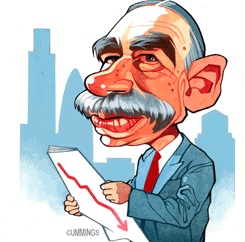
“The ideas of economists and political philosophers, both when they are right and when they are wrong, are more powerful than is commonly understood,” wrote John Maynard Keynes in 1936. “It is ideas, not vested interests, which are dangerous for good or evil.”

Does economics explains growth better than other disciplines? Iit reflects the typically narrow focus of a top mainstream economist. Sociology and political history are critical to understanding Chinese economic development, for example. The recently famous Hyman Minsky, who is now cited constantly for his work on speculative bubbles, was more sociologist and psychologist than technical economist.

Even today, seventy-eight years after Keynes taught the world how to end recessions, many politicians in many countries refuse to follow his (now very mainstream) advice. That’s not a good show for“a powerful force in policy circles.”

John Maynard Keynes


Whistleblower Alert in Italy

Eleonora Casuela directs our attenion to:  The Inland Revenue is ready to make war against corruption.  Rossella Orlandi, director of the institutuion, aske employees to report any incident that may occur. The complaint will be forwarded to a specific email address that has been activated to collect all reports. Orlandi has also specified that employees will not have to be afraid to report because they will be protected by the instituion.

Raffaele Cantone, the president’s anti-corruption, explained that there is no question of denunciation but accountability. The complaint will be forwarded in complete privacy and there will only be a dedicated mail: the Inland Revenue is launching a real listening center “with people who collect complaints and listen.”

The Orlandi, who some time ago presented in Parliament the draft to completely eliminate the receipt of the email. becuase payments are traceabile.  Tax evasion can be combatted. Time limits for the discovey of tax evasions will be extended.  “You have to provide for an extension of time for cases of evasion more insidious, if not doubled for all types, at least one extension, so that it allows to have the time necessary to prevent investigations from being wiped out by complex times prescription,” said Orlandi.

Tax Evasion in Italy

Oblivious Regulators?

Flloyd Norris writes:   What happens when you turn over regulatory responsibilities to people who think there is really no need for regulation?

The United States, and much of the world, tried that for a large part of the last quarter-century. Along the way, a series of crises sent out warning signals that were not heeded.

After the economy recovered from the stock market crash of 1987, Alan Greenspan, the Federal Reserve chairman who had poured money into the market to stem the damage, was celebrated as a hero. He believed in what came to be derided as “market fundamentalism,” holding that markets were far smarter than governments and would produce optimal results if only there were no interference from politicians.

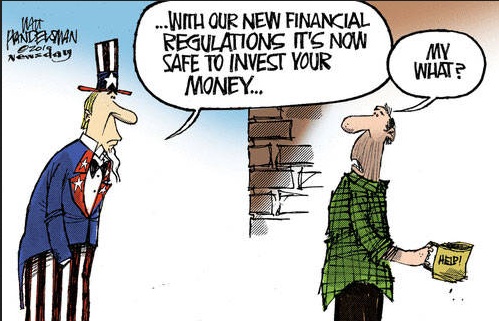
That analysis certainly seemed reasonable through much of the 1990s. The economy grew without a recession for 10 years, the longest such stretch in United States history. A few people worried that bad things could happen as a result of the explosive growth in derivative securities, but they were largely marginalized by the obvious fact that only good things were happening.  Financial Regulation

Financial Regulations

‘Make in India’ the Answer?

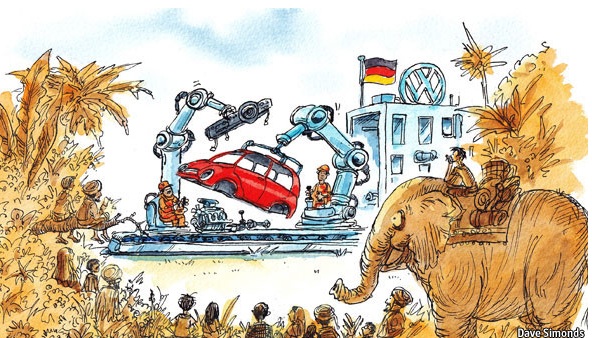
Dhiraj Nayyar writes: India’s central banker Raghuram Rajan is good at asking the right questions. He was one of the few to predict the 2008 financial crisis.  He’s now triggered a debate within India over Prime Minister Narendra Modi’s flagship “Make in India” campaign: an effort to boost India’s manufacturing sector to China-like levels.

Rajan questioned whether that should be India’s goal at all. The conventional wisdom is that the only way to find jobs for a young and growing population, and to move workers off the farm and into cities, is to expand India’s export-focused industries. That’s the same route Japan, China and the so-called Asian Tigers all pursued successfully. Yet, Rajan asked, does the world really need another export powerhouse? With demand in developed nations slowing, there simply may not be enough customers for Indian-made goods, no matter how cheap. The alternative — stimulating domestic demand artificially, by raising tariffs on imports — has been tried and failed spectacularly under previous socialist governments.

If one agrees with the goal of boosting manufacturing, the government has yet to offer any convincing strategies for achieving it.

Yet while businesses would happily embrace such changes, they’re unlikely to unleash a manufacturing revolution. Like China, India’s already tried to implement several of these reforms in special economic zones that advertise lower taxes and looser land and labor regulations.

These policies focus too much on symptoms of India’s malaise. The real problem is that markets for four critical inputs for manufacturing, or indeed any business — land, labor, power and capital — are badly distorted. Until the government resolves those distortions, “Make in India” will remain nothing but a slogan.

Consider land. A new land-acquisition law, passed in the dying months of the previous government in 2013, makes buying farmland on which to build factories tremendously complicated and expensive.

On labor, India should have a cost advantage over China, whose labor-intensive goods now flood  the Indian market. Chinese wages have risen rapidly over three decades of double-digit growth. India’s haven’t, and almost half the population is still engaged in unproductive agriculture.

Unreliable and expensive power supplies hamper all of India’s businesses.

The issue of expensive capital is one that should particularly exercise Rajan. He knows that India’s closed financial system artificially raises the cost of capital. He’s stuck with a tight monetary policy for the moment because of high inflation. But compared to the rest of the world, Indian interest rates tend to be too high even when monetary policy is more accommodative. There’s also plenty more room for India to open up its financial system.

The government can help manufacturers by following through on pledges to invest in roads, ports and connectivity. But only when India’s markets for land, labor, power and capital work efficiently will the foundations for a true cost-competitive manufacturing revolution exist. Rajan might then find himself a bit more optimistic: Indian companies shouldn’t need any special protections to compete with cheap Chinese goods at home. And when the advanced economies finally recover, there will be other markets to conquer.

Indian Manufacturing

Is Putin Holding Russian Billionaires Hostage?

Leonid Bershidsky writes: Russia’s financial crisis has seen the Russian equity market’s total capitalization plummet to $345.9 billion from $647.4 billion, as measured by the RTS index. That makes all the country’s public companies together worth about as much as Google, valued at $349.1 billion, and less than Apple, Microsoft, Exxon Mobil or Berkshire Hathaway. Russian billionaires have lost big chunks of their fortunes, and now, in some cases, the prestigious toys they have acquired abroad are said to be worth as much as the Russian industrial assets that made them rich.

This kind of analysis is largely meaningless, however: Markets are fickle, and wealth is too volatile to matter much to the ultra-rich themselves. It does, however, say something important about why the Russian billionaires are, for the most part, wedded to the country that nourished them: Actual cash flows to their assets in Russia are relatively high.

billionaires

Russian billionaires are a diverse bunch. Some, like nickel czar Vladimir Potanin, retail magnate Sergei Galitsky and natural gas mogul Leonid Mikhelson, own no foreign assets to speak of. Others, such as the omnivorous Viktor Vekselberg and steel titan Alexei Mordashov, are heavily invested overseas. Dmitry Rybolovlev, the former owner of potash producers Uralkali and Silvinit, is an outlier: He has no significant industrial assets anywhere, and his real estate, yacht, art and jewelry constitute 20 percent of his net worth.

Those with the biggest Russian assets have been the biggest losers this year. Mikhail Prokhorov’s holding in the Brooklyn Nets basketball team is proving his most secure investment.  Based on the numbers alone, the same could be said of Roman Abramovich’s Chelsea soccer club in the U.K.

That would be a misleading conclusion, however, because the sports teams’ valuations exist only on paper. So far, nobody is offering that kind of money to Prokhorov or Abramovich, and they would not necessarily be interested in such offers anyway.

The Nets lost $144 million last season, and even if their fortunes change radically this year, the free cash flow to Prokhorov’s stake can be generously estimated at zero. Chelsea earned $29 million for the year to June 2014, but that counts as profit only for European soccer’s Financial Fair Play policy, which was written to make clubs more equal regardless of their owners’ resources.

Is it fair then to compare the expensive British and American toys with the gritty Russian factories, operating in harsh climates and employing hard-drinking, gloomy, need-toughened men rather than glamorous athletes?

Across the board, Russian billionaires receive more free cash flow to their Russian assets than to their foreign ones, relative to these assets’ valuations:

cashvaluations

While the billionaires could theoretically cash out, as Rybolovlev did, and invest in hedge funds or other vehicles, they are more likely to sell their foreign assets than their Russian ones.  Even at the ruble’s current exchange rate, the latter continue to bring in more money than overseas holdings do. Also, Western assets are comparatively overvalued.

Even though Russian billionaires are part of the international jet set, with homes throughout the world and yachts and planes that can take them anywhere at any moment, they are invested in Russia’s fate. Vladimir Evtushenkov, was released from house arrest after the government made him give up his oil assets, claiming they had been illegally privatized.

Russian Billionaires


Privacy Debate Goes Viral

The privacy debate is getting louder in techlandia as it becomes clear that the National Security Agency’s digital snooping, along with other government surveillance programs, could upend the U.S. tech industry’s global dominancwe.

Two recent developments drive this home. The first is a high-profile court case involving the U.S. government and Microsoft. The second is China’s decision to rip foreign technology out of its most important institutions – state-owned companies, banks and government agencies — and shift to domestic suppliers.

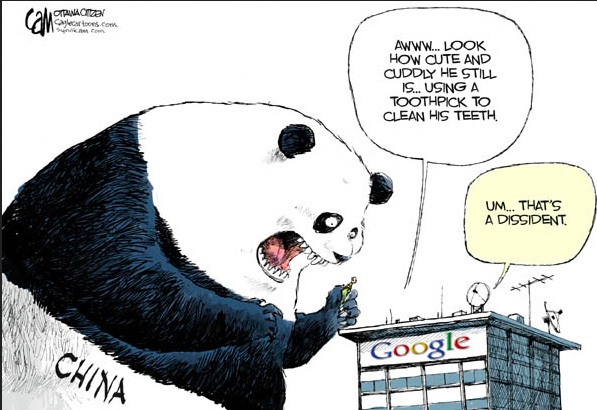
It’s worth noting that both the Microsoft case and the China decision are part of a bigger narrative that started taking shape last summer after Edward Snowden leaked information about the U.S. government’s sweeping surveillance programs. Privacy Debate

Privacy Debate

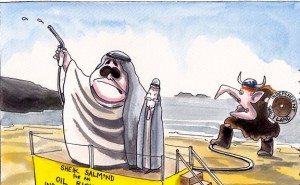
Oil Off the Cuban Coast?

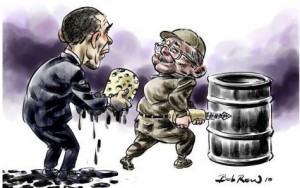
President Barack Obama’s decision to normalize relations between the United States and Cuba may lead to more commercial opportunities for Americans within the island nation. But don’t expect U.S. oil producers to move swiftly to take advantage of them.

In 2012,  two deep-water exploratory well in the Gulf of Mexico has proved busts. Cuba’s state oil company announced Monday, dealing another blow to the island’s dreams of petroleum riches.

The drilling operation carried out by PC Gulf, a subsidiary of Malaysia’s Petronas,

Analysis of the findings revealed an active petroleum system that could extend to other parts of the four blocs contracted by PC Gulf and Gazpromneft.

“Nevertheless, at that point the rocks are very compact and do not have the capacity to deliver significant quantities of petroleum and gas,” it continued, “so it cannot be qualified as a commercial discovery.”

Exploratory wells commonly turn out to be dry or not viable, and experts say production was always at least three to five years out from any confirmed strike.

An estimated 5 billion to 9 billion barrels of crude may be buried off Cuba deep below the Gulf of Mexico, according to geologic surveys, and authorities are hoping the reserves could be even bigger.

Cubapetroleo said PC Gulf and Gazpromneft will study the geologic information gained from drilling the 15,300-foot (4,666-meter) well to evaluate the potential of other parts of the four blocs they have contracted.

Ultradeep-water drilling is technologically challenging and extremely costly, with the platform that drilled out the two wells this year being leased out at $500,000 a day.  The US embargo means that exploratory ocmpanies like Repsol and Petronas had to turn to the Scarabeo-9, a one-of-a-kind vessel built with less than 10 percent U.S.-made parts to avoid triggering sanctions.

After Repsol opted out of a contract to sink a second well and Monday’s announcement of Petronas’ failed try, the massive semisubmersible now passes to Venezuelan state oil company PDVSA for an attempt near the island’s western tip.

Sonangol of Angola has an option to drill next, but after that the Scarabeo-9 is under contract to drill off Brazil with no word on when it might again be available to return to Cuban waters.

Russian company Zarubezhneft signed an $88 million, 325-day contract with Songa Offshore SE of Cyprus to rent out the Songa Mercur drilling rig for exploration off Cayo Coco, one of Cuba’s leading tourist resort areas.

But that bloc in the Bahamas Channel is relatively shallow, and Pinon said the Songa Mercur is not capable of the kind of ultradeep drilling required in the Gulf of Mexico, where nearly all Cuba’s offshore exploration zones lie.

If the US embarg is lifted in the next year, maybe oil companies will begin again with a freer hand.

Oil Off Cuba

US-EU Trade Deal Trojan Horse?

Over two months, three countries and nine cities the giant Trojan horse that is touring Europe has already raised awareness among thousands of people of the dangers of the proposed EU-US trade deal.With actions in cities across Hungary, Germany and Denmark, Friends of the Earth groups have used the Trojan horse to engage and mobilise citizens against the trade deal, which would put corporate interests over the needs of people and the planet.

Protesters outside the European Commission building in Brussels burned an effigy of German Chancellor Angela Merkel on Friday. The demonstrators were made up mostly of farmers on tractors who are opposed to a trade deal between the EU and the US. The protesters believe it will negatively impact Europe’s food standards.

The protest was meant to coincide with the second day of an EU summit, but most of the European leaders had already left the Belgian capital. EU-US Trade Deal

Is the EU-US Trade Deal a Trojan Horse?