Energy Tussle over European Commission Nominees

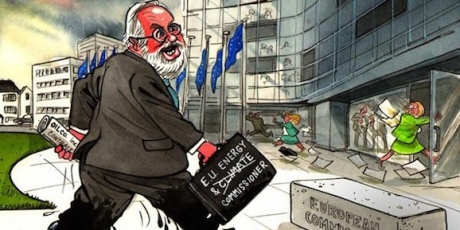
Alenka Bratušek, the Slovenian nominee to be the next European Commission vice-president for energy union, will be rejected in a vote tomorrow by the European Parliament’s environment and energy committees.  Both Bratušek and Miguel Arias Cañete, the Spanish nominee to be European commissioner for climate and energy, will be put up for a vote at the same time. Cañete has been blocked because of concerns over his ties to the oil industry. The centre-left S&D group will drop its objection to Cañete in exchange for the centre-right EPP group going along with the vote to reject Bratušek.

Once Cañete is safe, the EPP will vote to approve Pierre Moscovici, the centre-left French nominee who has been blocked because of concerns over his commitment to austerity, according to the plan.

UK nominee Jonathan Hill, who had been held over concerns about his lack of knowledge of European Union policy, will be waved through tomorrow following a second round of questioning today. Véra Jourová, the Czech nominee who saw confirmation withheld last week over her vague answers, was waved through today.

Who will replace Bratušek? That is the million-dollar question. There are three possible scenarios:

1) Bratušek is replaced by Tanja Fajon, a centre-left MEP. Fajon does not have enough experience to be a vice-president, so she becomes commissioner for transport. Maroš Šefčovič, the commissioner from Slovakia who was given the transport portfolio, becomes vice-president for energy union.

2) Bratušek is replaced by Tanja Fajon. Fajon is given the education, culture, youth and citizenship portfolio from Hungarian nominee Tibor Navracsics (the culture committee voted yesterday that Navracsics cannot have citizenship in his portfolio because of Hungary’s human rights abuses). Navracsics gets transport, and Šefčovič gets energy union.

3) Bratušek is replaced by Janez Potočnik, the current Slovenian commissioner (for the environment). Potočnik keeps the vice-president for energy union position for Slovenia. Navracsics has only citizenship take out of his portfolio, given to Dimitris Avramopoulos the Greek commissioner for migration and home affairs.  In any event, new confirmation hearings will have to be held. According to Parliament sources, the aim is to keep the final confirmation vote on 22 October in Strasbourg and quickly hold the two new hearings next week.
Canete

Credit Crunch in Russia After Sanctions

Russia companies face a looming credit crunch unless sanctions imposed by the west are relaxed and access to international capital markets is regained, according to Moody’s, the rating agency.

Debt issuaance by Russian companies in July when EU and US tightened sanctions.  Analysts said crunch would hit metals and mining, real estate and construction sectors could suffer most.

High quality global journalism requires investment. Please share this article with others using the link below, do not cut & paste the article. See our Ts&Cs and Copyright Policy for more detail. Email ftsales.support@ft.com to buy additional rights. http://www.ft.com/cms/s/0/70a578b4-4d70-11e4-9683-00144feab7de.html#ixzz3FTF3JfMb

Central bank statistics show that of $220bn in loans disbursed to non-banking corporates and households in Russia last year, almost $93bn came from jurisdictions that are home to large numbers of Russian offshore holdings but are not typical sources for large amounts of bank lending, including Cyprus, Ireland, Luxembourg and the British Virgin Islands.

Credit Crunch


Is Germany Running Out of Steam?

In August, German industrial outputplunged at its steepest rate since the height of the financial crisis.  Industrial orders are also declining.  What does this mean for Germany?

The year started strong in Germany but contraction has been steeady.  Domestic demand is not growing.

German Chancellor Angela Merkel’s government says it has little wiggle room for stimulus given its promise to balance the federal budget next year, and has attempted to move the focus to private investment. But the IMF said Berlin needed to do more.

Should Germany boost public spending and can it?

German Economy

Little Guys Strike Back in Subprime Mortgage Case

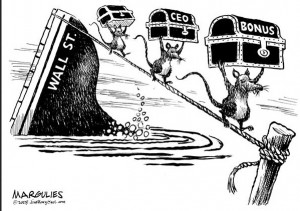
As Michael Hiltzik wrote in the Los Angeles Times, “Given the government’s failure to bring criminal cases against bankers and other Wall Street figures for collapsing the US economy in 2008, it’s been left to the little guy to strike back.” And the “little guy” did just that, in a case in Sacramento, where a federal jury acquitted four mortgage holders charged with fraud after hearing testimony that bank executives had pulled out all the stops to seduce them into taking out those toxic loans.

William K. Black, a key witness, says: This is the first time that a jury has ever got to hear what actually caused the crisis. And the jury was horrified. Because it was the lenders who deliberately made massive amounts of fraudulent loans and then sold these massive amounts of fraudulent loans through additional frauds to the secondary market and eventually brought down the global financial system.

And the testimony that came out in the case is that the agents, the FBI agents and the IRS agents simply assumed that the banks were the victims and the bankers were the victims and simply assumed that the little people, the mice, were the problem in all of this. So they never even investigated the banks and the bankers.

EMC, the mortgage arm of Bear Sterns issued mortgages to people who had no income and no assets.  Only West Virginia stopped them when they wanted to issue credit cards to these people.  Is the playing field level when a highly trained employee of EMC offers a mortgage to someone who wants a house and never has been able (and still is not able) to buy one?

The question everyone asks is why has no one paid the price for this fraud?

Too Big to Jail?

Korea Ranks One in Internet Speed

What this mean outside high speed trading and market advantage is hard to determine.

Korea’s internet users surfed at an average speed of 24.6 Mbps in the second quarter.

Korea is trailed by Hong Kong, Switzerland and Japan who each saw average speeds around 15 Mbps. The United States ranked 14th with an average connection speed of 11.4 Mbps, which is still way above the global average of 4.6 Mbps. To add a little perspective on what these speeds mean: At 10 Mbps it takes around 50 minutes to download a 2-hour movie in HD quality.

Fastest Internet Speeds

Ada Lovelace, the Woman Who Wrote the First Computer Algorithm

Walter Isaacson’s new book not only includes “the women that tech forgot”, but it also starts and ends with the story of Ada Lovelace who wrote the first computer algorithm and, according to Isaacson, “defined the digital age.” Her story, like that of so many other women, has been ignored in too many histories of the technology industry. Kudos to Walter Isaacson and his daughter, who raised Lovelace’s story to his attention.


Ada Lovelace

Gold Prices Head South

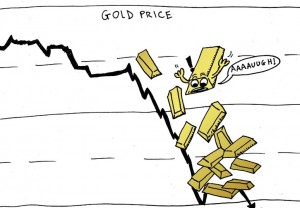
Barry Ritholtz writes:  Why the precious metals and many of the mining companies are struggling isn’t a great mystery. The U.S. dollar is at multiyear highs and gold prices tend to move inversely to the currency. Further, the economy continues to improve, which is rarely a positive for the catastrophe metal. The financial crisis is fading from memory, and now is six years in the rear-view mirror. Why the soft yellow metal continues to trade softly is obvious; less so are the many reasons why some investors remain overweighted in this underperforming asset class.

The idea that the world is ending and the accompanying demand for guns, canned food, bottled water and gold, is having difficulty attracting new adherents in an era of falling unemployment and rising wages. Indeed, many of those who hold those views are having a hard time reconciling their misplaced faith with reality. Regardless of your thoughts on the Wall Street bailouts and the Federal Reserve’s balance sheet — and I have been a loud critic of the former and an informed observer of the latter — the general backdrop has been one of improvement.

Gold Price

Russian App FireChat Powering Hong Kong Protests

Leonid Bershidsky notes that Firechat was devleoped by Stanislav Shalunov.  His quest to find ways to use bandwidth more efficiently and may be  just the beginning of a technological path that could change the way we understand connectivity.

Bershnidsky writes:  The Russian’s work had exciting implications for BitTorrent, the peer-to-peer file-sharing service that was facing problems with broadband operators for using too much bandwidth. BitTorrent acquired a small company that Shalunov had founded, and by 2011 it was using his flexible protocol for 95 percent of its traffic. Apple, too, adopted it to send updates to users of its software. The torrent app and the system updates could now run in the background without slowing the user’s usual Internet activity. “A typical connection on the Internet may only be utilized perhaps 50 percent,” Shalunov explained to Fast Company magazine last year. “This basically gives you a free factor of two for how much traffic you can carry on those same connections.”

FireChat Powering Hong Kong Dissidents?


Exorbitant Pharma Costs in US

Economist Robert Reich writes:  Drug companies pay the makers of generic drugs to delay their cheaper versions. These so-called “pay-for-delay” agreements generate big profits for both the proprietary manufacturers and the generics. Taxpayers pay.  The tactic costs us an estimated $3.5 billion a year.

Europe doesn’t allow these sorts of payoffs, but they’re legal in the United States because the major drug makers and generics have fought off any legislative attempts to stop them.

Pharma Costs in the US

Pharma Costs