Putin Faces the Russian Economy?

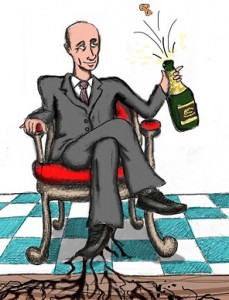
Putin spent his birthday alone in the SIberian forests.

Though the crisis with Ukraine has been reduced to a simmer, Russia has seen a strategic reversal in its critical borderland. In addition, the crisis moved the West to enact sanctions on Russia and loosen many financial and economic ties to the country. Now the Kremlin is in the midst of an economic crisis that is every bit as serious as the Ukraine situation. In the past two days, Russia’s central bank used $1.6 billion of its currency reserves to shore up the Russian ruble. Since the start of 2014, the central bank has injected $51 billion in currency reserves to keep the currency stable. The Russian economy is projecting flat growth for 2014, while foreign investment into Russia has fallen by 50 percent. The Kremlin may have $630 billion in its reserves, but these funds are being used quickly in an attempt to fill the cracks.

Concerns over Russia’s financial stability have erupted into public battles between the various Kremlin factions. On Tuesday, Russian Finance Minister Anton Siluanov, a key figure in the liberal economic clans, publicly called on Putin to cut Russia’s ambitious defense spending program.

While Siluanov’s argument against defense spending is financial, Putin also has to consider the security and political ramifications of such a decision. Russia’s continued struggles in its borderlands will require a robust military. Moreover, Putin is using the defense budget to appease Russia’s various security and defense circles.

Though Putin has ruled Russia for 15 years in a centralized and autocratic fashion, like any other leader he must balance various factions within the country. His ability to manipulate the various political clans is what brought him to power. The lack of that ability is what caused the downfall of Boris Yeltsin in the 1990s, and many leaders before him. Yeltsin was unable to manage the competition between his own loyalists, the more liberal circles of economists and the security and defense circles. Yeltsin wildly shifted policies in order to retain a grip on power, such as his economic shock policies and the restructuring of the Federal Security Services. Such erratic moves contributed to the Russian economic crash, the breakdown of the security services and the erosion of Russia’s military as it fought a savage war in the North Caucasus.

Putin’s grasp on power is not easy to gauge from outside the Kremlin. The decision for new leadership is made within the Kremlin walls, not among the people. Previous Russian leaders, from Nikita Khrushchev to Leonid Brezhnev to Yeltsin, were removed or pushed aside by the ones closest to them. Thus, it seems fitting that the current Russian leader chose to celebrate his birthday far from the Kremlin and its clans.
Putin's Birthday

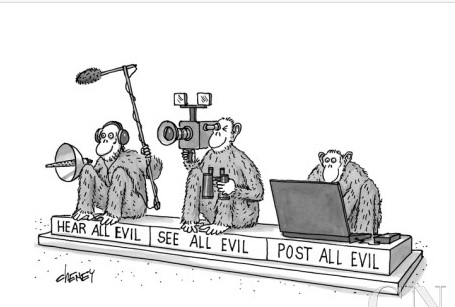
Beware Social Media: You Could Get Canned


Schmupeter writes:  Thanks to the digital revolution, chief executives now live in glass houses. An ill-judged remark can be broadcast to the world in an instant. An unwise “reply all” can provide sensitive information to a competitor. An exasperated complaint in the midst of a crisis can seal your doom. Tony Hayward, who was boss of BP during the oil spill in the Gulf of Mexico, never recovered from his plea that “I want my life back”.The digital revolution has dramatically shifted the balance of power from companies to their critics. Although big firms deploy armies of PR flacks, anyone with a smartphone and a socialmedia account now has the same power to reach a global audience. Whistleblowers once had to photocopy documents and smuggle them out in their underpants. Now they can be shared with the world in a trice, by e-mail or instant messaging.

By contrast, companies have failed to adapt. The biggest of businesses with the slickest of publicity operations, from McDonald’s to JPMorgan Chase, British Gas to Qantas, have found that when they tried engaging with tweeters on their home turf, they were drowned in a sea of sarcasm. British Gas’s attempt at an online discussion about its price rises was met with a barrage of tweets mentioning “death” and “greed”. Presumably they will get better eventually. But in “Glass Jaw: A Manifesto for Defending Fragile Reputations in an Age of Instant Scandal”, Eric Dezenhall, an American crisis-management consultant, points to two big reasons why companies are condemned to play catch-up.

The first is the nature of the internet. It is a beast that feeds on scandal and particularly delights in the flesh of the powerful and privileged.

The second is the nature of companies. They are designed to stay in business rather than to be good at defending their bosses from scandal. No matter what PR resources they throw at killing a story, NGOs and prosecutors will always have more stamina. In America no sensible firm will risk gambling on a jury trial when a negative verdict could bar them from doing business with the government.

The best defence in this age of instant global scandal may be  to be brilliant at your job. A couple of years after the crisis that almost destroyed his career, Tiger Woods was chosen for a Nike advertising campaign with the slogan, “Winning takes care of everything”. Unfortunately, for CEOs it may not: if you are an ace golfer mired in personal scandal you can redeem yourself on the greens. But a boss brought down by a baying social-media mob does not always get a second chance.

Social Media

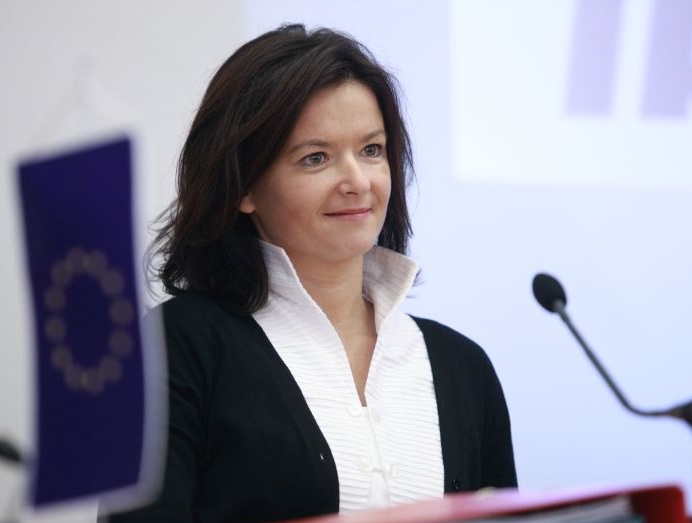
Tanya Fajon to Represent Slovenia in EP

Fajon’s chances will be bolstered because she is a woman. The biggest political parties in the European Parliament have repeatedly warned they will vote down Juncker’s team if it has less than nine women. Without Bratušek, there are only eight.

After Juncker confirmed Bratušek had quit, the two biggest political parties in the parliament, the S&D and the majority European’s People’s Party (EPP), came out to support Fajon.

The Chairman of the EPP Group in the European Parliament, Manfred Weber, also said in a statement that Fajon was already one of the candidates presented by the Slovenian government last summer. She perfectly fits the bill to become Slovenia’s Commissioner, he said.

Party of the European Socialists President Sergei Stanishev said that Fajon has experience, skills and the energy to be the right candidate. “Tanja has my support and that of the PES Presidency,” he said.  Fajon, a former journalist, was elected for the first time to the European Parliament in 2009. She sits in the Civil Liberties, Justice and Home Affairs Committee.

Tanya Fajon

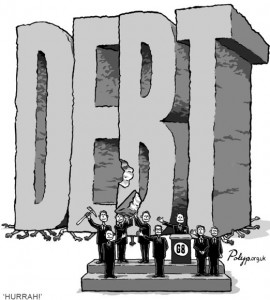
Public and Private Debt Considered

Frances Coppola writes:  The debt is still growing, but the world’s GDP growth is slowing. Indeed as aggregate debt figures are usually quoted versus GDP, the two are connected. The debt pile grows faster as growth slows, simply because the denominator is falling.

The report looks at total debt/GDP – not just sovereign debt. This is refreshing: unrelenting media focus on sovereign debt as the principal problem misses the fact that in many countries the bigger burden is PRIVATE debt. However, it makes the figures even worse. Global debt, it seems, is a terrible problem.

None of this will come as a surprise to anyone, except perhaps the news that the world as a whole is actually accumulating debt rather than deleveraging. The deleveraging efforts by developed countries are being more than offset by the increasing debt of emerging markets, particularly China.

Who are the owners of all this debt?  Debt

Debt

IMF Sees Uneven Global Recovery

Despite setbacks, an uneven global recovery continues. Largely due to weaker-than-expected global activity in the first half of 2014, the growth forecast for the world economy has been revised downward to 3.3 percent for this year, 0.4 percentage point lower than in the April 2014 World Economic Outlook (WEO). The global growth projection for 2015 was lowered to 3.8 percen

Despite setbacks, an uneven global recovery continues. Largely due to weaker-than-expected global activity in the first half of 2014, the growth forecast for the world economy has been revised downward to 3.3 percent for this year, 0.4 percentage point lower than in the April 2014 World Economic Outlook (WEO). The global growth projection for 2015 was lowered to 3.8 percent.

Downside risks have increased since the spring. Shortterm risks include a worsening of geopolitical tensions and a reversal of recent risk spread and volatility compression in financial markets. Medium-term risks include stagnation and low potential growth in advanced economies and a decline in potential growth in emerging markets.

Given these increased risks, raising actual and potential growth must remain a priority. In advanced economies, this will require continued support from monetary policy and fiscal adjustment attuned in pace and composition to supporting both the recovery and longterm growth. In a number of economies, an increase in public infrastructure investment can also provide support to demand in the short term and help boost potential output in the medium term. In emerging markets, the scope for macroeconomic policies to support growth if needed varies across ountries and regions, but space is limited in countries with external vulnerabilities. And in advanced economies as well as emerging market and developing economies, there is a general, urgent need for structural reforms to strengthen growth potential or make growth more sustainable.

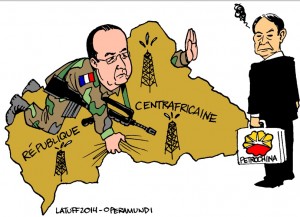
China’s Midde Man in Africa

Tom Burgis writes:  On his way home from Nelson Mandela’s memorial service in December, Ernest Bai Koroma, the president of Sierra Leone, stopped off in Angola to discuss an investment in his war-scarred nation. Fellow guests in the dining room of a golden skyscraper in the centre of Luanda, one of the towering edifices that an oil boom has raised above the slums of Angola’s capital, observed Koroma in rapt conversation with the Chinese man seated to his right.
The short 56-year-old had a receding hairline and a neat goatee beard. He wore a black suit, a red tie and rectangular spectacles. He goes by at least seven names and keeps a lower profile than the Chinese dignitaries who have visited African capitals to trumpet Beijing’s burgeoning alliance with a continent whose oil and minerals have helped feed China’s phenomenal economic growth. Most commonly, he is known as Sam Pa.  China’s Middleman in Africa

China in Africa


Left Wing Parties Join with Business to Solve Problems

Can the left parties in Italy and france succssfully embrace business?  In an effort to imprvee eocnomic conditions, both countries are trying to do this.

Beginning in the 1990s with the notion that governmnets are more the problem than the solution we have seen parties and polliticiians of all stripes trying different allliances to make economies strong and stable.  This is particularly true in France and Italy today.

Business and government join to takle problems


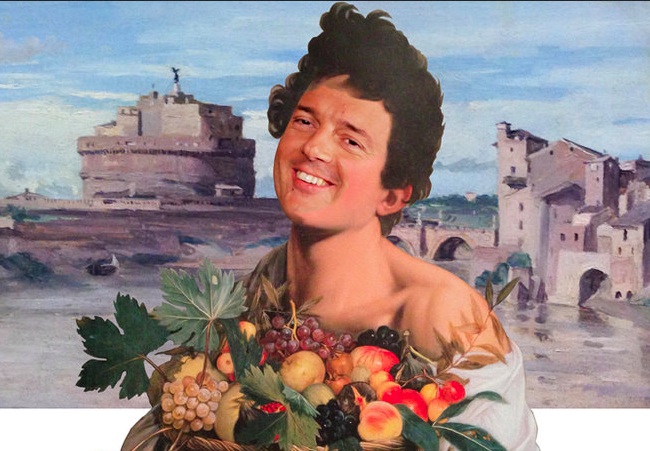
Italian Prime Miister Renzi Faces Confidence Vote over Labor Reforms

Italian Primte Minister Renzi faces a confience vote over labor reforms.

Renzi called the vote in order to cut short debate over his broad proposal to change labor laws that many economists say have stifled job creation and scared off foreign investors in a country whose economy has stagnated for the past two decades.

“We want to eliminate the poison that kills investment,” Labor Minister Giuliano Poletti said in a speech to the Senate.

The government’s proposals are still very broad-brushed, however, and it remains to be seen how far Renzi’s proposed reform will go.

In particular, it is unclear how the government plans to change a measure that currently makes it very difficult for companies with more than 15 employees to fire workers with open-ended contracts. Also, based on official comments thus far, none of the changes are expected to apply to Italy’s bloated public sector.

Renzi

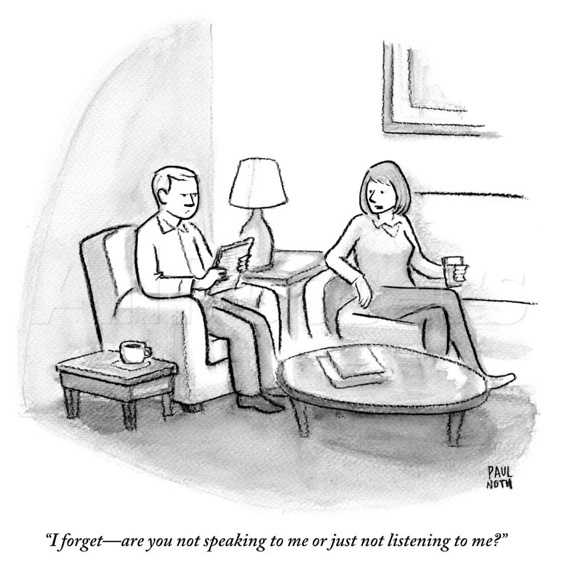
Why Don’t Men Listen to Women?

Amanda Bennett writes:  What happens when a man’s casually assumptive, visceral reflex that nothing said by the woman sitting next to him could possibly be as interesting as anything said by the man sitting across the table extends — as it still does — to the absence of women’s voices in decision-making?

What do we lose?

Well, at the very least, I think the guys seated next to me lost a chance to have a more interesting evening. I’m not famous. I’m not important. But I do have ideas about things, and I am cheerfully willing to banter. And just imagine what was lost to the guys who years ago droned on to a certain woman who later novelized the experience of being “seated forever, trapped between two immensely powerful men who think it’s your function as their dinner partner to draw them out. You ask them about the SALT talks. You ask them about the firearms lobby. You ask them about their constituencies. You ask them about the next election.” Uh, that was Nora Ephron, guys. “Sleepless in Seattle” Nora Ephron. “When Harry Met Sally” Nora Ephron.

The SALT talks? Really?

What if NFL Commissioner Roger Goodell had thought well enough of the voices of women when it counted? Would a woman have said: Hey, hold on a minute. Let’s think about the 45 percent of our fans who are women and might be able to picture how they would feel if they were cold-cocked in an elevator?

Well, he’s hearing those opinions now. And he’s hearing them because women are telling them. Only he’s having to hear it on places like ESPN, from women such as Hannah Storm, who spoke recently of the effect of the Ray Rice video on her three daughters: “I spent this week answering seemingly impossible questions about the league’s biggest stars,” she said last month. “Mom, why did he do that? Why isn’t he in jail? Why didn’t he get fired?”

There’s nothing new about the fact that a woman like Storm is a sports anchor with a powerful platform. There’s nothing new about the fact that women take issue with the decisions of men in power. What is new is that many more women like Storm are becoming increasingly confident and, yes, feeling entitled to say: You didn’t ask for my opinion, but I have one. And it’s worth something. Would it save some anguish if we skipped some steps and moved them a bit further up the decision-making chain?

In any case, I’m grateful to Storm for showing me something. At the end of another D.C. event, I turned to my table-mate in mild exasperation and said, “We’ve been at dinner for two hours, and I know everything about you. I know where you went to school, how you got into business. I know your views on the nonferrous metals industry (not his real business) that is your passion. But you don’t know one single thing about me. Why not?”

His matter-of-fact answer: “I talked. You listened.” He didn’t deny he wasn’t listening. But neither was I speaking. I had a voice. I just wasn’t using it.

Do Men Listen to Women?

Egyptians Optimistic About Future?

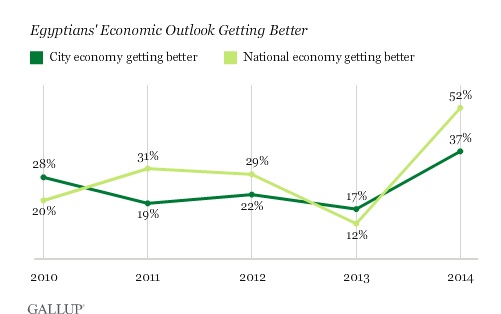
Mohamed Younis writes:  After a tumultuous year of political turmoil, violence, and at times international isolation, Egyptians seem to be turning a corner. The percentage of Egyptians who rate their lives poorly enough to be considered “suffering” has been cut in half, dropping to 16% this June, one year after hitting a record high of 34%. At the same time, the percentage who rate their lives highly enough to be considered “thriving” has nearly doubled over the same time period, rising from 9% to 17%.

Egypt 2