Dollar Gains on Yen

  • US dollar has gained 7% against yen since August
  • Japan PM Abe uneasy with sudden yen weakness
  • Incremental rise in Japan’s sales tax possible

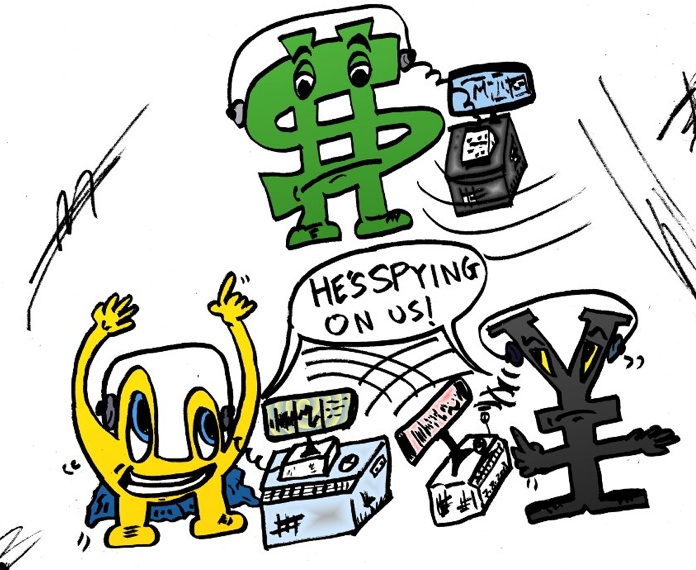
​On September 19th USD/JPY reached highs of 109.46 not seen since early 2008, after one of the busiest weeks in currency markets all year. The greenback has gained almost 7% against JPY since August, a move that can be pinpointed to have begun on August 28th when the gross domestic product figure for the US came in at 4.2% in the second quarter, compared to the -2.1% that had been printed in the previous quarter.

Dollar Gains on Yen

Swiss Lead World in Financial Assets

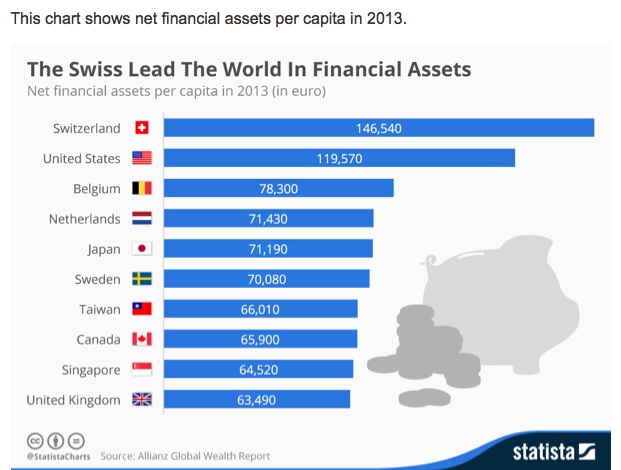
Global financial assets now stand at a record €118 trillion. Swiss households hold the greatest slice of this wealth, with net financial assets per capita of €146,540 when real estate assets are excluded. The United States and Belgium are in second and third place with net per capita financial assets of €119,570 and €78,300 respectively.

Assets

Women CEOs’ Salaries Lag Behind Men’s in Non Profit Orgs

New Guidestar report suggests that women CEOs of non-profits are paid less than men.  The report found that for the 14th year in a row, median compensation for female CEOs lagged behind that of respective male CEOs by up to 23 percent depending on the organization size. It also found that only 17 percent of organizations with budgets larger than $50 million had a female CEO, compared to smaller organizations with less than a million dollar budget, the majority of which have women CEOs.The report found that for the 14th year in a row, median compensation for female CEOs lagged behind that of respective male CEOs by up to 23 percent depending on the organization size. It also found that only 17 percent of organizations with budgets larger than $50 million had a female CEO, compared to smaller organizations with less than a million dollar budget, the majority of which have women CEOs.  Non Profit Salaries

Salary Issues Remain

Argentina’s Bonds

Joseph E. Stiglitz and Martin Guzman write:   In the midst of the ongoing dispute between Argentina and the “vulture funds” that hold its bonds, a broad consensus has emerged concerning the need for sovereign-debt restructuring mechanisms (SDRMs). Otherwise, US Federal Judge Thomas P. Griesa’s ruling that Argentina must pay the vultures in full (after 93% of other bondholders agreed to a restructuring) will give free rein to opportunistic behaviors that sabotage future restructurings.   Argentina’s Bonds

Argentina's Bonds

Harvard’s Launch Lab Launched

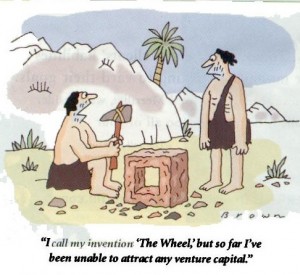
Just three years after Harvard University opened its Innovation Lab,  a space for students to develop startup ideas, there’s a new annex for alumni businesses located right across the street. The Launch Lab is intended to support not only recent grads who may be growing companies they started when they were students, but also alumni several years out who are working on new ventures. Both the Launch Lab and the Innovation Lab are in the former WGBH television complex on Western Avenue in Allston. I stopped by earlier this month to have a look…

Jodi Goldstein calls the 3000-square foot facility a “prototype for the future,” and says the goal is to “prove to the university that there’s demand for an entrepreneurial ecosystem here in Allston.” (The current sign at the entrance to Launch Lab, right, is also a prototype. The permanent one hasn’t yet arrived.) To be eligible for admission into the Launch Lab, only one person on a startup’s team has to be a Harvard alumnus. Right now, the price is $200 per desk, per month. That’s less than other local “coworking” spaces like CIC or Workbar, which charge about $350 per month. “We had some generous donors who are helping to subsidize this,” Goldstein says, adding that about half the operating costs of the Launch Lab are expected to come from rent, and half from donors. Harvard brought on a former Workbar staffer Alison Baldygar to help run the Launch Lab.

Goldstein says that before Harvard even began broadly publicizing the plans for Launch Lab, “we got about 50 applications.” The space can fit about 15 startups, she estimates, or 55 people total. Tenants began moving in earlier in September.  The common thread is that these are first-time entrepreneurs looking for coworking space.” The Launch Lab’s first-floor digs are in a Harvard-owned commercial building that is right next door to the university’s future site for an expanded School of Engineering and Applied Sciences.

There are already 14 businesses working out of the space; the largest, with about 10 employees, is Censio.  The company plans to use a smartphone app to monitor your driving habits — with your permission — to enable insurance companies to offer you a lower rate if you exhibit save driving habits. (IE, no excessive speeding, slamming on the brakes, etc.) Former Zipcar chief executive is serving as the company’s interim chief executive, and the startup has already raised some early funding from General Catalyst and Bain Capital Ventures.

Venture Financing


Why Women Leave High Tech Jobs

Why do women leave good high tech jobs? It’s not the math.  Many women said that it wasn’t motherhood alone that did in their careers. Rather, it was the lack of flexible work arrangements, the unsupportive work environment, or a salary that was inadequate to pay for childcare. As Rebecca, a former motion graphics designer, put it, “Motherhood was just the amplifier. It made all the problems that I’d been putting up with forever actually intolerable.”    Why Women Leave High Tech

Women in High Tech

China’s Great Firewall Overcome

 Zach Toombs writes:  For China, online censorship is no longer just about cutting off a flood of information from international news outlets. Now, it’s about plugging a billion little leaks in the Great Firewall. And that’s proving an increasingly difficult task.

In managing the thousands of pro-democracy protesters in Hong Kong’s financial district, some of the censors’ tried and true tactics still work.  Several sudden drops in mobile connectivity in Hong Kong over the past few days, suggesting a police shutdown of mobile networks.

But the growing popularity of VPNs, WeChat, and other workarounds has long put a strain on the Great Firewall. And now a massive effort to push information about what’s happening in Hong Kong onto China’s mainland is making that more apparent, and more relevant, than ever.

Protesters have fallen back on apps like FireChat, which allows chatting with others nearby even without an Internet connection – perfect for the densely packed HK protests.

Monday’s shuttering of Instagram resolved an especially touchy issue for the Communist Party: the sharing of mass protest photos that could very well remind mainlanders of 1989. But the decision to kill the app, which was very popular in China, also might have backfired on Beijing. Interest in VPNs, providing safe passage over the Great Firewall, has spiked in the last week.

Those one or two million people who do know the story coming out of Hong Kong might not know the true story. While a total media blackout is a losing fight for Beijing in the smartphone age, the Communist Party has another tool at its disposal: spin.

Hong Kong and the mainland share little modern history. And loyal state-run outlets have tried especially hard this week to frame the protesting Hong Kongers as lacking patriotism as well. It’s a message that resonated with much of the mainland on the week of China’s National Day this past Wednesday.  Tthe Umbrella Revolution’s cause is not about economics directly. It’s about democracy. And while images and information from the protesters carry loud and clear to the West, for now they’re just poking holes in the Great Firewall and hoping their message is heard, unfiltered, on the other side.
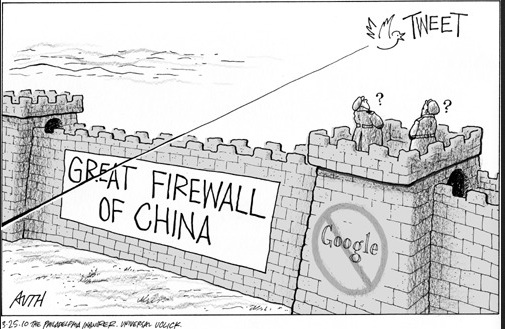

Twitter Beats the Firewall

Entrepreneurial Invention and Economies of Scale

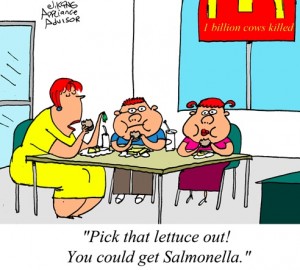
In-n-Out has to watch growth, becuase people prefer it to McDonald’s because the food is fresh.  You have to stay close to the food supply and forget freezing and shipping.

Megan McArdle writes:    We are the heirs of the Industrial Revolution, and, of course, the Industrial Revolution was all about economies of scale. Its efficiencies and advances were made possible by banding people together in larger and larger amalgamations, and we invented all sorts of institutions — from corporations to municipal governments — to do just that.

This process continues to this day. In its heyday, General Motors employed about 500,000 people; Wal-Mart employs more than twice that now. We continue to urbanize, depopulating the Great Plains and repopulating downtowns. Our most successful industry — the technology company — is driven by unprecedented economies of scale that allow a handful of programmers to make squintillions selling some software applications to half the world’s population.

In-n-Outt doesn’t think it can deliver the same level of quality as a far-flung mass-market operation. Not to mention the effect of expanding beyond easy trucking range of top-notch California produce. McDonald’s solved this problem by relying on frozen products machine-prepared to exact written specifications. Which is why so many people prefer In-N-Out to McDonald’s.

Sometimes entrepreneurs can compete by delvering the same goods in a different way.  Fresh versus frozen in this case.
Fresh lettuce?

Security Breaches in Computer Systems of US Banks and Department Stores

Katie Benner writesL

Was Round 1 only a set-up? Photographer: Ron Antonelli/Bloomberg

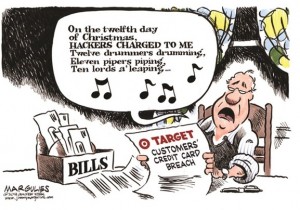
When hackers broke into JPMorgan Chase’s computer systems they nabbed name and contact information for 83 million households and small-business account.

But it seems like they didn’t take more sensitive data like account numbers, passwords and Social Security numbers, the stuff that someone can use to steal your money or your identity. The bank says that the breach hasn’t given way to an uptick in fraudulent activity.

This sounds like very good news — burglars entered, looked around, took some family photos and left the cash and jewelry behind.

Unfortunately that’s not quite how cyber breaches work. Talk to enough people in the security field and you’ll hear some version of this story: Once the attackers knew they had been discovered, they went into hibernation for months or a year and then they started moving around and doing damage. It’s more like the robbers hid when the cops arrived, only to emerge months later when you thought they were all gone.

Is the US ready for a series of re-breaches of seurity next year?

Security Breaches

Food Prices Rise in Russia after Counter-Sanctions

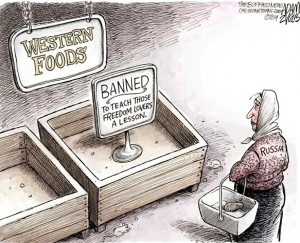
Sanctions are taking their toll on Russia.  When Russia announced counter-sanctions against the European Union, USA, Canada and Australia banning imports of food items from those countries, it was clear there would be imminent consequences. But just how those are playing out isn’t as some had expected.

Gennadi Kaakevitch writes: Russia imports 39% of food.  The immediate result of restrictions on imports should be a considerable increase in prices. It is incorrect to suggest, like various commentators in Russia do, that price increases should only affect luxury imported foods, such as exclusive sorts of French cheese and Spanish ham. They have argued locally produced basic items, such as meat and milk, would not be affected and, therefore, ordinary people consuming ordinary food should not feel the impact.

On the contrary, shoppers facing increases in prices for imported products inevitably switch to domestically supplied alternatives. This results in the price of domestic alternatives being pushed up.  Ordinary people in Russia think that banning imports will help local farmers and the food industry to develop domestic production and keep prices down. But to what extent is the substitution of imports with increasing local produce possible?

Is it possible for Russia to replace imports from the countries subjected to counter-sanctions with products from other countries? Meat can be sourced from Brazil and Argentina, but South American exporters have already increased their prices for Russia, blaming sanctions.

Prices for food items jumped by 30-40% in August alone.

Food in Russia