US Educated Mubarak Rashad Khamis to head Central Bank of UAE

The UAE said on Monday that Mubarak Rashid Khamis Al Mansouri has been appointed as the new governor of the country’s central bank, replacing Sultan Nasser Al Suweidi.

The move was announced as part of a federal decree issued by UAE President Sheikh Khalifa bin Zayed Al Nahyan to restructure the board of directors of the Central Bank of the UAE. Mansouri is the chief executive of Emirates Investment Authority, a federal investment fund.

According to the decree, Khalifa Mohammed Al Kindi will be chairman, Khalid Juma Al Majid, vice chairman, and Younis Haji Al Khoori, Khalid Ahmed Al Tayer, Khalid Mohammed Salem Balama and Hamad Mubarak Bu Amim will be board members. All will serve a four-year term, official news agency WAM reported.

Mansouri, who served as a central bank board member in the past, also sits on the board of the stock market regulator, the Securities and Commodities Authority, as well as telecom operator Etisalat, Abu Dhabi Securities Exchange and some other Abu Dhabi entities.
Mr. Mubarak Rashed Khamis Al Mansouri has been the Chief Executive Officer of Emirates Investment Authority since May 2008. Mr. Al Mansouri has been Governor of Central Bank of United Arab Emirates since September 23, 2014. He served as General Manager of The Abu Dhabi Retirement Pensions & Benefits Fund. He serves as Director at Arab International Bank, Abu Dhabi National Co., Securities & Commodities Authority of UAE (SCA), Etisalat Misr in Egypt, Emirates Telecommunications Corporation and Etihad Etisalat Company. Mr. Al Mansouri has been Director at Abu Dhabi Securities Exchange since May 2010. He has been a Director of Central Bank of United Arab Emirates since September 23, 2014. He served as Director at Abu Dhabi Holding and National Central Cooling Company PJSC. In 1994, he worked on establishing the âEURË UAESwitchâ which started operations in 1996 and was able to connect all bank ATMs in the UAE. He has Master’s degree in Finance from University of West Florida, USA.


UAE Central Bank

Barclays Fined for Failing to Safeguard Customer Assets

 British bank Barclays was fined 38 million pounds ($62 million) on Tuesday for exposing customers to unnecessary risks by failing to ensure client assets were properly safeguarded and adequate records kept.

Imposing its highest fine for client asset breaches, Britain’s financial regulator said there were “significant weaknesses” in Barclays’ systems and controls between November 2007 and January 2012 that put 16.5 billion pounds of client’s assets at risk.

The Financial Conduct Authority (FCA), which has tightened rules governing client asset protection since the collapse of Wall Street bank Lehman Brothers in 2008, said that customers risked incurring extra costs, lengthy delays or losing their assets if the bank had become insolvent.

“Barclays failed to apply the lessons from our previous enforcement actions, numerous industry-wide warnings and exposed its clients to unnecessary risk,” said Tracey McDermott, the head of enforcement and financial crime at the FCA.

Protecting Assets

Women on Boards and Stock Prices Rise

A recent Credit Suisse report shows that women on board add value.

Companies that have female directors out perform those that only have men.

Companies with a market cap greater than US$ 10 billion that have at least one woman on the board of directors outperformed those that had no women at all by 26% for large caps over the six years leading up to 2011.  “Importantly, this mix of companies would also have outperformed global equities as measured by MSCI’s ACWI,” write Credit Suisse analysts Julia Dawson, Richard Kersley and Stefano Natella.

This is a global phenomenon.

From 2012 to June 2014, companies with at least one woman on the board have seen a 5% outperformance on a sector neutral basis.

That amounts to a compound excess return since 2005 of 3.3%.

global_edited 1Credit Suisse

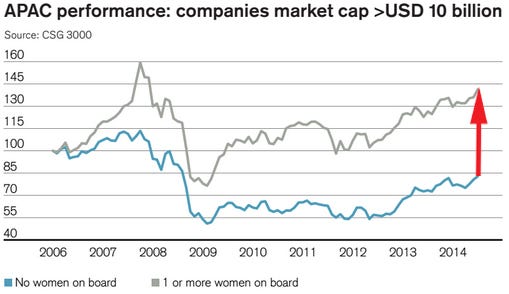
Countries in the Asia-Pacific saw the greatest outperformance with a 55% excess cumulative return. That’s a huge number.

APACCredit Suisse

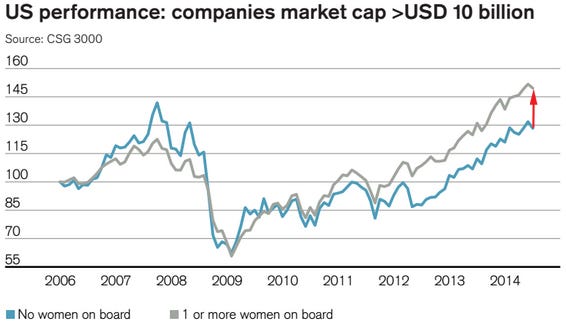
They were followed by the US, which saw 20% outperformance, also a significant amount.

Screen Shot 2014 09 24 at 5.11.07 PMCredit Suisse

And third in Europe, which had 18% outperformance.

Screen Shot 2014 09 24 at 5.11.07 PM

The Glitter of Gold Gone?

Mohamed A. Ell-Erian writes:  Gold has let down its loyal investors during the past year, declining by about 8 percent. It has failed to benefit, as one might expect, from a series of geopolitical crises and concerns that stocks are overvalued. It has even failed to keep up with government bonds, usually the other recipient of flight-to-quality trades. Moreover, it has responded weakly to the excitement in India — its biggest physical retail market –– over the prospects for economic reforms under newly elected Prime Minister Narendra Modi.

Here are three major reasons for gold’s disappointing performance.

First, it usually does badly when the dollar appreciates. The greenback has gained during the past year as foreign-exchange traders have started to take account of less accommodating U.S. monetary policy, including the widening contrast with Europe and Japan.

Second, gold has been hurt by a general slump in commodity markets as global economic growth has fallen short of expectations in both developed and developing nations.

Third, it has found few investors willing to buy on the dip, either directly or through commodity funds.

None of this is likely to change anytime soon absent a bigger conflict in Ukraine or the Middle East.  As such, gold is likely to continue to disappoint its devotees. Yet investors shouldn’t forget that gold has its place and that a well-diversified portfolio should have gold holdings equal to 3 percent to 8 percent of total assets.

The biggest risk facing investors today is a large and sustained fall in assets whose prices have been artificially supported by central banks — particularly bonds and equities. This is especially the case should a decline in global growth be accompanied by greater geopolitical turmoil.

There are good reasons for gold to be unloved at this stage and thus having a position in gold toward the lower end of the allocation range is justifiable. But only brave investors would omit it from their investment portfolios given the fluid world we live in.

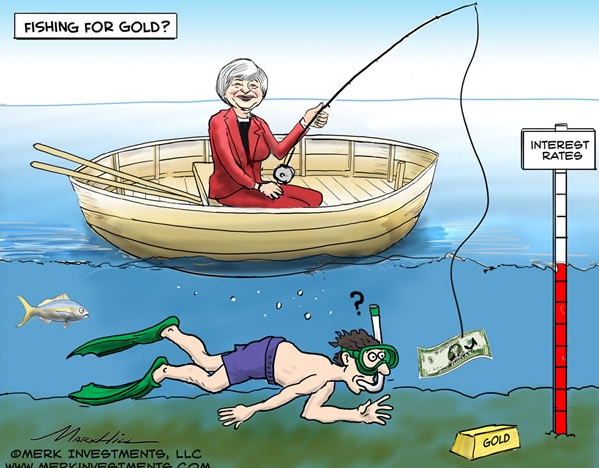
Gold?

UK to Make Market Manipulation a Criminal Offense

Bloomberg notes: Amid a spate of scandals over the rigging of financial benchmarks ranging from commodities to currencies to interest rates, the U.K. government is making a bold move toward restoring confidence: By the end of this year, it plans to make manipulation a criminal offense in all the affected markets.

The U.K.’s plan — aimed at maintaining London’s role as a major financial center — raises some questions. Can’t investors look out for themselves? Wouldn’t tweaking the way markets are designed, combined with the risk of damage to reputation, suffice to keep traders in line? No and no.

“Buyer beware” doesn’t apply. These markets aren’t casinos, where people can choose whether to play. Trade in money and commodities is central to the functioning of the global economy. The prices set in these markets affect what people pay for everything from gasoline to mortgages. If insiders manipulate them for personal gain, they do so at the expense of millions of ordinary consumers.

And reputation, by itself, isn’t enough of an incentive to keep traders honest. The profits from manipulation — and the bonuses they entail — can be huge, and traders and executives change jobs too often for the good name of an institution to carry much weight. Consider: Many of the world’s largest banks lied about their borrowing costs for years, in some cases with the knowledge of senior executives.

Regulators are rightly taking steps to make benchmarks less vulnerable to manipulation, in part by requiring them to be based on observable transactions (rather than relying on traders to tell the truth) and administered by independent parties (rather than by the same banks that set the prices). Good market design will help, but it’s no panacea.  Traders managed to rig currency benchmarks that already met regulators’ guidelines.

Stronger deterrents are needed. Fines alone fall short: The billions of dollars that banks have paid hit shareholders, whose control over corporate culture and behavior would be limited even if they chose to exert it. The threat of criminal penalties will be much more potent.

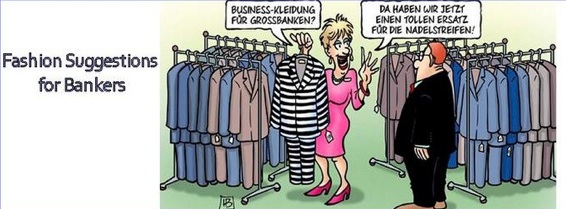
UK Clamping Down on Bankers

Sweden Veers Left

Everyone thought the Nordic countries were the model for helping countries move from the welfare state to modern economic realities.  Privitization and tax-cutting went too far for Swedes.  Sweden still has eniable gender equality and functional democracy, but here, as in much of the world, inequality looms large.  Stefan Lofven the new prime minister says there are bad cracks in the system.

Swedish youth unemployment is at 22 %.  Norway’s and Germany’s youth unemplooyment is at around 8%.  Unemployment drives fears about the number of immigrants entering the country, as it does in the US.

Sweden -- Looked After?

Standard & Poors Enters Inequality Debate in US

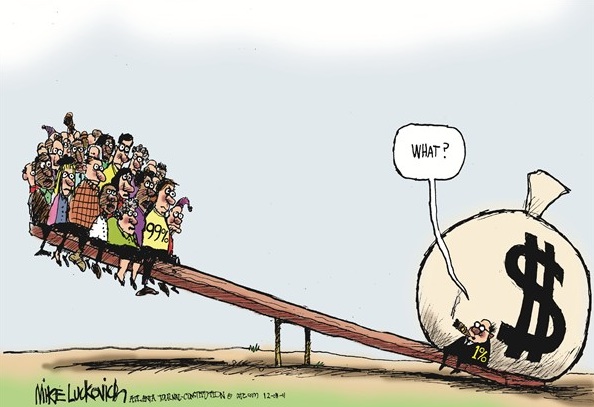
A Pew poll found that 56% of Americans said that their income was falling behind the cost of living.  At higher income levels, people said they were staying even and getting ahead, their incomes moving faster than inflation.

Standard & Poors reports that state income coffers have been effected by the decine in middle class wages.  In most states, tax revenue growth has not kept pace with the growth of the economy and S&P says inequaity is the cause.

Inequality in the US

Singapore Gives Up Online Sports Betting. New Jersey Takes it On

Singapore proposed a law that is ust short of outlawing online gambling. They were tired of betting and related crime syndicates that fix sports matches worldwide.

Governor Christie of New Jersey in the US made a surprise move, offering to Atlantic City”s ailing casinos.  In defiance of federal law, he decided to let casinos accept remote wages on most sports events.

Singapore is now doing its part, but New Jersey is going in the opposite direction.

Gambling on Sports

Schulz, head of EP, Demands Response from Juncker on Health and Environment Portfolios

Advocates unhappy with new structure on heath and environment.  Schulz has said about the environment:  We need to diversify our energy sources, and reduce the high energy dependency of several of our Member States.  We need to keep our European energy market open to our neighbours. Howeveri if theprice for energy from the East becomes too expensive.

in political terms, Europe should be able to switch very swiftly to other supply
channels.  We need to be able to reverse energy flows when necessary.
And we need to strengthen the share of renewable energies on our continent. This is
not only a matter of a responsible climate change policy. It is, at the same time, an
industrial policy imperative if we still want to have affordable energy at our disposal in
the medium term. I strongly believe in the potential of green growth.
I therefore want Europe’s Energy Union to become the world number one in renewable
energies I would also like to significantly enhance energy efficiency beyond the 2020
objective notably when it comes to buildings and I am in favour of an
ambitious, binding target to this end.  I want the European Union to lead the fight
against global warming ahead of the United Nations Paris meeting
in 2015 and beyond.
Direction of the EU


US Fed Failed to Regulate Banks

Michael Lewis writes: The US Fed failed to regulate the banks because it did not encourage its employees to ask questions, to speak their minds or to point out problems. These are detailed in 46 hours of tapes obtained by Jake Bernstein.


Just the opposite: The Fed encourages its employees to keep their heads down, to obey their managers and to appease the banks. That is, bank regulators failed to do their jobs properly not because they lacked the tools but because they were discouraged from using them.

The report quotes Fed employees saying things like, “until I know what my boss thinks I don’t want to tell you,” and “no one feels individually accountable for financial crisis mistakes because management is through consensus.” Beim was himself surprised that what he thought was going to be an investigation of financial failure was actually a story of cultural failure.

Financial Regulation Tapes