Russia’s Banking Sector Under Pressure

Ben Aris writes from Moscos:  Five of Russia’s six largest banks are now on the US sanctions list, which is hurting the whole sector and could eventually precipitate another financial crisis.

Russia’s largest lender, the savings bank Sberbank, was included in a new sanctions list for the first time in September. It joins its sister state-owned banks VTB, which concentrates on corporate financing; the retail specialist VTB24; Gazprom-owned Gazprombank; Bank Moskvy, which was acquired from the City of Moscow in 2011 by the VTB Group; and Russian Agriculture Bank (Rosselkhozbank), which finances the agricultural sector.

Sanctions are being imposed an already extremely sick sector and will only add to the deterioration. Cut off from international capital markets and an economic malaise at home depressing retail deposit growth, the sector is currently being supported by the Central Bank of Russia (CBR). Lending by the CBR is approaching levels last seen during the blackest days of the 2008-09 crisis. The government has already been forced to recapitalise two state-owned banks – VTB and Russian Agriculture Bank – and is pouring more money into the sector.

A recent report from Standard & Poor’s says that Russian banks have sufficient resources to weather the storm for now. “We believe that the credit quality of Russian banks will not suffer immediately from the restrictions on tapping EU and capital markets. Our analysis suggests the sector has enough liquidity to refinance its international debt falling due until the end of 2015,” the rating agency says in a September 18 report entitled, “Sanctions Will Increasingly Weigh On Russian Banks’ Funding And Liquidity Profiles.”

However, it adds that, “the longer restrictions on capital market access last, the larger funding imbalances will become, potentially calling into question the banks’ capacity to adequately finance the economy.”

While the list of sanctioned banks is short, they still represent more than half of all Russia’s banking assets. Luckily, following the 2008 crisis Russian banks became a lot more cautious in their borrowing and are not heavily exposed to international lenders. S&P estimate that banks total external obligations for the 2014-15 is $57bn, which they should be able to cover from their liquid reserves and maybe with some help from the CBR.

Impact of Sanctions

Flipkart Versus Amazon in India

Samidha Sharma writes:  The e-commerce war is playing out hot and heavy between Amazon and Flipkart ahead of the much-storied US e-tailer’s founder Jeff Bezos’ visit to Bangalore.

Sources told TOI that Flipkart is executing what it calls the ‘Welcome Mr Bezos’ campaign. The company has put up huge billboards at the airport, highways and close to Amazon’s headquarters – places where the communication is sure to hit Bezos’ eyes – for its festive season sale campaign called Big Billion Day. The communication will follow Bezos to Delhi where he is scheduled to go next, sources privy to the matter said.

Flipkart, which is fighting an all-out battle with Amazon, is looking to send out a message to its arch-rival that it’s the number one e-tailer in the country. Sources said Flipkart is also running a ‘Project Victory’ campaign within the organization, a celebration of what it calls a win in the first round of war with Amazon.

When asked about Flipkart’s response to Bezos’ visit, Sachin Bansal, co-founder of Flipkart said, “It’s a panic reaction to the fact that Amazon is not able to make any inroads in India. Our market share has increased in the last six months.”

Flipkart, founded by two ex-Amazon employees Sachin and Binny Bansal, is moving rapidly towards touching $2 billion in annual sales (known as gross merchandize value in e-commerce industry) while Amazon is moving close to the billion-dollar figure. Delhi-based Snapdeal, the other big player, is also at about $1 billion in annual sales.

For the Seattle-based $75-billion Amazon, India is an extremely crucial market, which was signalled by Bezos’ announcement of a $2 billion investment two months back. That statement came just a day after rival Flipkart raised $1 billion in a new financing round, valuing it at $7 billion.

Having started its marketplace in June last year, the online retail juggernaut has been doubling down on competitors with top dollars being put in to advertising, heavy discounting and bringing on new merchants and sellers on to its platform. It bought the sponsorship for the Indian Premier League cricket tournament and unleashed a price war, taking the challenge right up to Flipkart. Over the past few months, though, Flipkart went on an overdrive with exclusive tie-ups with mobile phone makers like Motorola and Xiaomi even as the Myntra acquisition gave it a leg up in the fast-growing apparel and fashion space.

The war between the two players has only just begun and Bezos’ visit will simply help fuel the e-commerce fire.

Amazon versus Flipkart in India

China to Cut Off Corrupt Officials from Escape Routes

A Chinese senior prosecutor has pledged efforts to chase fugitive corruption suspects as well as to “resolutely cut off the escape route of suspects.”

At a conference on an international manhunt of duty-related crime suspects on Saturday, Qiu Xueqiang, deputy procurator-general of the Supreme People’s Procuratorate (SPP), urged prosecutors to intensify their work to prevent relevant suspects from escaping.

Such efforts include proper risk evaluation of the targets’ fleeing and early warning against such situations, Qiu said.  Prosecutors should enhance the information sharing with other authorities and formulate detailed plans to prevent suspects’ absconding.  Qiu told the prosecutors to target on suspects both in China and abroad and they should take measures to chase the suspects at large and at the same time stop potential fugitives.

The SPP announced the launch of a half-year campaign targeting fugitive suspects of corruption and other duty-related crimes. On Saturday, Chinese police announced that it has seized 102 suspects in a separate campaign targeting corrupt officials and suspects in economic crimes that have fled abroad.

In a latest move, Chinese police escorted four suspects captured in Thailand to Beijing.  One of the four was suspected of loan fraud and has been at large for 10 years. The other three were suspected of contract frauds with one case involved money up to 67 million yuan (10.9 million U.S. dollars), the Ministry of Public Security (MPS) said in a statement.

It was also the fourth time Chinese police conducted arrests in Thailand amid the police’s recent manhunt campaign and to date a total of 16 suspects of major economic crimes in the country have been seized and brought back to China.

China launched the Fox Hunt 2014 operation in July to “block the last route of retreat” for corrupt officials and other economic criminals at a time when China’s major crackdown on graft has already narrowed the space for abuse of power.

Meng Qingfeng, director of the economic crime investigation bureau of the MPS said the international pursuit is an important step of China to crack down on graft and to promote the rule of law.  Meng said Chinese police will continue the efforts to deepen international cooperation of law enforcement and diligently practice its duty to fight crimes and protect the people.

Capturing Economic Criminals


US Small Business Administration Strengthening Supply Chains Across North America

U.S. Small Business Administration Administrator Maria Contreras-Sweet and Mexican Ambassador to the U.S. Eduardo Medina Mora will discuss strengthening supply chains across two continents in a webinar for entrepreneurs and smalll businesses on September 30.

Born in Guadalajara, Mexico, Contreras-Sweet was a successful entrepreneur and business executive before joining President Barack Obama’s cabinet in April 2014. In brief remarks, she will address the need for dynamic and competitive supply chains in North America, to be followed by a Davos-style conversation with Medina Mora.

Small- and medium-sized enterprises (SMEs) are the backbone of not only the U.S. economy, but also of the broader North American free-trade area. Canada and Mexico are the top two destinations for U.S. exports from SMEs, and small-business suppliers also feed inputs into larger companies and benefit with expanded exports of the final products. In the run-up to the next round of the U.S.-Mexico High-Level Economic Dialogue and the North American Leaders Summit, this on-the-record discussion will explore the importance of interlocking supply chains to the broader goal of North American competitiveness.

Speakers:

  • Maria Contreras-Sweet, Administrator, U.S. Small Business Administration
  • Eduardo Medina Mora, Ambassador of Mexico to the U.S.
  • Eric Farnsworth, Vice President, Americas Society/Council of the Americas (moderator)

To register: Please email us at as-coawashington@counciloftheamericas.org

Cross Border Supply Chains

7 Trillion in Cash Reserves of 5000 Companies Soon to be Invested

Ben Marlow and Ashley Armstrong note that the world’s corporate giants are poised to tap into record cash reserves.  Hopes are rising for a massive boost to the global economic recovery.

As the economic recovery gets under way and factories begin to operate at full capacity, investors are growing increasingly frustrated at more than half a decade of prudence, pushing chief executives to loosen the purse strings, experts believe.

“Capital spending could increase as early indicators show that industrial companies are beginning to run at higher levels of capacity than has been the case over the last five years,” Dennis Jose, senior global and European equity strategist at Barclays, said. “When factories and the like are running at less capacity on the back of lower demand there is very low capital expenditure.”

In the aftermath of the financial crisis companies hunkered down and re-engineered their balance sheets, diverting funds from investment to pay off debt or stockpile cash. However, even since the recession ended and the economy has picked up, many have continued to hoard cash leading to growing calls from investors to deploy cash reserves, which earns low returns sitting on balance sheets. Governments too are calling for a loosening of the purse strings to help propel the economic recovery, which is showing signs of stalling in many parts of Europe.   Will 7 Trillion in Cash Reserves Be Invested

Corporate Cash Reserves

China/India Relations

A. G.  Noorani writes:  Chinese President Xi Jinping’s visit to India, from Sept 17 to 19, was successful in some important respects but not so in others. On matters economic, success was predictable and achieved. Politically, the result was disappointing.

Uniquely, the Chinese president’s visit began from Ahmedabad, in the prime minister’s home state Gujarat. The talks, which began there, were continued in Delhi. Both sides agreed that the boundary question should be settled “at an early date”. Neither spelt out by which process.

A boundary agreement defines the border which is then demarcated actually on the ground. Xi’s stand was simple: there’s no need to freeze the existing status quo by demarcating the LAC. That will postpone the agreement on a proper boundary. Instead, both parties should negotiate a settlement “at an early date”.

Thereby hangs a tale. In September 1993 India and China concluded an agreement on “the resolution of differences between the two sides on the alignment of the Line of Actual Control”. Three years later, they signed another agreement “to speed up the process of clarification and confirmation of the Line of Actual Control.” As an “initial step”, the segments on which their perceptions differed would be taken up. Maps would be exchanged “indicating their respective perceptions of the LAC as soon as possible”.

The Sino-Indian boundary is divided into three sectors to facilitate clarity in discussion. The western sector (Ladakh), the middle sector (Uttar Pradesh) and the eastern sector (the McMahon Line). Very sensibly, they began by exchanging maps on the middle sector, where the area in dispute is small and so are the differences. By March 2002 this process was complete. Not quite sensibly they moved next to the western sector, instead of the eastern sector.

This led to the collapse of the entire exercise in June 2002.  This was due to ignorance and narrow nationalism. India’s map covered the segment to the west of the Karakoram Pass right up to the tri-junction of Pakistan, Afghanistan and China. The depiction was hopelessly wrong factually. The Sino-India LAC did not extend to that area.

China had repeatedly made plain that it would not discuss this part of the segment in the western sector — first, in the Nehru-Zhou En-lai talks in Delhi in April 1960 and next, in the talks between their respective officials at Beijing soon after.

China’s position did not change 42 years later. In between came the Pakistan-China Boundary Agreement of March 1963, based on a sensible understanding. It was based on Curzon’s letter to London in August 1905. The agreement resulted in Pakistan acquiring 1,942 square kilometres of administered territory. No territory was given to China. It will never agree to any agreement with India which challenges the 1963 agreement.

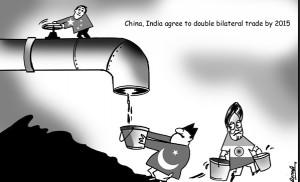
This step backward on the boundary dispute was, however, accompanied by several steps forward in the economic sphere. China is eager for engagement with India.

China:India Trade


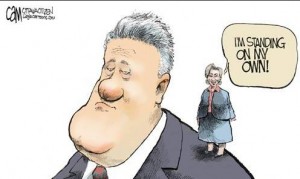
Hillary Clinton to Run as a Woman

In 2008 her policy advisor Mark Penn advised against it.  This time, she probably won’t have another ‘first’ to contend with in the primaries, so Clinton is going to brave it out.

Many women prefer to vote for the best candidate, and we don’t yet know who will be opposing her.  Biden.  Warren,  Webb.  Bernie Sanders has already announced.

On the east and west coasts of the US, Mrs. Clinton is very popular, but spend time in the flyovers and you can see quite the opposite reaction.  Oscar WIlde has said only the superficial ignore appearances, but the scratchy, chalk on the blackboard voice of Mrs. Clinton’s has not been overcome yet.

Hillary Clinton for Women


Cutting Off Criminal Funds to ISIS

Jamie Dettmer writes:  Turkey needs to stem money laundering and to stop traders in Turkey buying smuggled oil from the Islamic State.

For years, Ankara has fallen foul of international money-laundering agreements, and despite passing a law last year aimed at preventing the financing of terrorism, Turkey remains on a global list of uncooperative countries. It languishes on what is known as the gray list overseen by the Financial Action Task Force, an inter-governmental body.

The G7-founded body, which is tasked with implementing global standards to counter illicit financing, says Turkey has a weak framework for identifying and freezing terrorist assets. With the U.S. gunning for ISIS and determined to hit its funding, Turkey will be pushed to play its part on hitting the militants in their wallets.

From racking in millions in ransom money for Western hostages to trafficking in rare antiquities looted from museums and archaeological sites in Syria and Iraq, militants of ISIS have turned their jihad into a cash cow and become terror tycoons. Analysts say they are the world’s first self-funding terrorist organization and, unlike al Qaeda, don’t need to go cap-in-hand to wealthy sympathizers in the Gulf—although they don’t say “no” when offered donations.

Depriving ISIS of its oil revenue is going to be a monumental task. Hitting a dozen rudimentary refineries isn’t going to undercut the group, according to analysts.

Even more than bombing, a key component in stopping ISIS from profiting from oil will be blocking militants from getting their oil to market by locking up the border with Turkey and Jordan and pressing Kurds to stop dealers in semi-autonomous Kurdistan from trading. The Turks have shown little enthusiasm for halting the trafficking in the past, although in recent weeks they have interdicted some tankers carrying illicit oil.

Western and Iraqi officials were given a good rundown on where the militants’ wealth comes from when ISIS computers and databases were seized by Iraqi intelligence officers from the Mosul home of an ISIS courier, Abdulrahman al-Bilawi, a few days before jihadists overran the northwestern Iraqi city. The breakdown of the group’s financial resources shocked even senior Iraqi officials and it suggested ISIS was worth more than $800 million even before it added loot pillaged in Mosul to its coffers.

The databases revealed ISIS is receiving cash not only from oil trafficking but also from selling to overseas traders, other Syrian insurgent groups and even the Assad regime. It is also reaping profits from selling industrial machinery from plants and factories pillaged in Aleppo, priceless antiquities stolen from archaeological sites and museums, and cars and weapons captured from the Syrian army.

ISIS leaders on the ground prioritize quickly what is to be looted when they capture new territory, and there is strict management of resources.

Turkish Money Laundering

Modi to Madison Square Garden and then the White House

Joshua Keating writes:  At this time last year, Narendra Modi was legally banned from the United States.  Modi had been denied a business visa due to accusations that in 2002, when he was chief minister of the state of Gujarat, he allowed or even encouraged riots in which more than 1,000 people, most of them Muslims, were killed. The U.S. ambassador wouldn’t even meet with him until February, when it became overwhelmingly clear he was about to be elected prime minister of India.

While Modi, once known as a Hindu nationalist firebrand, toned down his rhetoric on the campaign trail, there was widespread concern that his business-friendly modernizing message masked ethnic nationalist, internationally hawkish, or autocratic tendencies.   But in the four months since he’s been elected, he’s done little to confirm the direst predictions of his critics.

Relations between India and its neighbors China and Pakistran have been rocky in recent months, though it’s hard to blame that on any provocations from the prime minister. He invited Prime Minister Nawaz Sharif to his inauguration, has has held talks with the Pakistani leader, and went on a successful tirp to Beijing this summer. Modi took the unusual step of pressing Chinese President Xi Jinping over the countries’ ongoing border dispute during a meeting in New Delhi last week, but the exchange could certainly have gotten a lot more heated.

On domestic issues, Modi has relieved some and disappointed others who expected he would take a free-market hatchet to India’s public sector.  He has moved slowly on economic policy and focused on reforming  India’s bloated and notoriously slow-moving bureaucracy.

Modi promises to “create world-class infrastructure that India badly needs to accelerate growth and meet people’s basic needs” in a “sustainable and environmentally sensitive” manner. Modi’s obviously a long way from delivering on some very big promises—access to electricity, sanitation, and financial services for every one of India’ 1.2 billion people, to name just a few of those vows—but from the point of view of foreign governments, including the U.S., that were extremely skeptical of him a few months ago, Modi’s been on his best behavior so far.

Though a U.S. administration desperate for reliable allies in Asia would probably prefer to let bygones be bygones, nearly every newspaper article about a meeting between Modi and a senior U.S. official will note the controversy over the riots and the travel ban. We may someday get to the point where what happened in Gujarat in 2002 no longer colors the international perception of Modi, but we’re not there yet.

Modi Looking Forward

Retiring USAG Holder Did Not Hold Individuals Liable for Criminal Activity

Attorney General Eric Holder has efforts and achievements to be proud of, no doubt, but will probably be remembered above all for something he didn’t do: prosecute top executives for their role in the 2008 financial crisis.

He declined to hold senior executives accountable not because he wished to be soft on financial crime but because of a strategic error. In a 1999 memo written when he was deputy attorney general under President Bill Clinton, he’d explained how prosecutors could charge corporations as criminal enterprises. In 2002, the testing of that doctrine on Enron Corp. auditor Arthur Andersen LLP caused the company to fold, and thousands of innocent people lost their jobs.

During and after the financial crisis, Holder kept the focus on corporations, but moved more cautiously. Fearing a repeat of the Arthur Andersen debacle, prosecutors were careful to leave companies standing, even as they extracted tens of billions of dollars from banks for transgressions ranging from mortgage-related fraud to laundering money for drug cartels.

The inhibition was understandable. Yet it arose because, under Holder’s leadership, prosecutors lost sight of what mattered most: holding individuals, not companies, accountable for crimes. Of 21 separate actions against major financial companies from 2009 through May 2014, only eight were accompanied by charges against individuals, and none of them were high-level executives. The authors of any offenses related to the 2008 financial crisis can relax: In most of the cases, the statute of limitations now applies.

Could it be that nobody went to prison because no crimes were committed? This seems unlikely, at the very least.

Holder’s successor should strive to put this right. First, insist that prosecutors taking action against companies charge individuals, too. Second, eliminate non-prosecution agreements, in which prosecutors settle without pressing charges. These make it too easy to hide bad behavior or subject companies to shakedowns. Third, ask Congress or the Judicial Conference which drafts changes to the rules of criminal procedure — to give judges power to review deferred prosecution agreements, in which prosecutors file and settle charges, to make sure these serve the public interest.

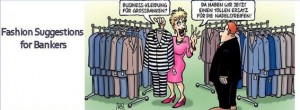
Jail Offending Bankers.