Nexus between Credit Suisse and Swiss Ukraine Crisis Sanction

Our correspondent Andreas Frank writes:  US Attorney General Eric Holder met with Eveline Widmer-Schlumpf, his counterpart from Switzerland, as investigators cracked down on Swiss banks that help US customers avoid paying taxes.

Widmer-Schlumpf was accompanied by State Secretary Jacques de Watteville as well as representatives of the Federal Department of Foreign Affairs and the Federal Department of Justice and Police. The talks with Mr. Holder focused on the current US programme to settle the tax dispute for category 2, 3 and 4 banks, as well as the ongoing US criminal investigations concerning category 1 banks domiciled in Switzerland.

Switzerland is committed to ensuring with the US authorities a fair and balanced procedure in accordance with the principle of proportionality in order to prevent Swiss banks from being treated worse than other banks.

US officials were tight-lipped about the content of the meeting between Holder and Eveline Widmer-Schlumpf, but confirmed that the US probe into the Credit Suisse bank was discussed.

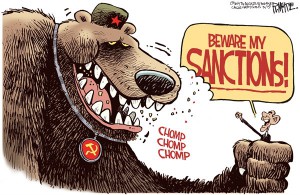
The day the Swiss negotiated with the DOJ “a fair and balanced treatment of Credit Swiss”, Switzerland added 15 individuals to a list of people who are subject to business restrictions and travel bans because of their involvement with the crisis in Ukraine, a move that follows the expansion of European Union sanctions.

Swiss authorities said financial institutions in the Alpine country could no longer do business with Russian Deputy Prime Minister Dmitry Kozak, Russian military head Valery Gerasimov and the leaders of separatist groups that have seized buildings in eastern Ukrainian. The expansion means 48 people are now subject to restrictions.

Europe and the U.S. announced new sanctions in late April in response to Russia’s actions in Ukraine. EU sanctions focus on individuals but U.S. sanctions also target banks and other companies.

The Swiss announcement is a reversal of the Swiss Federal Council’s March 26 decision not to impose sanctions against Russia for its seizure of Crimea, claiming it wanted to find a “balance” between international law and Switzerland’s interests.

It is obvious that pledges given by the DOJ to the Swiss in the Credit Swiss case tipped the balance in favour of Switzerland joining the EU sanctions.
Sanctions

India Joins the World

The Christian Science Monitor writes:  Years before Narendra Modi won this month’s election that now allows him to become India’s next leader, the former tea-stall worker asked this question on behalf of the world’s second most-populous nation:  “It is often said that India does not dream big and that is the root cause of all our problems. Why can’t we dream like China, Europe or America?”

Note how Mr. Modi compares India to other continental powers. This reveals just how much today’s 1.25 billion Indians, who are digitally hitched to the global flow of ideas, have adopted new views of their capacity for progress – not only for India but for themselves.

During his campaign, Modi tapped into this rising aspiration for India to emulate the best in other countries. One in eight voters went to the polls for the first time, a sign of the fact that two-thirds of the population is under 35. He and his Bharatiya Janata Party (BJP) promised economic growth, clean governance, and decisive leadership, all of which Modi delivered as chief minister of Gujarat state – although sometimes too harshly or divisively.

His record and his campaign promises really reflect an India ready to join the global community. Voter turnout was a record 66 percent. And the electoral results cut across the old divides of caste, rural vs urban, old vs. young, poor vs. middle-class. On those measures alone, India has surpassed China, which is not even allowed to have elections, and the political disunity in Europe and America.

The BJP’s election sweep was achieved in part out of public frustration with the long-ruling Congress party. Its corrupt, paternalistic, and dynastic style no longer fits an India of smart phones and social mobility. More than two-thirds of Indians are dissatisfied with their country’s direction, according to a Pew poll. In throwing off the past, voters have allowed the BJP to rule with a clear majority in the lower house of parliament. Such a feat was achieved only once before, in 1984, after the assassination of Indira Gandhi boosted the Congress party in an election.

As prime minister, Modi must not forget he is riding an awakening of Indian expectations as much as leading them. His checkered past as a Hindu nationalist, and in sometimes treating India’s Muslims as less than citizens, cannot color his leadership in a constitutional democracy. Religion, including Hinduism and Islam, can help Indians define their individual identity. But in a country of such size and diversity, one that is home to a third of the world’s poor, only secular rule can ensure the unity needed to fulfill people’s collective hopes.

“India has won,” Modi tweeted after his victory. This apparent humility may serve him well in preventing an overreach of his powers. India does not need big-man style rule now that a historic election has shown Indians are ready to dream big.

India's Next Step

What the Credit Suisse Guilty Plea Means

Our correspondent Andreas Frank is an expert on shadow banking and Credit Suisse.  His most recent report can be found here.

Here is his most recent report and documentation.  Mr. Frank writes:

In a sign that banking giants are no longer immune from criminal charges, despite concerns that financial institutions have grown so large and interconnected that they are too big to jail, federal prosecutors demanded that Credit Suisse’s parent company plead guilty to helping thousands of American account holders hide their wealth.

As part of a deal with the Justice Department, the Swiss bank met the demands, agreeing to one count of conspiring to aid tax evasion in a scheme that “spanned decades.” Credit Suisse, which has a giant investment bank in New York and whose chief executive is an American, will also pay about $2.6 billion in penalties and hire an independent monitor for up to two years.

The rebuke from federal prosecutors as well as from the Federal Reserve and New York’s state banking regulator, Benjamin M. Lawsky, is intended as a blow against overseas tax dodging and the shadowy world of Swiss bank secrecy. The deal also signals a shift in prosecutors’ tactics. It is the most prominent bank to plead guilty in the United States since Drexel Burnham Lambert in 1989, and the largest to do so since the Bankers Trust in 1999, a bank a fraction the size of Credit Suisse.

Credit Suisse has done what no other bank of its size and significance has done in over two decades: plead guilty to criminal wrongdoing.

For Credit Suisse, other than the fines and the reputational stain of being a felon, the implications are likely to be limited. The bank may lose some clients but is otherwise expected to survive largely unscathed. The plea deal also enables it to move beyond a case that had prompted a congressional hearing and had thrust the bank into an international squabble over tax dodging. If the bank had continued to fight the case, it would have been indicted, calling into question its very existence.

Credit Suisse Handling Clients

Credit Suisse Pleas Criminal Guilt. Too Big To Jail.

Credit Suisse AG has pleaded guilty to helping wealthy Americans evade taxes in offshore havens, and the Swiss bank has agreed to pay U.S. authorities $2.6 billion in penalties, the Justice Department has announced.

For the big banks, these fines are simply the cost of doing business.

Attorney General Eric Holder told a news conference in Washington on Monday that the Swiss bank had “engaged in an extensive and wide-ranging conspiracy … to help tax cheats dodge U.S. taxes.”

Holder said the conspiracy spanned decades and involved bank employees destroying records in an effort to hide the truth and that the destruction of evidence continued after the Justice Department launched its investigation in 2010.

The conspiracy charge was filed in a criminal information, which is a charging document that can only be filed with a defendant’s consent and which typically signals a guilty plea.  The penalties will be paid to the Justice Department and to regulators.  Citing an unnamed source, The Wall Street Journal says that Credit Suisse’s Dougan and Chairman Urs Rohner will retain their jobs as part of the settlement.

Credit Suisse is not the first bank to make such a settlement. In 2009, UBS agreed to pay $780 million to U.S. authorities and to identify the names of its U.S. account holders. In 2013, Switzerland’s Wegelin & Co. paid $57.8 billion after pleading guilty to aiding tax evasion.

Too Big to Jail

Using Executive Pay to Take the Risk Out of Banking

Making banks more secure has become the holy grail of regulators writes Mark Roe.

Tying senior managers’ pay to the bank’s stability, the financial sector, advocates argue, would be forced to police itself. This incentive-based regulation could bolster economic stability more effectively than expecting regulators to keep pace with banks’ risky activities.

The proposal is not perfect – not least because bank managers’ compensation would still be tied to profits. If a banker is told that he or she will be compensated entirely in bonds this year, with the bank’s annual profits determining the number of bonds to be received, the banker would obviously want to boost this year’s profits – even if it required taking bigger risks.

Despite these challenges, a new, bond-based compensation strategy could enhance bank stability considerably. Though there is no silver bullet for bank regulation, implementing such a system with care and vigilance would be an important step in the right direction.
Bonds

Why Did Qatar Invest in Deutsche Bank?

Qatar is building itself up to be a knowledge center and their Financial Center is based on assets and insurance.  Oil is bountiful is this small country, but they are aware that hydrocarbons will run out eventually.

While banks are not central to their future plans, they recognize them as undervalued assets today.  Reeling from litigation, bank stocks have not returned to their pre-financial crisis highs.  Qatar sees them as a good long-term investment.

They are not being purchased on behalf of the country however.  The purchase vehicles benefit only the royals.

Qatar Royals

Swiss Vote Down $25 Minimum Wage

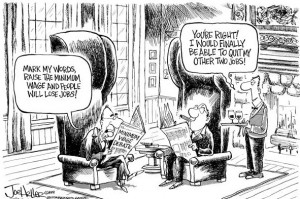
Swiss voters resoundingly rejected a measure that would have hiked the country’s minimum wage to the highest level in the world.  If approved, the referendum would have raised the national minimum wage to $25 an hour. Bloomberg reports that 76.3 percent of voters no on the measure.

Trade unions sponsored the wage proposal as way of fighting poverty in a country that, by some measures, features some of the world’s highest prices. But opinion polls indicated that most voters side with government and business leaders, who have argued it would cost jobs and erode economic competitiveness.

Switzerland currently has no minimum wage, but the median hourly wage is about 33 francs ($37) an hour.

The Organization for Economic Cooperation and Development lists the highest current minimum wage as Luxembourg’ at $10.66 an hour, followed by France at $10.60, Australia at $10.21, Belgium at $9.97, and the Netherlands at $9.48. The U.S. minimum wage of $7.25 came tenth on the list. The OECD adjusted figures for spending power.

Minimum Wage

The Nature Conservancy and Dow Chemical Team Up

Mark Tercek who heads up the Nature Conservancy made  lot of money as a Goldman Sachs partner.  Daniel Max, writing in the New Yorker, looks at what he has done to raise environmental and global warming awareness, not by scolding and accusing, but by pointing out the advantages of being green-aware.  Not to stave off picketers, but rather as a good business practice that does not cost any more, and may cost less in the long run.

When Terek opened up conversations with Dow, he told them that the Nature Conservancy were not eggheads out of touch with the real world.

Already Dow is helping rebuild marshes near its Texas plant.  This has a future benefit.  Global warming is going to make water encroach on Dow’s factory territory.  The marshes will keep the waters at bay, and cost much less than building barriers.

Is this a model for going well by doing good?

Mark Tercek


Wildlife Crime Worth $ 8-10 Billion Annually

Andreas Frank reports: Urging the international community to “come together at the highest political level” to halt the escalation of wildlife and forest crime, the United Nations crime chief said today that the $8-$10 billion reaped annually from this “ruthless trade” ranks it alongside the trafficking of human beings, arms and drugs in terms of illicit profits.

“The rate of poaching is such that a number of iconic and lesser known species risk being wiped out over the next decade – and we will all bear responsibility for those losses,” warned Yury Fedotov, Executive Director of the UN Office on Drugs and Crime (UNODC), at a special event taking place in Vienna on the margins of the 23rd session of the Commission on Crime Prevention and Criminal Justice.

Mr. Fedotov stressed that the illegal wildlife trade – broadly considered poaching and other illicit exploitation of the world’s wild flora and fauna – needed to be recognized everywhere for what it is: a very serious transnational organized crime requiring effective legislation and criminal justice systems. The London Conference that took place in February 2014 had added to the political commitments expressed in Paris, Gaborone, Marrakesh and Bishkek in 2013.

“We must now translate our resolve into concrete action and channel this momentum into the General Assembly,” he said.

Stemming this tragedy is a shared responsibility, said Mr. Fedotov, explaining that UNODC is working with Governments and partners, such as the International Consortium on Combating Wild Life Crime (ICCWC), to improve legislation, strengthen law enforcement and criminal justice systems that can investigate, prosecute and sentence criminals in source countries and end-markets, and forge closer international cooperation.

In addition, UNODC will soon launch the Global Programme for
Combating Wildlife and Forest Crime, which would deliver regional and national assistance to support law-enforcement responses, put in place legislation to address this crime, strengthen investigative, prosecutorial and judicial capacities, as well as combat the related issues of money-laundering and corruption. It will also support States in their efforts to introduce livelihoods to affected communities.

Mr. Fedotov stressed however that law enforcement alone cannot eliminate wildlife crime, and he underlined the need to tackle the underlying development dimension. “Education and public awareness campaigns are needed to reduce the demand for protected fauna and flora, together with efforts to promote sustainable livelihoods for communities in source countries, where poverty and their lack of economic opportunities drive many to engage in this criminal enterprise,” he said.

Mr. Fedotov said he hoped that more countries would implement the UNODC Wildlife and Forest Crime Analytic Toolkit developed with ICCWC to assess countries’ preventive and criminal justice responses to wildlife and forest crime, following the example of Gabon, Nepal, Bangladesh and Peru.

Other initiatives of UNODC include the recent “Be a responsible traveller” campaign jointly launched with the UN World Tourism Organization (UNWTO) to curb demand for wild animals, exotic plants and endangered wood products.
UNODC_PressRelease_13.5.14
Wildlife CrimeIs the last Siberian Tiger Corrupt
Reports on Corruption