In US jobs, women have to work fifteen months to make what men make in twelve. President Obama signed an executive order permitting employees to discuss their pay with their colleagues. Hopefully they can then act. The executive order only applies to companies doing business with the government.
Nobelist Dario Fo Corrects History’s Picture of Lucrezia Borgia
Her family has been portrayed as evil. She was painted with the same brush. Dario Fo now tells her true story.
Lucrezia has long been portrayed as an incestuous femme fatale who poisoned her enemies. But the Nobel prize-winning writer Dario Fo is trying to rehabilitate the Renaissance aristocrat as a peaceful, courageous victim of her family’s misdeeds.
Fo, 88, has attacked the depiction of Borgia in books, plays and films; he singled out the television series The Borgias, starring Holliday Grainger as Lucrezia and Jeremy Irons as her father Pope Alexander VI, saying it “borders on pornography”.
“The focus is all on sex, the plots are coarse,” said Fo who publishes his own take on her, The Pope’s Daughter. “They make her out as a poisoner, a woman who slept with her father and her brother, an evil woman who just accepted the husbands her father imposed on her.”
Fo says Lucrezia was neither subservient, nor violent. “The accusations are all false,” he said.
Can News Delivery Be Financed by Conferences?
When Tina Brown announced that she would leave The Daily Beast, she reported that she would begin to organize conferences. Re/Code, a tech news site run by two veteran reporters from the Wall Street Journal and the Washington Post was launched with backing from NBC Universal among others. They also have a conference company, Code Conference, which is charging $6,500 a person for their upcoming conference in Rancho Palos Verdes, Ca. Do people still want (and need) to interface live? Is some combination of ether and live talk the answer to delivering news?
Sallie Krawcheck Gives You a Question
For April is FInancial Literacy Month, ask yourself this question, courtesy Sallie Krawcheck of about to be re-named 85 Broads:
A friend brought up the idea that we all need to ask ourselves: am I a stock or I am a bond? Am I in a profession that’s higher risk, where I could lose my job? If that’s the case then I’d better be very conservative in how I think about my savings and my investments. Or I am I bond? Where I’m confident I’m in a job I’m not going to lose. I’m not going to hit the home run but I’m probably not going to lose my job. In which case with my investments I can take on a little more risk as I think about saving for retirement. I don’t know that anybody’s asking that question but it’s worth thinking about: are you a stock or a bond?
Men Ask for Salary Increases; Women Don’t.
It’s not an exaggeration to say most of America’s financial sector is run by men. In the securities and investment banking industries, men hold more than 80 percent of executive positions. And women hold only 17 percent of the board seats on Fortune 500 companies.
Sallie Krawcheck bucked the odds.
As former president of global wealth and investment management for Bank of America, she oversaw more than $2 trillion in assets. But corporate turnovers and personnel changes got her unceremoniously pushed out.
Wall Street lost one of its few women at the top when Krawcheck left, but she’s not the only one. During the economic downturn, women lost finance jobs in greater numbers than men. And before that, women had beenleaving the financial sector for several years.
Krawcheck is now on a mission to bring those numbers up. Last year, she took charge of 85 Broads, a women’s network that’s grown to include more than 30,000 members.
On bringing more women onto corporate boards
Women have been shown to be, on average, more risk averse [than men] … to be longer-term in their outlook. In fact, I saw a recent piece of research that showed, on average, when men enter a negotiation, they’re focused on coming out the other side winning. And when women enter a negotiation, they’re more focused on coming out the other side with the relationship intact.
On the consequences of women not asking for money
What I’ve found over time is that when it would come to bonus time or raise time, I would hear from the gentlemen, “I want to make X.” I don’t think I ever heard from a woman who worked for me, “I want to make X.” And research shows, men ask and women don’t. … Say we’ve got two employees, Joe and Joanne. They’re both set to make $5 in bonus. Joe comes into my office and says, “Hey, Sallie, I’ve had a great year. I’d like to make $10 this year.”
After Joe leaves, I call the head of HR, and we sort of say, “Can you believe this? Joe wants to make $10, he’s in for $5, ha ha ha.” But we don’t want to lose him. So we put him in for $7. And that means Joanne isn’t going to get the $5 we had planned. She’s going to get $3. Because the bonus pool doesn’t go up. She sees her bonus actually reduced.
On her women’s professional network 85 Broads
These women have intuitively recognized the research that says the No. 1 unwritten rule of success in business is networking. Not schmoozing, but having access to information, knowing people. … Stuff I want to know that can help me in business and life that my company isn’t providing. We do online education seminars on things like: How do you ask for a raise? How do you get on a board? How do you pivot into public service?
And what is really interesting, the women who have joined our network have lower attrition rates from the workforce than the average for the professional woman. So there’s something that’s happening in the network by bringing together these like-minded individuals, that’s helping these women in their careers.
Credit Suisse Under Continued Pressure from US
Benjamin Lawsky, Ny State’s Financial Services Superintendent, has Credit Suisse in his crosshairs.
Our correspondent Andreas Frank calls our attention to Reuters reporting:
Switzerland’s second-largest lender had raised expectations it was emerging from its long-running American tax controversy when it set aside an extra half a billion dollars last week to deal with a U.S. Department of Justice investigation of its participation in offshore tax evasion.
But Benjamin Lawsky, New York’s financial services superintendent, is now examining whether the bank lied to New York authorities about creating tax shelters, raising the possibility of another investigation, a source familiar with the matter told Reuters.
Shares in Credit Suisse dropped 2.6 percent to 28.69 Swiss francs in Zurich on Monday, underperforming the European benchmark <.SX7P>, which was 1 percent weaker, as investors digested the possibility of a costly inquiry.
“There is still a lot of uncertainty around all these legal issues at Credit Suisse. Nobody can tell how much it will really cost in the end,” said Peter Stenz, a portfolio manager of Swiss equities at Swisscanto, one of the 50 largest stakeholders in Credit Suisse.
Testifying before the Senate Sub Committee on Permanent Investigations, Credit Suisse waffled.
Cyber Hacking in China
Only Google objects. The ECONOMIST reports that China’s hackers may be the terror of the Earth, but in fact most of their attacks are rather workaday. America and Russia have hackers at least as good as China’s best, if not better. What distinguishes Chinese cyber-attacks, on anything from governments to Fortune 500 companies, defence contractors, newspapers, think-tanks, NGOs, Chinese human-rights groups and dissidents, is their frequency, ubiquity and sheer brazenness. This leads to an unnerving conclusion.
“They don’t care if they get caught,” says Dmitri Alperovitch, who used to work at McAfee, a computer-security firm, where he helped analyse several Chinese hacking operations in 2010 and 2011, and is a co-founder of CrowdStrike, another cyber-security firm. The indiscriminate tactics of China’s 2010-11 campaign made it relatively easy to track. His team identified more than 70 victims (among many more unidentified ones), dating back to 2006, and found that the average time the hackers stayed inside a computer network was almost a year. “They’ll go into an organisation and then stay there for five, six years, which of course increases the chances that they get caught.”
Mr Alperovitch offers two reasons for the careless abandon of China’s hackers. The first is that their attacks are on an industrial scale—“thousands of continuous operations”—so they could hardly be expected to go unnoticed. The second is that “they don’t see any downsides to being caught. They have so far not suffered economically or politically for being caught.” Cyber Hacking
US Jumpstart Coalition for National Literacy
Jump$tart Coalition for Personal Financial Literacy consists of 180 organizations and 47 affiliated state coalitions dedicated to improving the financial literacy of youth from kindergarten through college age by providing advocacy, research, standards, and educational resources. Jump$tart strives to prepare youth for lifelong successful financial decision making.
• Suggest a range of content that students should know and be able to act on • Provide guidelines for evaluating published educational materials • Help to shape lesson plans, unit and course outlines, learning activities, textbooks, and other instructional materials • Increase awareness of the need for personal finance in the nation’s schools
The Less People Know About Bitcoins, the More They Disapprove
New poll reveals that ignorance damns.
“Some people, when they don’t know what something is, want to ban it,” says Reason-Rupe polling director Emily Ekins. “Other people, if they don’t know what something is, they think it should be allowed unless it’s causing someone harm in some way. And this question really delineates who those individuals are that favor choice and favor prohibition.”
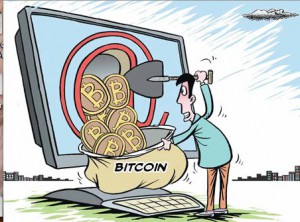
Only 19 percent of respondents had “a lot” or “some” knowledge of bitcoin, but that didn’t stop 47 percent of them from saying they wanted to ban it. However, the more someone claimed to know about bitcoin, the less likely he or she was likely to want to prohibit it, with 71 percent of respondents who claimed to know “a lot” about bitcoin saying it should be allowed and, on the other side of the spectrum, only 27 percent of those who claimed to “know nothing” about it wishing to allow it. Among groups polled, the strongest supporters of bitcoin included young people (ages 18-29), gamers, and political independents.
Tips for Raising Money from Investors
Global Invest Her makes these suggestions:
Helpful Tips for Raising Money from Investors

If you are considering raising money from investors,
check out this excellent video that covers:• What to consider when determining your funding needs?
• How to know when you’re ready?
• What to prepare?
• How to get in front of investors?
• Key terms and financing strategies
• Strategies for raising money – from pitch to closing