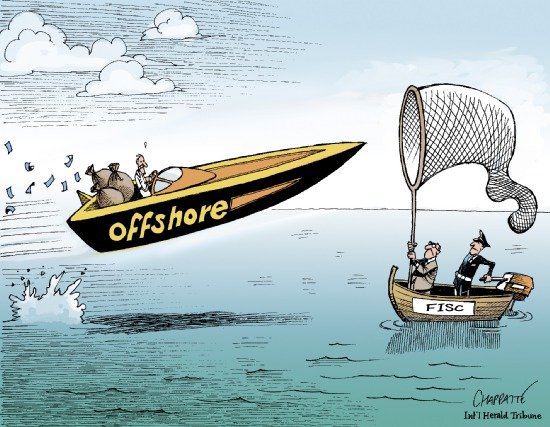
Addressing Inequality: Transparency in Offshore Deposits

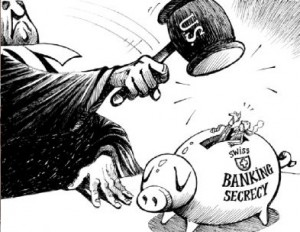
Senator Carl Levin has been probing Swiss banks compliance with US demands for transparency.  Over and over again Senators asked, “Why would someone who lives in the US deposit money offshore?”

The Department of Justice notes its investigations have helped spur voluntary disclosures by U.S. taxpayers through an Internal Revenue service program, started in 2009, that offers reduced penalties for people who owe back taxes, interest and penalties.

“The prospect of U.S. prosecution has been forceful enough to cause 43,000 taxpayers to self-report and pay nearly $6 billion in taxes and penalties,” the Justice Department said.

This is the kind of probe and litigation that will help reduce inequality.


The Prospect of Jail

Senate Takes on the Swiss Banks

During a Senate hearing, Credit Suisse bank laid out a detailed defense, saying that the perpetrators were a small group of Swiss-based bankers, and that while it wanted to hand over more client names, it was caught between U.S. and Swiss law.

“Credit Suisse is ready to provide the additional information requested by the U.S. authorities on U.S. account holders, but we have been unable to do so,” the bank said in a statement provided at the hearing.

Credit Suisse had provided as much information as allowed under Swiss law, it said, and while it wanted to provide more client names, the U.S. Senate had not ratified a bilateral treaty with Switzerland that would allow it to do so.

Subcommittee Chair Carl Levin, a Michigan Democrat, poured cold water on that argument, saying the treaty will only expose U.S. accounts at Swiss banks after 2009, when it was signed.

If U.S. customers closed their accounts before 2009, they could evade detection and years of U.S. tax bills, Levin said, which Credit Suisse bankers acknowledged.

“We can’t collect taxes owed by those folks, which is what the heart of the problem is. … Don’t tell us the treaty is going to get us what we want,” he said. “It won’t.”

Levin also scolded the Justice Department for only having retrieved 238 client names from Credit Suisse – and none from the other banks under investigation. But the Justice Department officials said their work did show good progress.

Credit Suisse said it was a “demonstrably inappropriate assumption” that all 20,000 U.S. clients were tax cheats, saying many U.S. clients, such as expatriates living in Switzerland, had a valid reason to hold a Swiss bank account.   Senators accused the Department of Justice of dragging its feet.  Department of Justice Testimony
Member Statements for Download

Swiss Banking Secrecy

Indian Finance’s Most-Powerful Woman Tackles Bad Loans

Arundhati Bhattacharya, chairman of State Bank of India, attends the Annual Bankers’
When she was a village branch manager in eastern India, she was quick to grab a screwdriver to fix power outages. Now, as the most-powerful woman in Indian finance, Arundhati Bhattacharya must tackle the highest bad-loan ratio among India’s 10 largest banks.
Appointed in October as the first female chairman and most-senior executive officer of the country’s largest lender, State Bank of India, Bhattacharya has been combing through balance sheets riddled with 678 billion rupees ($10.9 billion) of bad debt. Some 5.7 percent of total loans at the 207-year-old behemoth are nonperforming, the highest level in at least eight years, the earliest date for which data are available, exchange filings show.
Indian Finances Most-Powerful Woman Tackles Bad Loans

Arundhati Bhattacharya

Breaking Bad for Money Launderers

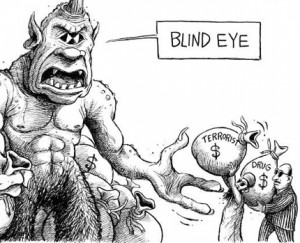
Our correspondent Andreas Frank points out efforts by the US Financial Crimes Enforcement Network to crack down on money laundering by using the Patriot Act.  Jennifer Shasky Calvery, director of the network, wants to put more muscle behind it.  Calvery noted:  TV watchers know Saul Goodman simply as a sleazy lawyer. But there’s a more formal way to describe the character played by comic actor Bob Odenkirk on the hit series “Breaking Bad.”  Saul Goodman would be a third party money launderer.”

Calvery was illustrating the point that money laundering by third parties is a growing concern at Fincen.  “Third party money launderers are professional money launderers,” Calvery said at an anti-money laundering conference in Miami. “Using their connections, professional expertise, and influence, third party money launderers transfer funds on behalf of others, knowing that the funds are involved in illicit activity.”  She described various schemes that these individuals use to infiltrate banks, including “using false documentation.”

For the uninitiated, “Breaking Bad” is about a meth producer in Albuquerque, N.M. Saul Goodman is the drug dealer’s lawyer. He eagerly creates false documents in order to launder money, and also serves as the show’s comic relief.

“I’ll generate false currency transaction reports out the wazoo,” Goodman exclaims in one Season 3 episode, “as well as the necessary W-2Gs, and a couple of casino managers who will jump at the chance to report false losses. It’s a win-win for everyone!”

Breaking Bad

Breaking Up Drug Cartels: Intelligence v Insider Info

The dramatic arrest of the head of the Mexican drug cartel, Sinaloa, which counts for 30% of drugs illegally entering the US can give false hope.  “El Chapo’ Guzman was the country’s leading drug dealer, but for years both the DEA in the US and the Mexican government gave him a pass in return for information.  What are the consequences of these deals in terms of the long term control of drug cartels?  Can control be achieved with information gleaned from sources other than the drug cartels themselves?  It is difficult to say.  But perhaps ending the privileged relationship with Guzman’s organization is a good first step.  Unfortunately a cell phone call did Guzman in.  Let’s hope this does not give the NSA a boost.

by Fernando Llera

by Fernando Llera

Canada Fines Brokerage Firms for Money Laundering

Andreas Frank reports;  Canada’s financial watchdog that supervises money laundering and terrorist financing has issued details of violations committed by a Canadian regulated broker dealer.

Financial Transactions and Reports Analysis Centre of Canada (FINTRAC), a government organization that reports to Canada’s ministry of finance, has found Questrade, a domestic financial services firm guilty of negligence in relation to serious principles in the way it deals with money laundering. As a result, FINTRAC enforced a financial penalty in 2011 to the multi-asset discount broker.

FINTRAC announced full details of the violations committed by Questrade the press statement. The Order states that: “Questrade, Inc., a securities dealer in Toronto, Ontario, was imposed an administrative monetary penalty of $346,140 on October 19, 2011, for committing nine violations of the Proceeds of Crime (Money Laundering) and Terrorist Financing Act (the Act) and the Proceeds of Crime (Money Laundering) and Terrorist Financing Regulations (the Regulations).”

FINTRAC, a government organization, was set up in 2000 to specifically tackle money laundering and terrorist financing related crimes. Canada has a range of financial regulators for brokers, banks and fund managers operating in the financial markets arena. Questrade is a member of the Investment Industry Regulatory Organization of Canada, a self-regulatory organization which oversees all investment dealers.

During FINTRAC’s investigations, Questrade was found to have poor systems and controls in its compliance and anti-money laundering procedures. The major issues according to the briefing issues were:

  • Failure to report a suspicious transaction;
  • Incomplete compliance policies and procedures, failure to develop a written ongoing compliance training program and failure to take special measures for high risk activities;
  • Inadequate practices of ascertaining client identity and confirming the existence of an entity other than a corporation, failure to enter into an agreement or arrangement with an agent or mandatory for the purposes of ascertaining identity, and incomplete record keeping;
  • Failure to take reasonable measures to determine whether a person is a politically exposed foreign person.

The financial penalty is one of the first issued to a financial services broker for such activities, highlighting Canada’s commitment to safeguarding its financial services sector.

Canada’s financial regulators adhere to state regulations which vary from region to region. In October 2013, the Ontario Securities Commission (OSC) cautioned investors about global FX broker, YouTradeFX, and advised users not to deal with unauthorized brokerage firms.   FINTRAC Penalty  

Brokerage Carelessness

California Political Dynasty Accused of Money Laundering

Our correspondent Andreas Frank reports: The political dynasty of Ron and Tom Calderon took a body blow as U.S. Attorney Andre Birotte Jr. charged the brothers with criminal political corruption and painted a devastating picture of Ron Calderon as a man who drew his own son and daughter into his web.

Ronald S. Calderon, 56, of Montebello, is charged in a 24-count indictment that was returned late the before by a federal grand jury with mail fraud, wire fraud, honest services fraud, bribery, conspiracy to commit money laundering, money laundering and aiding in the filing of false tax returns.

Sen. Ron Calderon, a Democrat from a politically prominent family in Los Angeles’ blue-collar suburbs was charged with accepting $100,000 in bribes, lavish trips and no-show jobs for his children in exchange for pushing legislation to benefit a hospital engaged in billing fraud and participating in a film industry tax scheme that actually was an FBI sting.

The 24-count federal indictment against Sen. Ron Calderon depicts a rogue legislator eager to trade his clout at the state Capitol to enrich himself and his family. His brother Tom, a former state lawmaker-turned-lobbyist, was charged with money-laundering for funneling bribes through a tax-exempt group he controlled, prosecutors said.

State officials called one of the two schemes “the largest insurance fraud in California history” involving former hospital owner Michael Drobot in Long Beach. An IRS executive at the press conference said Drobot bribed Calderon by hiring his son for a phony job paying $10,000 that was solicited by Ron Calderon, and that Calderon knew was fake. Then, authorites allege, Calderon helped to lie about the income on his son’s tax return.

Bribery money flowed to lobbyist Tom Calderon’s entity, Californians for Diversity, officials allege, and that money was ultimately laundered by being deposited in banks in a manner meant to cover up the original bribery, according to Birotte and the IRS.

Investigators explained their actions in a prepared statement that flew through Sacramento legislative offices “like a storm cloud” says one legislator.    Calderone Indictment
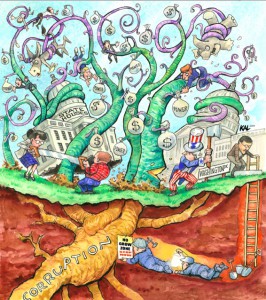
Corruption

SEC and Credit Suisse in 196 M Settlement

Our correspondent Andreas Frank writes:
Credit Suisse Group AG agreed to pay $196 million and admitted that it improperly solicited thousands of American clients, ending a U.S. regulatory probe while a broader criminal investigation of tax evasion still looms.  The settlement today includes almost $82.2 million in disgorgement, $64.3 million in prejudgment interest and a $50 million penalty.

The bank collected about $82.2 million in fees and amassed as many as 8,500 U.S. client accounts from at least 2002 through 2008, the SEC said in an administrative order today. The accounts held an average total of $5.6 billion in securities assets, the SEC said.

Credit Suisse has been ensnared in a wider Justice Department probe for the past three years into Americans’ use of off-shore bank accounts to avoid taxes. Eight bankers, including Credit Suisse’s former head of North America offshore banking, were charged in 2011 with conspiring to help American clients evade taxes through secret bank accounts.

“As Credit Suisse admitted as part of the settlement, its employees for many years failed to comply with these requirements, and the firm took far too long to achieve compliance,” Andrew Ceresney, director of the SEC’s enforcement division, said in the statement. “The broker-dealer and investment adviser registration provisions are core protections for investors.”

Credit Suisse admitted to the facts in the SEC order, which concluded that the bank “willfully violated” securities laws, and agreed to hire an independent consultant, according to the regulator.

Creidit Suisse has a history:
In 2012, Credit Suisse come into the spotlight when Christos Bagios a former banker at UBS AG and Credit Suisse was indicted and pled guilty supporting wealthy Americans hide millions of dollars from U.S. tax authorities.
In 2011 Credit Suisse was fined 149 million euros to settle allegations against the bank for helping German citizens to evade taxes.
In 2009 Credit Suisse was fined $536m  for money laundering and sanction violations by the DOJ.   SEC Credit Suisse Settlement

Credit Suisse


Where U.S. Offshore Tax Evaders Live And Bank

Andreas Frank International Anti-Money Laundering AML Expert  Reports:

The latest U.S. Government Accountability Office report shows which states have the most taxpayers disclosing such accounts (California is No. 1), and where they are located (Switzerland is No. 1). The report was published on Jan 6, 2014 but publicly released on Feb 19, 2014.GAO

The GAO report is a supplement  to its
“Offshore Tax Evasion: IRS Has Collected Billions of Dollars, but May be Missing Continued Evasion.”

There is nothing illegal about keeping money offshore, but you have to report it on a form called the Foreign Bank and Financial Account (FBAR) form – if the account value is $10,000 or more – and pay taxes on earnings. For those ready to fess up, the IRS held the 2009 voluntary disclosure program, followed by one in 2011, and another that opened in 2012 and is still reeling in taxpayers. The programs offer incentives for taxpayers to disclose their offshore accounts and pay delinquent taxes, interest and stiff penalties – to avoid criminal prosecution.
GAO_Offshore_Tax_Evaders

 Chappatte

Chappatte

Problem mit der Geldwäsche Bekämpfung