Mexico Retreats

US Elections and Women’s Role

Post election polls in the US suggest that races which focused on the sex of the candidate did not help the candidate much.  This does not come as a surprise.  It is always the economy and economic matters that drive governance issues.  In the US, post ‘great recession’ issues linger.  Foremost among them are jobs and matching preparedness with available jobs.  Because training people for the workforce is in part the job of education, we will have to wait until the education system catches up with the job market to make better matches between available jobs and available workers.

To this end, W-T-W.org Women and FInanace has proposed a 20-year infrastructure program, at the same time mending the country’s delapidated roads, bridges and educating the workforce for jobs in the new economy.

Women are more interested in families and children than men are.  We are focusing on women’s role in this new and important effort.

The recent election in the US shows that “it’s the economy,” is a battle cry for both sexes.  Women may hae a unique and potentially powerful approach to economic issues.

Women Advocates

Infrastructure and Energy in Russia

Russia possesses 18 percent of the world’s reserves in gas, 13 percent in petrol; 70 percent of its export revenues and 30 percent of its gross domestic product (GDP) are based on hydrocarbons. And 20 percent of its gas is exported to Europe. But with the price of oil now below $90, standing at $80.54 a barrel (West Texas Intermediate) and at $85.68 (Brent Crude), coupled with a drop of 1.3 percent of Russian GDP in 2013 and with zero growth forecasted, it is clear that “the old system no longer functions,” said Tatiana Mitrova.

Russia grew at 6 percent until 2009 and then fell to 0.2 percent this year, per International Monetary Fund (IMF) data. Russia’s gas production stands at 600 billion cubic meters, which is in decline. Novatek’s production is up 1,000 percent and Rosneft is in expansion. But internal Russian market demand is in decline.

In theory Russia could be a gas hub, but its storage facilities are insufficient. Sanctions have cut off investment funds.  The Russian people know little about the sanctions.  Within the governmnet, however, there is a move to open markets in China.

States like South Africa and Iran grew stronger after sanctions.. Russia is surrounded and its people may be ready to change their priorities.  Russian energy businesses may learn to be more attentive to this shift and are prepared to turn inward and also toward China.  Infrastrcture and Energy in Russia

 Gazprom

Fair International Tax Competition?

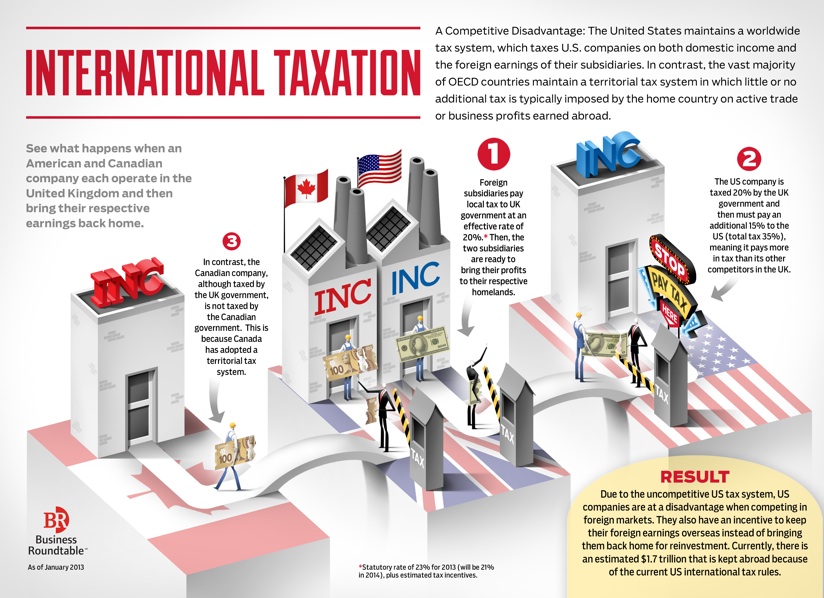
Wolfgang Schuble writes;  We are witnessing profound changes in the way that the world economy works. As a result of the growing pace and intensity of globalization and digitization, more and more economic processes have an international dimension. As a consequence, an increasing number of businesses are adapting their structures to domestic and foreign legal systems and taxation laws.

Thanks to technical advances in the digital economy, companies can serve markets without having to be physically present in them. At the same time, sources of income have become more mobile: There is an increasing focus on intangible assets and mobile investment income that can easily be “optimized” from a tax point of view and transferred abroad.

Tax legislation has not kept pace with these developments. Most of the tax-allocation principles that apply today date back to a time when doing business internationally primarily meant transporting goods across a border to a neighboring country.  Rules that were devised in the 1920s and 1930s are no longer suitable. They need to be adapted to the economic reality of digital services.

In the absence of workable rules, states are losing revenue that they urgently need in order to fulfill their responsibilities. At the same time, the issue of fair taxation is becoming more and more pressing, because the number of taxpayers who make an adequate contribution to financing public goods and services is decreasing.

The resulting tensions between national fiscal sovereignty and the borderless scope of today’s business activities can be resolved only through international dialogue and uniform global standards. Within the European Union, permitting groups of states to forge ahead with joint solutions to issues that can be addressed only multilaterally has worked well in the past. If such measures prove successful, other states follow.

This approach can also serve as a global governance model for resolving international problems. In today’s world, even large states cannot establish and enforce international frameworks on their own. Groups of countries still can. This has been demonstrated in the context of financial-market regulation; it is starting to become clear with regard to the regulatory framework for the digital economy; and it is now being confirmed in the area of taxation.

The Seventh Meeting of the Global Forum on Transparency and Exchange of Information for Tax Purposes took place in Berlin this week, bringing together representatives from 122 countries and jurisdictions, as well as the EU. A joint agreement on the automatic exchange of information on financial accounts was signed on Wednesday.

The joint agreement was originally an initiative by Germany, France, Italy, the United Kingdom, and Spain. Roughly 50 early-adopter countries and territories decided to take part, while other countries have indicated their willingness to join.

The agreement is based on the Common Reporting Standard, which was developed by the OECD. Under the CRS, tax authorities receive information from banks and other financial service providers and automatically share it with tax authorities in other countries. In the future, virtually all of the information connected to a bank account will be reported to the tax authorities of the account holder’s country, including the account holder’s name, balance, interest and dividend income, and capital gains.

Various measures are in place to ensure that banks can identify the beneficial owner and notify the relevant tax authorities accordingly. The CRS thus expands the scope of global, cross-border cooperation among national tax authorities. In this way, we can establish a regulatory framework for the age of globalization.

The automatic exchange of information is a pragmatic and effective response to the perceived lack of global governance regarding international tax issues. By making taxation fairer, governments will have a positive impact on people’s acceptance of their tax regimes.

This great success in the fight against international tax evasion would have been unthinkable only a few years ago. Now it is important to continue the efforts of the OECD and the G-20 in the area of corporate taxation. We need to make sure that creative tax planning in the form of profit-shifting and artificial profit reduction is no longer a lucrative business model.

A “beggar-thy-neighbor” taxation policy, by which one country pursues tax policies at the expense of others, is just as dangerous as beggar-thy-neighbor monetary policies based on competitive currency devaluation. It leads to misallocations – and will ultimately reduce prosperity around the world.

That is why we need to agree on uniform international standards in order to achieve fair international tax competition.

International Taxation

Central Bankers as Superstars

Kenneth Rogoff writes:  Why do the comments of major economies’ central bankers command outsize attention nowadays? It is not as if they change interest rates all of the time. Nor have they developed new, more robust models for analyzing the economy. On the contrary, major central banks’ growth and inflation forecasts in the years since the financial crisis have consistently overestimated both growth and inflation – and by wide margins.

There are many good reasons for the attention lavished on monetary policymakers, including the rise of central-bank independence, public acceptance of the need to appoint highly competent technocrats to oversee the money supply, and the deepening of financial markets. And many central bankers have been rightly lauded for their role in preventing a global meltdown during the financial crisis.

Even so, given the numerous uncertainties surrounding macroeconomic forecasts and the effects of policy instruments (not least quantitative easing), many academics find it puzzling that central bankers’ speeches and statements generate so much fanfare. Moreover, central bankers bear a share of the blame for the crisis in the first place, mainly owing to lax regulatory policy.

Many central bankers portray former US Federal Reserve Chairman Alan Greenspan (who served from August 1987 until January 2006) as the culprit, saying that he projected an image of central-bank omnipotence that is not warranted in theory or practice. But this critique is overblown: Greenspan is long gone, but the focus on central-bank pronouncements is greater than ever.

What, then, is going on? I would argue that, in addition to all of the factors listed above, three further considerations should be noted. For starters, the public perception that central bankers are omniscient makes them an attractive whipping boy for politicians. Moreover, the digital revolution in media has elevated the role of business news, one of the few profit centers for print and broadcast journalism in many countries. Central bankers’ pronouncements are of interest to businesspeople – especially in the financial sector – and businesspeople are of interest to advertisers.

Finally, and perhaps least appreciated, is the fact that central-bank policy pronouncements are almost unique in having clear and predictable effects on financial markets, at least in the very short run.

Some economic indicators, such as unemployment or inflation data, are indeed immediately important for central banks, because they may directly concern their mandates, and therefore have rather predictable effects. But much information is simply noise. This makes policy opinions that come straight from the horse’s mouth almost uniquely valuable.

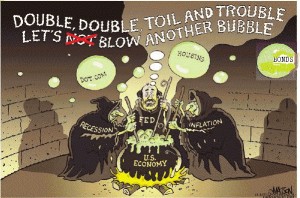
In short, there are many good reasons why central bankers receive so much media focus, including their relative independence and generally solid performance. But there are also other reasons having to do with politicians’ need for scapegoats, the media’s struggle to reinvent itself in the Internet age, and central-bank pronouncements’ predictable short-term effects on financial markets. These other factors have combined to create a bubble around central-bank pronouncements and decisions that grossly exaggerates their economic significance.

Is this a bubble that central bankers should worry about? The answer is clearly yes. The news bubble is of particular concern, because it reinforces the idea that central bankers somehow care disproportionately about financial markets, which is generally not the case.

Most central bankers really are targeting growth, inflation, and financial stability, if not necessarily in that order. The political bubble is an inevitable product of central-bank independence, and preventing monetary policy from becoming a target for elected officials requires constant effort. The predictability bubble is perhaps the trickiest to navigate, though my instinct is that less would be more. Exaggerated importance is one kind of bubble that central bankers should always be eager to burst.

Central Bankers

Evaluating China’s Economic Power

Joseph S. Nye writes:

The World Bank recently announced that China’s economy will surpass that of the United States this year, measured according to purchasing power parity (PPP). But this is far from a holistic depiction of China’s global economic standing.

Though PPP can serve some purpose in comparing welfare across countries, it is affected significantly by population size. India, the world’s tenth largest economy measured according to the market exchange rate of the US dollar and the Indian rupee, is the third largest in PPP terms. Moreover, power resources, such as the cost of imported oil or an advanced fighter aircraft engine, are better judged according to the exchange rates of the currencies that must be used to pay for them.

But, even if China’s overall GDP surpasses that of the US (by whatever measure), the two economies will maintain very different structures and levels of sophistication. And China’s per capita income – a more accurate measure of economic sophistication – amounts to only 20% of America’s, and will take decades, at least, to catch up (if it ever does).

Moreover, as Chinese officials and researchers have acknowledged, though China surpassed Germany in 2009 as the world’s largest exporter by volume, it has yet to develop into a truly “strong” trading country, owing to lackluster trade in services and low value-added production.

China’s lagging economic sophistication is also reflected in its financial markets, which are only one-eighth the size of America’s, with foreigners permitted to own only a tiny portion of Chinese debt. Though China has tried to increase its financial clout by encouraging the international use of its currency, renminbi-denominated trade still represents just 9% of the global total, compared to the dollar’s 81% share.

Not even China’s massive foreign-currency reserves – the world’s largest, at nearly $4 trillion – will be adequate to boost its financial leverage, unless the authorities create a deep and open bond market with liberalized interest rates and an easily convertible currency. These reserves do not give China much direct bargaining power over the US, either, given that interdependent relationships depend on asymmetries.

China holds dollars that it receives from its exports to America, while the US, by keeping its market open to Chinese products, helps to generate growth, employment, and stability in China. Yes, China could bring the US economy to its knees by dumping its dollars, but not without taking a serious hit itself.

The differences between China and the US in terms of economic sophistication extend to technology as well. Despite some important achievements, China relies on copying foreign inventions more than domestic innovation for its technological progress.

In the coming decades, China’s GDP growth will slow, as occurs in all economies once they reach a certain level of development – usually the per capita income level, in PPP terms, that China is approaching. After all, China cannot rely on imported technologies and cheap labor to support growth forever. The Harvard economists Lant Pritchett and Lawrence Summers have concluded that regression to the mean would place Chinese growth at 3.9% for the next two decades.

But this straightforward statistical estimate does not account for the serious problems that China must address in the coming years, such as rising inequality between rural and urban areas and between coastal and inland regions. Other major challenges include a bloated and inefficient state sector, environmental degradation, massive internal migration, an inadequate social safety net, corruption, and weak rule of law.

Moreover, China will face increasingly adverse demographic conditions. After enforcing a one-child policy for more than three decades, China’s labor force is set to peak in 2016, with elderly dependents outnumbering children by 2030. This has raised concerns that the population will grow old before it grows rich.

China’s authoritarian political system has demonstrated an impressive ability to meet specific targets, from the construction of high-speed railways to the creation of entire new cities. What China’s government is not yet prepared to do is respond effectively to increasingly loud demands for political participation – if not democracy – that tend to accompany rising per capita GDP. Will political change occur when per capita nominal GDP, now at roughly $7,000, approaches $10,000, as occurred in neighboring South Korea and Taiwan?

It remains to be seen whether China can develop a formula to manage an expanding urban middle class, regional inequality, and, in many places, restive ethnic minorities. Its lagging economic sophistication may complicate matters further. In any case, it means that aggregate GDP, however it is measured, is inadequate to determine when – and whether – China will overtake the US in economic power.


China's Economic Power?

Is Balance Necessary in Global Economies?

Sanjeev Sanyal writes: In recent weeks, there has been a chorus of opinion arguing for a sharp increase in global investment, particularly in infrastructure. Former US Treasury Secretary Lawrence Summers asserted that public investment really is a free lunch, while IMF Managing Director Christine Lagarde has argued that an investment boost is needed if the world economy is to “overcome a new mediocre.”

These comments suggest that the world has been under-investing for many years. In fact, according to International Monetary Fund data, the current overall global investment rate, at 24.5% of world GDP, is near the top of its long-term range. The issue is not a lack of overall investment, but the fact that a disproportionate share of it comes from China.

China’s share of world investment has soared from 4.3% in 1995 to an estimated 25.8% this year. By contrast, the United States’ share, which peaked at 36% in 1985, has fallen to less than 18%. The decline in Japan’s share has been more dramatic, from a peak of 22% in 1993 to just 5.7% in 2013.

China dominates global investment because it saves and invests nearly half of its $10.5 trillion economy. But this investment rate is likely to decline sharply over the next 5-10 years, because the country already boasts new infrastructure, has excess manufacturing capacity in many sectors, and is trying to shift economic activity to services – which require less investment. Moreover, China’s rapidly aging population and declining working-age population will reduce long-term investment demand.

Because the current-account balance is the difference between the investment and savings rates, the decline in investment will generate large surpluses unless savings also decline. And the experience of other aging societies, such as Germany and Japan, suggests that domestic investment falls faster than savings rates.

Thus, China can expect large external surpluses to transform the country from the world’s workshop into its main financier. Indeed, the scale of capital outflows could be so large that long-term capital will remain cheap even after the world’s major central banks tighten monetary policy. How the world absorbs those surpluses will define the next period of global economic expansion.

Emerging markets may be able to take some advantage of this low-cost financing. India would undoubtedly benefit, though it is unlikely to absorb a significant portion of China’s excess savings. India’s share of world investment is only 3.4%; and even a large expansion will not compensate for a small decline in Chinese investment. Furthermore, East Asia’s growth model has been sustained ultimately by mobilizing rising domestic savings and pumping out exports. So, although India might initially absorb some international capital, it might ultimately prefer to build foreign reserves by running small external deficits or even a surplus.

Other emerging countries are also unlikely to absorb much of China’s capital. Notwithstanding its advocacy of public investment spending, even the IMF accepts that a sudden increase in public investment is more likely to cause developing-country indebtedness than growth.

That is why calls by the IMF and others to scale up public infrastructure spending are really aimed at developed countries. Yet this, too, may prove insufficient. Germany’s investment-savings gap is so large that, even if it increases domestic investment, the most we can expect from Europe is that it does not add to the global savings glut.

Only a revival in US infrastructure investment can create a sustained global economic recovery. The US has the necessary scale to absorb China’s surplus, and its inadequate infrastructure provides plenty of avenues for fruitful investment.

Ironically, the IMF’s new investment mantra ultimately leads back to large global imbalances. But, far from decrying this as a major failure of global policy coordination, economists should accept imbalances as the natural state of the world and try to manage the resulting distortions.

Is Helicopter Money the Answer to Deflation in the EU?

John Muellbauer writes:  It is now a near certainty that, by the end of this year, falling energy and commodity prices will push annual inflation in the eurozone below zero – well under the European Central Bank’s target of near 2%. Rather than continue to allow misguided conventional thinking, centered on German economic ideology, to impede effective action, the ECB must pursue quantitative easing (QE) “for the people” – an adaptation of Milton Friedman’s “helicopter drops” strategy – to reverse deflation and get the eurozone back on track.

As it stands, conventional monetary policy has had – and American-style QE will have – little impact on the eurozone’s core countries. This can be explained partly by the fact that, when it comes to credit provision, capital markets do far less of the heavy lifting in the eurozone than in the United States. As a result, bringing down yields on government, corporate, and asset-backed bonds has less impact.

At the same time, the euro exchange rate – the one mechanism whereby current policies could still make a difference – cannot be pushed down much further. In Germany, France, and Italy, higher house prices spur non-owners to save more for the down payment and inspire caution among tenants, who expect future rent hikes. And the housing wealth of existing owners does not translate into significantly higher spending, given the lack of access to home-equity loans and cheap mortgage refinancing. Finally, in countries like Germany, where households’ bank and saving deposits far outweigh their debt, lower interest rates reduce total household spending.

Another factor impeding QE’s impact in the eurozone is low bond yields, which, by increasing measured pension-fund deficits, make some companies reluctant to invest.

US-style QE channels more money toward the wealthy, who have a lower propensity to spend, without providing much to the poorer people who would use it to consume more. In the eurozone, the distribution issue is especially complex, given that institutional differences between countries can give the impression of discrimination among them.

Clearly, the ECB must develop a strategy that works in the eurozone’s unique system.
One simple solution would be to distribute the funds to governments, which could then decide how best to spend them in their countries. But the eurozone’s rule against using the ECB to finance government spending bars this approach.

A more feasible option, therefore, would be to provide all workers and pensioners with social-security numbers (or the local equivalent) with a payment from the ECB, which governments would merely assist in distributing. Another alternative would be to use the electoral register, a public database that the ECB could use independently of governments.

Of the roughly 275 million adults with social-security numbers in the eurozone, some 90% are on the electoral register.  Beyond lifting the eurozone economy out of deflation, such an initiative would have massive political benefits, as it would reduce resentment toward European institutions, especially in struggling countries like Greece and Portugal, where an extra €500 would have a particularly strong impact on spending.

Germany may resist this approach by marshaling arguments about prudence and responsibility. But the fact is that Milton Friedman’s  “helicopter money” would work – and nothing in eurozone law prohibits it.

After years of austerity, infighting, and unemployment, it is time to implement a QE program that delivers what Europe needs.

Helicopter Money

Can You Go Back to the Future?

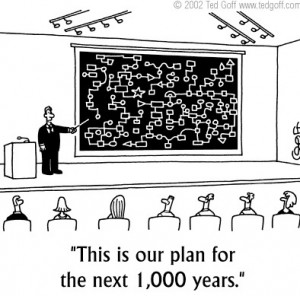
A core assumption in much of strategic management research is that more accurate forecasts of future competitive actions or the future value of certain business capabilities will lead to strategic success.  Executives have long been exhorted to conduct analyses of internal and external environments and construct scenarios of the future. However, seeing strategy in this way has some serious weaknesses. It assumes that accuracy can be achieved through rigorous analysis and conscientious efforts to overcome individual biases in perception. It also assumes that the process will be relatively frictionless and primarily analytical.

There is an important tension at work here. Because the future is essentially unknowable, leaders must rely on the past for information and insight. Moreover, given that the future is unknown, there are likely to be differences and conflicts within the organization about what that future might hold. Such conflicts can impede progress on the development and execution of new strategies — especially innovative strategies that depart significantly from a company’s current approach to the market.

Studies have pointed to the “abject failure” of most forecasting efforts to attain the desired precision. While strategy researchers tell managers they should project into the future, we tell them little about how to do this.

Strategic Planning

Are Hedge Funds Worth Their Fees?

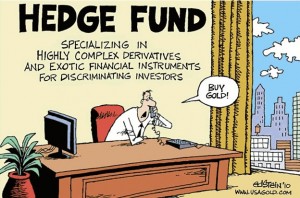
Cliff Asness, founder of hedge fund AQR Capital Management, doesn’t think hedge funds hedge enough. In his opinion, a hedge fund should be about as long the market as it is short, but most hedge funds end up being mostly long the market and perform like an expensive index fund.

Generaly Asness thinks a 2% fee and 20% on profits, the normal hedge fund charges, as too high.  Some indiividual hedge fund investors are worth it, but most are not.

If a manager is twice as aggressive with your money, Asness said that would at least justify the 2% fee on money under management, as they would be able to manage half the amount of other people’s money. And Asness added that of course there are also managers who do outperform, who do generate real alpha, and these folks are worth “2 and 20.

When CAlPERs pulled out of hedge funds the pendulum may have swung too far.  But it’s probably worth asking exactly what a hedge fund does that you can’t buy elsewhere for less money.
Hedge Funds