Scotland: Yes and No

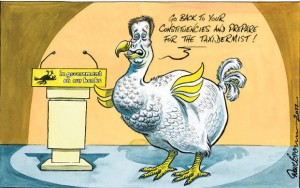
Conservative columnists suggest that it is unfair to other citizens of the UK who can’t vote on an issue that impacts them.  Others are arguing that there are benefits to separation for workers.  They talk about civic nationalistm – the idea that all citizens should be engaged in the process of deciding where society is headed, not just getting their hands on the tiller once every four or five years. It utilises the n-word because democracy on a national level offers the best opportunity for fundamental change.

The vote appears to be close, but insiders think there will be no split at this time.

 Scotch Independence

The State of the Irish Economy

John O’Hagan writes:  Some recent commentaries would at times lead one to believe that our public finances problem has almost been resolved. And that with renewed significant growth the severe unemployment and equity problems that followed the crisis have largely been addressed.

Three years ago the economy of the Republic was still reeling from tumultuous years of economic setback.  Output after 2007 had declined on a scale almost never seen in peacetime anywhere, unemployment had trebled, employment had declined by almost 300,000 and large-scale net emigration had resumed for the first time in almost 25 years.

At times it seemed like the political system could not survive intact in the face of widespread anger and with huge numbers facing large-scale financial problems arising from negative equity, lost jobs and a fear that the euro zone might implode.

Three years on, things look a lot brighter. As some populist commentators fuelled the flames of discontent, most of the Irish population, it seems, got on with dealing with a crisis that was largely of our own making. There is only so long one can lament events and attempt to blame others, be it at a personal or societal level, but ultimately we must move on and try to make good the damage and plan for a better future.

Many of those most affected complained least: the involuntary emigrants, the newly unemployed, the people trapped in negative equity and the young who took the brunt of the pain. Very often it was those least affected who complained the most: those in secure, pensionable jobs and many of the elderly who were largely protected from the effects of the recession.

Last year now appears to have seen a major turning point, with further large employment increases likely this year. A remarkable recovery in employment, then, will have occurred in just three years.  There is no reason why the Republic cannot prosper in years to come and remain one of the high-income countries of the world.

The country has a healthy, stable democracy and a well-established rule of law. The skill levels of the labour force are the same as they were prior to 2008. There is a healthy openness to competition and entrepreneurship.

All democracies are flawed to an extent and economic debates are often fraught and misinformed, Ireland over the last six years being no exception. It is worth remembering therefore that economic policy is exercised in the political market place, and will continue to be so in the years ahead.

Economists may have forgotten their history up to recent times but so also do they often forget that economic policy and politics are inseparable. Having a solution to an economic problem is of little benefit if the political system cannot be assured of delivering on it without risking major instability, thereby exasperating the difficulties.

Huge inequities persist despite the recovery. The most important antidote to such inequities is to create employment which is now happening on a large scale in the Republic.  Bringing about major further reductions in unemployment is the great social and economic policy challenge ahead.

A disturbing reflection of this is the exercise electorally of “grey power” in recent years, where as a result payments to over-65s, regardless of their circumstances, have largely been protected while those to other, younger groups have been cut.

Short-term fluctuations

One also should not be deflected from the medium- to long-term focus by the short-term fluctuations of financial markets or predictions of imminent doom or boom.

Ireland  still has a huge accumulated debt and continued large borrowing needs to fund day-to-day expenditures.

Jobs in Ireland

Can Alibaba Justify its Price?

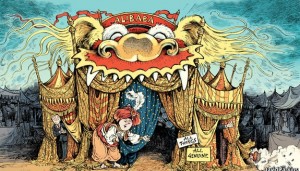
Alibaba Group Holding Ltd’s high-profile initial public offering on the New York Stock Exchange is just days away, with trading expected to commence on Friday.  The IPO has been forecast to raise as much as $24 billion, which will make the IPO the largest in history.  Investor attention and probable attraction has been heightened by the relatively conservative initial share price set at $60 to $66.

Alibaba could be valued at about $170 billion and sit firmly in the top 25 companies in the S&P 500 index.  But amid the impressive figures and the frenzy surrounding this flotation, would it not pay for the investment community to take a rather cautious and wary approach?

Simon Xie: Jack Ma’s unassuming lieutenant at Alibaba In the very short term, it is difficult to foresee anything other than a sizable gain on any investment.  The initial share price, which could rise slightly shortly before the float, is widely regarded as a deliberate move to raise investment interest.  But once the euphoria fades and attention switches to rational analysis, major concerns over Alibaba’s medium- to long-term competitiveness may emerge.

One of the major concerns is the complex and opaque nature of Alibaba’s ownership structure and accounting practices.

For example, what are the real relationships among the 29 companies Alibaba has bought during the past two years and the group’s overall, impressive profit record?  Market growth is also slowing in China, and Alibaba’s initial, tentative overseas forays have not yet led to major success.

The rapid growth in market share and profitability enjoyed by Alibaba may be replaced by far more modest gains where consolidation takes priority over entrepreneurial endeavor.

Alibaba’s success in the Chinese mainland has been built on an “architecture of trust” that has empowered consumers and businesses with its reliable online payments and related services.  China’s e-commerce industry is still hampered by deep mistrust, except for Alibaba.

However, things are very different in the lucrative United States and European markets where strong competitors such as Amazon.com Inc already have well-entrenched market positions and strong corporate brands.

Many Chinese companies that have global ambitions also have low brand awareness among foreign consumers, and Alibaba is no exception.

Most consumers in other countries who are aware of the Alibaba brand mostly think of its charismatic leader and co-founder, Jack Ma.

Ma’s undoubted charm and ability to attract media attention with his passion for business will probably boost Alibaba’s initial listing and may well lead to a short-term burst on the NYSE.

But is this style of leadership most suitable for the analysis and planning now needed to secure successful entry and growth in increasingly competitive markets?

The fears of investors looking at the longer term will only be assuaged if Ma can be seen to quickly build a senior management team based on international market knowledge and experience.

Clearly, Alibaba’s IPO will generate tremendous excitement, but long-term growth prospects remain cloudy, and investors should proceed with caution.
Alibaba IPO

Industrial Production Slumping in India

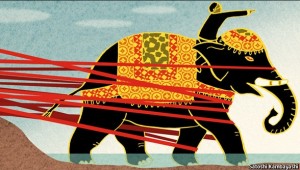
The honeymoon for new Prime Minister Narendra Modi may be over.  For three months, April though June 2014, Industrial Production in India averaged almost 4.0% real growth year-over-year.  The number for July has fallen to 0.5%.  The three consecutive months with y-o-y growth 3.4% or higher was the first such period in nearly three years.

Rajesh Kumar Singh writes:  The optimism fanned by Modi’s rise to power has already brought inflows of nearly $14 billion of foreign funds into Indian equities this year as investors bet that his drive to cut red tape will revive stalled projects and underpin the economic recovery.

The 50-share Nifty has gained over 30 percent in U.S. dollar terms this year to become the best-performing equity index in Asia. Goldman Sachs upgraded its target for the index this week, citing optimism over future earnings of Indian firms.

To sustain this euphoria, economists say, Modi must overhaul India’s strained public finances, stringent land acquisition laws, chaotic tax regime and rigid labour rules.

During his first 100 days in office, the new prime minister showed little appetite for such structural changes, and there is concern that sharply higher growth in the last quarter could reduce their urgency.

That could be damaging for an economy that is still hobbled by slack consumption and weak business investment. Persistently high inflation and years of stagnant growth have forced consumers to cut discretionary spending.

India's Economy


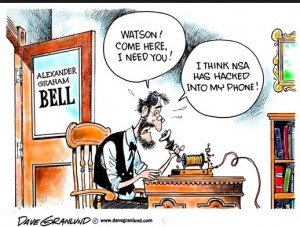
Privacy, Security and US-German Relations

Andy Müller-Maguhn, Laura Poitras, Marcel Rosenbach, Michael Sontheimer and Christian Grothoff reporting:  When it comes to choosing code names for their secret operations, American and British agents demonstrate a flare for creativity. Sometimes they borrow from Mother Nature, with monikers such as “Evil Olive” and “Egoistic Giraffe.” Other times, they would seem to take their guidance from Hollywood. A program called Treasure Map even has its own logo, a skull superimposed onto a compass, the eye holes glowing in demonic red, reminiscent of a movie poster for the popular “Pirates of the Caribbean” series, starring Johnny Depp.

Treasure Map is anything but harmless entertainment. Rather, it is the mandate for a massive raid on the digital world. It aims to map the Internet, and not just the large traffic channels, such as telecommunications cables. It also seeks to identify the devices across which our data flows, so-called routers.

Furthermore, every single end device that is connected to the Internet somewhere in the world — every smartphone, tablet and computer — is to be made visible. Such a map doesn’t just reveal one treasure. There are millions of them.

The breathtaking mission is described in a Treasure Map presentation from the documents of the former intelligence service employee Edward Snowden which SPIEGEL has seen. It instructs analysts to “map the entire Internet — Any device, anywhere, all the time.”  The NSA Breach of Telekom and Other German Firms

Security?

Political Divorce: UK, Spain and Ukraine Style

Pyotr Romanov writes:  Divorce among couples rarely ends without problems, and all the more so with divorce between states. Those splits inevitably involve political and economic hardships, mutual recriminations and a complex and painful division of property. And even once this nightmare is over, the very presence of the other party causes interminable irritation and anger.

The only example that I can recall of a civilized “state divorce” in Europe was the peaceful division of Czechoslovakia into two parts.

Divorce and separation remains a very real problem for Europe. Scotland’s agitation to leave the U.K., Catalonia’s attempts to escape the custody of Madrid and Novorossia’s bloody fight to break away from Ukraine are all ongoing issues.

And although each case is very different, they share one aspect in common: London, Madrid and Kiev are exerting great efforts to prevent those disunions. However, a strict interpretation of international law indicates that, in all three cases, those advocating separatism have every right to at least advocate their cause.

In 1945, the right to self-determination was included in the United Nations Charter. Then, in 1966, this right was enshrined in the International Covenant on Economic, Social and Cultural Rights and the International Covenant on Civil and Political Rights.  Still later, this right was confirmed in documents of the Organization for Security and Cooperation in Europe.

In theory, the people living in the area affected should resolve these disputes, without any outside interference. The UN Charter states that “all states shall, in accordance with the provisions of the UN Charter, encourage the right to self-determination, and shall respect that right.” The only problem is that nobody “respects” that right.

The UN Charter also contains the contradictory principle of “the inviolability of borders” because after World War II the leading powers wanted to ensure stability by any means. The second reason is that the clause on self-determination was introduced during the collapse of the colonial system when the authors had the African states in mind.

The underlying problem with the current world order is that it has long outworn its original set of clothing and just plods on wearing the same old, uncomfortable and increasingly tattered rags. A prime example of this is the fact that the victors in World War II continue to control the UN Security Council, a completely inappropriate situation given the wealth and power of the world’s developing nations.

If Kiev and Moscow had enough sense, it would avoid all this bloodshed by letting Novorossia go in whichever direction it wanted. Thus freed from that heavy burden, Kiev could finally pursue meaningful integration with Europe.  However, Madrid will continue desperately clinging to Barcelona, London to Scotland and both Kiev and Moscow to the Donbass.  If only someone would follow the example set by Vaclav Havel.

Whose Constituency?

Vote in Scotland: History Changing/Making

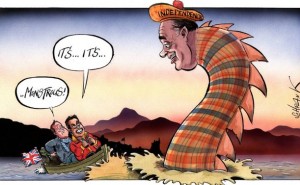
Tom Devine writes:  In four days’ time, we may see the end of Britain as we and our ancestors have known it for generations. If some of the polls are to be believed, Scotland the nation will once again become a sovereign nation state. It is difficult to overestimate the colossal historical significance of such an extraordinary development.

Its consequences for the British archipelago and Britain’s place in the world will be incalculable for many years to come. A third of the UK land mass will immediately cease to be British territory. “South Britain” beckons as the presumptive name for the remainder of the UK. Even if the no campaign manages to achieve a narrow victory, the crisis in the union will continue unabated. The evidence to date suggests that Westminster politicians do not yet possess the imaginative capacity to deal with it.

All this presents a major intellectual challenge for the historian. Little more than a generation ago, in the 1950s and early 60s, the union could not have been more secure.

The memory of the collective British sacrifice of the second world war lived on for the postwar generation in comics, books and films. The empire started to dissolve with the independence of India in 1947. Yet, contemporaneously, the welfare state was established and soon became the new sheet anchor of the Anglo-Scottish union. Nationalisation of key industries further strengthened the idea of a British-wide collective economic enterprise.

Yet all this can be seen in retrospect as the quiet before the storm. Winnie Ewing’s surprise victory for the SNP in 1967 was a small but significant portent of what was to come. The crucial historic importance for Scotland of maintaining free access to English markets ceased to be of such importance when the UK entered the common market.

A shared English and Scottish commitment to Protestantism in the past had provided much of the ideological glue of union. This is no longer so in the age of secularisation.  he two political parties most committed to the union left little space for the growth of nationalism. Moreover, Catholics had at that time a profound suspicion of the SNP, believing it to be dominated by Presbyterians, as well as having a few notorious bigots in its senior ranks.

The experience of Scotland in the 1980s lost nearly a third of its manufacturing capacity. The great heavy industries that had made Scotland’s global economic reputation over more than a century disappeared in a matter of a few years. A post-industrial economy did emerge in the 1990s, but the crisis left behind a legacy of social dislocation in many working class communities and created a political agenda north of the border in marked contrast to that of the south of England.

Equally fundamentally, state involvement and public spending became even more important to many Scots,  It is also the root of those Scottish political attitudes that seem to favour Scandinavian-type social policies, and which strongly oppose neoliberal market economics, associated in the public mind with the alien ideology imposed during the Thatcher years. Sean Connery at the opening of the Scottish parliament in 1999. ‘The parliament eventually became the vehicle for a transformed SNP.’ Photograph: UPPA Ltd.

The foundation of the Scottish parliament in 1999 and the referendum were not directly linked causally. But the parliament did eventually become the vehicle for a transformed SNP to gain political power and then trigger the referendum process.

There may well be a no vote on Thursday. But a victory for unionism will be far from decisive or definitive. Nearly half the Scottish electorate will almost certainly vote yes and may not be easily satisfied by post-referendum  concessions that are also likely to further fuel resentments south of the border. If the yes campaign wins, Britain will never be the same. Three centuries and more of political union between England and Scotland will be consigned to history. It’s the possible end of an old political union rightly thought by many Scots to be no longer fit for purpose.

Scotch Vote

Smart Watches Must Track Activity

We’ve already seen smartwatches from Samsung, Motorola and LG and now Apple.  Some are shaped rectangular and others look more like traditional wristwatches. But what value do these wearable mini computers deliver and what do consumers really want from them?

According to an international survey conducted by German research institute GfK, the most wanted feature in a smartwatch is activity tracking. Borrowing from fitness wristbands, most smartwatches can track steps, measure your heart rate and tell you how many calories you are burning throughout the day. Apple’s rumoured iWatch is also expected to focus on the health aspect, even though it might take things further than other devices have thus far.

Smart Watch

Greek Debt at “B” via Standard & Poor’s

Standard & Poor’s upgraded its debt rating for Greece on Friday, up from B minus to B, with a stable outlook for the rating. S&P had an optimistic forecast on Greece’s economy, predicting a slow recovery in 2014 after seven years of continuous economic downturn.

“‘The outlook is stable, balancing our view of Greece’s progress in fiscal consolidation against its still-weak economic recovery and political resolve to continue with structural and institutional reforms,’ said S&P in a news release on Friday.”

Greece’s current long-term sovereign credit rating of B indicates “more vulnerable to adverse business, financial and economic conditions but currently has the capacity to meet financial commitments.”

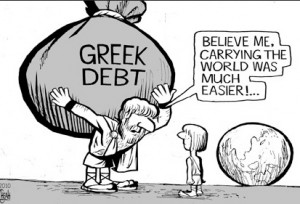
Greece was one of the many countries involved in the aftermath of the 2008 financial crisis. In 2010, Greece received a “junk” rating on its debt and subsequently became locked out of private capital markets. The country then received a bailout from the rest of Europe and the International Monetary Fund totalling 240 billion euros.

Greek Debt Picture