Confidence in Juncker Faces Vote?

The motion, backed by 76 MEPs, including the UK Independence Party and the National Front in France, is unlikely to succeed.  It alleges Mr Juncker is unfit to hold office because of what it calls aggressive tax avoidance schemes in Luxembourg while he was PM there.

If the motion, which also has the support of the Five Star movement in Italy, did succeed, the Commission would have to resign.

It argues that EU member states have lost billions of euros of potential tax revenues because of tax avoidance schemes implemented in Luxembourg during the 18 years Mr Juncker was prime minister there.  Actually the US has lost a lot more money because of deals of which Juncker at the very least was knowledgeable.s.

UKIP MEP Steven Woolfe said: “This motion of censure means there must now be a debate on the behaviour of President Juncker and a vote to remove the entire European Commission.

Liberal Democrat MEP Catherine Bearder criticised UKIP leader Nigel Farage for joining the National Front, led by Marine Le Pen, in backing the motion.

Instead of this opportunist grandstanding, the EU needs a proper independent investigation into the allegations against Juncker and his possible involvement in tax evasion.”

Mr Juncker, who took over as head of the EU’s executive body at the start of November, has come under pressure over claims that some 340 global companies were granted deals to help them avoid tax during his 18 years in office, which ended last year.

Mr Juncker was Luxembourg’s finance minister before becoming its head of government in 1995. He has insisted all tax settlements reached under his leadership complied with national laws and international rules.

Speaking in Brussels last Wednesday, Mr Juncker said there was “nothing in my past indicating that my ambition was to organise tax evasion in Europe”

Luxembourg, Tax Haven?

Monsanto Pivots to Big Data?

Monsanto was founded in 1902 producing an articial sweetener in St. Louis.  It has gorwn iinto the worlds largest producer of genetically modified seeds.  Now it proposes to enter the field of big data.  Pivot, pivot, pivot, a remarkably agile company.  From industrial chemical to the notorious Agent Orange, Monsanto has faced huge business challenges and survived.

Is it possible that its next turn will be toward Bid Data?  In its 2013 Annual Report, Mansanto blamed lost profits on failure to predict the climate properly and failure to recognize changing habits of famers.  To address both issues they are becoming information experts.   As a side effect, they will be able to contribute to knowledge about climate change and quality food production, two areas that the press has been merciless on exposing as they examine genetically modified seed produciton.  Monsanto’s Pivots

Big Data

German Companies Gobble up Food Market in UK

German discount food companies are gobbling up the market in the UK.  Aldi and  Lidl are waging war and driving down prices.  This is good for British consumers, but bad for the local food chain Tesca, which used to be Britain’s grocery market chain.

Asda, which is owned by Wal-Mart Stores, has been holding its own.

Tesca is also under investigation by the UK Serious Fraud office for fudging its books.

Internet shopping and delivery to home services have made grocery stores on the outskirts of any town almost suerfluous.

Goldman Sachs, analyszing the situation in Britain, says that stores are going to have to close venues and cut capcacity.

Low Cost Supermarkets in UK

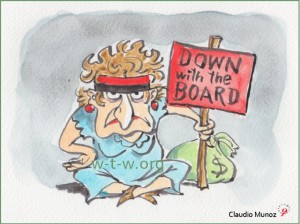
Are Men the Answer to Putting More Women on Corporate Boards?

Caroline Fairchild writes: Women occupy just 16.9% of Fortune 500 corporate board seats today, and progress has been slow. A new report from the Committee for Economic Development outlines how we can increase the rate of change.

After years of making the business case for diverse boards via research and panel discussions, it’s time for a different approach.

Despite all of the studies showing corporate boards with female directors perform better than all-male peers, women occupy only 16.9% of Fortune 500 corporate board seats today. In the last decade, that percentage has grown by just 3.3%.

“We don’t need any more studies, we get it,” says Janice Ellig, the co-CEO of executive search firm Chadick Ellig. “There is a pipeline out there of very talented women running major divisions at companies or law firms or working in science and they should be sitting on boards.”

To accelerate change, the Committee for Economic Development, a business-oriente  public policy group, plans to go directly to nominating committees of prominent corporate boards to engage them in a dialogue on the issue. By making some simple changes in the way that they think about recruiting new board directors, the CED believes the U.S. can achieve 30% female representation on corporate boards by 2018.

“You get a lot further by talking with people rather than talking at them,” says Debra Perry, the co-chair of CED’s women’s economic contribution subcommittee. “There is a vast amount of research and public relations efforts that have been underway, but there still has been very little progress.”

To get to the goal of 30% female representation in four years, every other board seat that becomes available between now and 2018 will have to be filled by a woman. While the goal might sound impossible given how slowly things are currently moving, the CED suggests in a new report that expanding the criteria for qualified directors will go a long way to getting results. Nominating committees typically draw up an excessively narrow list of qualifications for directors.

Former or current CEOs are considered to be the ultimate prize for elite companies searching for board members. Only 5% of CEOs at Fortune 500 companies are women, so this narrow definition of qualified candidates considerably shrink the talent pool. Yet if nominating committees more aggressively recruited slightly lower ranking leaders – divisional presidents, law firm partners, financial service executives and entrepreneurs – a lot more women would be eligible.

The CED is not recommending the U.S. consider government-mandated quotas for women on boards. While several European countries such as France, Spain and Norway have increase the diversity of their boards this way, the CED believes this is an intrusive regulation that will make people view female appointees differently by their male peers on the board.

Qualified female candidates also need to step up. Gerri Elliott, a director Whirlpool Corporation WHR 0.95% , Bed Bath and Beyond BBBY -0.51% and Charlotte Russe, has a combined 34 years of senior executive experience at tech business like IBM IBM -1.38% and Microsoft MSFT -0.83% . Yet when she decided over a year ago to look for her first seat on a public board, she had a hard time finding the right opportunity.

“The CED report outlines well how we need to increase the diversity of our boards for good business reasons,” says Elliott, a CED trustee. “We haven’t moved the needle fast enough. But it’s also up to women to help themselves by aggressively getting a plan in place to make it happen.”

The CED’s call to bring in one woman for every man that gets a new board seat in the next four years, will hopefully change the current approach.

Women on Boards


The Masai May Prefer Internet Explorer

The Tanzanian government seems to be moving ahead with a deal to sell 600 square miles of land to a UAE luxury safari company, but that land is currently home to thousands of Masai pastoralists.

The land on which the Masai peoples’ cows can graze is under threat of shrinking – again.

A UAE-based luxury safari company’s proposal for an extensive wildlife corridor that would border the Serengeti National Park, which was called off last year, appears to be under consideration by the Tanzanian government once more. Government officials have ordered that the pastoralists vacate the land by the end of the year.

The Tanzanian government is offering one billion shillings – a little more than half a million US dollars – to go towards socio-economic development projects as compensation, but the Masai are intent on keeping their land. Representatives from the ethnic group were scheduled to meet with Prime Minister Mizengo Pinda in Dodoma, the Tanzanian capital, on Tuesday.

The Masai, a pastoralist people that have resided for centuries in East Africa, herd cows as a central part of their existence. They rely on moving around semi-frequently to allow grazed land to regenerate during their absence. Masai herders’ attachments to their land also come in the form of maintaining ancestral heritage.

Colonization of the region by the British in the 19th century forced the Masai into smaller parcels of land and in 1959, British colonialists persuaded the Masai to sign an agreement that evicted them from the Serengeti, but provided them living space in the Ngorongoro highlands.

The development proposal, which would allow access of the area exclusively to the Ortello Business Corporation, requested that the land be used to build a 600-square-mile corridor through the Loliondo region. In order to do so, the government would have to evict 30,000 Masai from the land before handing it over to the corporation that has close connections to the Dubai royal family. Members of the Masai tribe argue that the eviction would impact the lives of closer to 80,000 people.

The Tanzanian government first leased land in Loliondo, which was used for commercial hunting camps, to OBC more than two decades ago. And while government officials have argued that the Masai’s pastoralist behavior threatens endangered wildlife, members of the ethnic group and researchers alike claim that government interests lie elsewhere.


Masai


Russia Hangs Up on Germany

It is a fundamental principle of German foreign policy that talks are the best way to solve diplomatic problems. Such was the rationale behind Gernot Erler’s recent trip to Moscow to speak with Russian parliamentarians about the ongoing Ukraine-related difficulties. There was no one in parliament who was willing to speak with him.

For Erler, the message was clear: Russia is no longer particularly interested in dialogue. That is true for simple parliamentarians just as it is for Vladimir Putin. The Russian president still, to be sure, speaks regularly with Angela Merkel. But the chancellor believes that what Putin says and what Putin does have long since diverged. Russian policy, says Erler, is currently following the “principle of organized unpredictability.”

From the perspective of Berlin, Russia has gone from being a difficult partner to being an adversary within just one year.  One official at Merkel’s Chancellery says that in some ways the situation is even more difficult than it was during the latter phases of the Soviet Union. Back then, the official says, Moscow at least adhered to agreements.

Berlin has observed a broad new approach by the Kremlin in the Balkans.  The same holds true for Serbia’s neighbor, Bosnia-Herzegovina. In a paper on “Russia’s soft-power strategy” in the Balkans that was drafted for Putin by the influential Council on Foreign Relations in Moscow.
Putin would seem to have taken the advice to heart. The Russian Railways company, headed by Putin-ally Vladimir Yakunin, is currently refurbishing a 350-kilometer (217 mile) stretch of track in Serbia at a cost of three-quarters of a billion euros. Furthermore, the Moscow-based oil multinational Lukoil now owns 79.5 percent of the local service-station chain Beopetrol while Gazprom holds majority ownership of the country’s largest natural gas supplier. “Russian investments have improved the prospects of regions that were heavily damaged by the NATO bombardment in 1999,” the paper reads. In Montenegro, Russia is the largest foreign investor, with Russians controlling one-third of all companies in the country.

The German government believes that Russia’s approach in the region has been largely successful. The Foreign Ministry analysis notes that October’s 70th anniversary celebration of Belgrade’s liberation from the Nazis was moved up by four days to coincide with Putin’s visit there.

One particularly odd meeting underscores the methods Putin uses to expand his influence in Serbia. One year ago, Nikoli received the head of the Moscow motorcycle club Night Wolves, Alexander Zaldostanov. Putin refers to Zaldostanov (alias: The Surgeon) as his “brother.” The gang has made repeated headlines for its outspoken anti-Semitism and homophobia, stances that are consistent with attitudes widely held in Serbia.

It is not easy for the German government to counteract the Russian offensive. Angela Merkel has sought to thwart Putin’s efforts diplomatically. At a Balkans conference in the Chancellery at the end of August, she encouraged the gathered heads of state and government to commit to a pro-EU path.

Putin’s efforts to expand his influence do not stop at EU borders.  Now he is doing his best on influence policy-making in individual EU member states, particularly in Bulgaria.

The country has traditionally been closely allied with Russia and is almost completely dependent on Russian natural gas and oil. An internal report from the German Foreign Ministry notes that around 300,000 Russians have bought property in Bulgaria. Officials in the Chancellery are concerned that Putin could seek to instrumentalize the alleged interests of the Russian minority there.

The fundamental problem from a Western standpoint is the fact that the desire for escalation and the ability to do so is not divided equally. Putin appears prepared to promote Russian interests in his neighborhood economically, politically and, if necessary, militarily. The West doesn’t have much to offer in response.

Critics of Moscow, such as Andreas Schockenhoff, the deputy head of Merkel’s conservatives in German parliament, believe that the sanctions must be maintained until the costs become too great for Putin. But even during the last round of EU sanctions, Merkel had difficulty convincing skeptics, such as Italian Prime Minister Matteo Renzi and Hungarian Premier Viktor Orban to agree to the penalties. She was thus particularly upset by recent comments by the EU’s new foreign policy chief, Federica Mogherini, calling the effectiveness of sanctions into question.


Is Russia Taking Germany for a Walk?

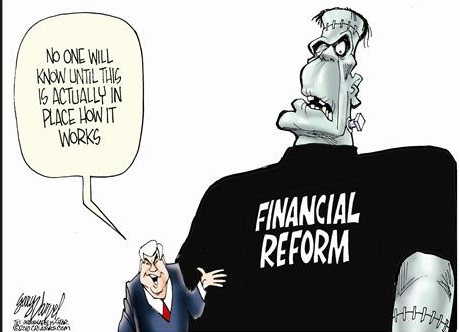
Last Gasp for Financial Reforms Before Republicans Take Over?

In Washington all eyes wil be on the FederalReserve’s meeting notes for clues about a rise in interest rates.

Sen. Sherrod Brown (D-Ohio), chairman of the Senate Banking subcommittee on Financial Institutions and Consumer Protection, is scheduled to convene a hearing on Wall Street regulations.  The hearing will specifically spotlight a Sept. 26 report from NPR and ProPublica that raised questions about how the New York Federal Reserve Bank has regulated Wall Street.

That hearing will follow the U.S. Senate Permanent Subcommittee on Investigations’s Thursday plans to hold a hearing into how Wall Street banks have impacted the commodities markets. Chairman Carl Levin (D-Mich.) and Brown have been extremely critical about how big banks have stored physical commodities that some say has unfairly driven up costs.

The House Financial Services Committee will hold a hearingregarding how international regulatory standards affect the competitiveness of the U.S. insurance market. It will feature testimony from Thomas Sullivan, senior adviser for the Federal Reserve Board of Governors.

Mel Watt will testify before the Senate Banking Committee.  It will be one of the first times that Watt, a former Democratic lawmaker, will appear before Congress as the director of the Federal Housing Finance Agency since his turbulent confirmation process. Housing insiders will be watching for clues to see if anything comes up about whether the new Congress will tackle housing finance reform.

Financial Reforms?

The Diaspora Votes Against Corruption in Romania

Leonid Bershisdky writes: Corruption and weak institutions are major reasons that East Europeans leave home to seek their fortunes. In developed countries, the public often sees them as economic emigres or even “benefits tourists” leeching off their hosts’ welfare systems. It would be more accurate, however, to see them as refugees from hopelessness. Had their motives for emigrating been purely economic, they wouldn’t be voting in such large numbers, and would have no interest in their home countries’ politics.

The way the emigres vote is telling. In the 2012 Russian presidential election, President Vladimir Putin lostt to billionaire Mikhail Prokhorov in France, Canada, Australia, the Czech Republic, Holland and Switzerland. In several other developed countries, Putin’s lead was narrower than in Russia. In the May 2014 Ukrainian presidential election, pro-Western billionaire Petro Poroshenko Ukrainian got 62.3 percent of the diaspora vote.

Corruption in Romania

What To Do With a Sluggish World Economy?

The G-20 meeting in Australia didn’t focus sufficiently on hte lessons of the Japanese economy.  The International Monetary Fund has repeated over and over that government spendiing is necessary to stimulate sluggish economies around the globe.

W-T-W.org Women and Finance is advocating a 20-year infrastructure program to make long overdue and necessary repairs to roads, bridges, and public transportation in the US.  This would also employ people who have been out of work for too long.  We think this program is a win-win.  While repiars are made, we can focus on preparing people for the jobs of the future so that there is a better match between workers and jobs.

At  G-20 what needed to be done was clear.  The question is: Does the world have the political will.

Infrastructure Repair

Is Facebook @Work?

Mark Zuckerberg has not had an easy time monetizing Facebook.  Facebook’s average revenue per user is  $1.13.  LinkedIn’s is $3.33/   LinkedIn has a niche market, but it is a desirable one: white collar workers.

Now Google is preparing to launch Facebook@Work.   Google is the workplace giant at the moment, with shared docs, GooglePlus for groups and is still the web search of choice.

Facebook, unable to buy Snapshot, developed a messaging app called Slingshot.  But you can’t open your message until you send one.

Zuckerberg wants to be in the office, but can he get there?

Facebook