Blackstone Pulling Out of Russia

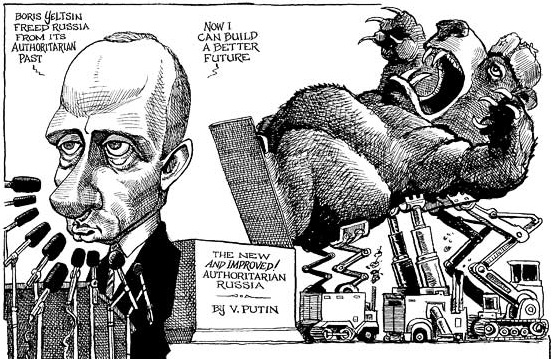
US private equity group Blackstone is “giving up on Russia”, highlighting how even well-connected western investors are shying away from doing business in the country.

The New York-based buyout group has been frustrated in its attempts to find deals in the country since its co-founder Stephen Schwatzman joined the international advisory board of the Russian Direct Investment Fund, a $10 billion government-backed fund, three years ago.

It hired Dmitri Kushaev, the former head of investment banking at ING in Russia and a former private equity executive, as senior adviser to assist on deals in the country.

But Blackstone, which does not have an office in Russia, has chosen not to renew the contracts of the consultants it employs in the country.

According to a person with knowledge of the matter, the move will bring to an end Blackstone’s embryonic attempts to break into Russia.

US and European sanctions against Russian individuals close to the Kremlin, as well as state-backed industrial and banking groups, have led to a freeze in Western investments in the country.

Blackstone’s decision was also prompted by the fact that it had not found suitable investment opportunities in the past three years, the person said. “In the good times, Blackstone couldn’t find anything to do and in the bad times, Blackstone can’t imagine doing anything.”

Russian Economy

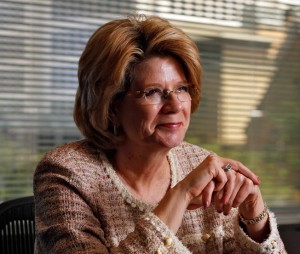
Beth Mooney, the Most Powerful Woman in Banking

The American Banker named Beth Mooney the most powerful woman in banking for the second year in a row.

Beth Mooney has made history as the first female CEO of a top 20 U.S. banking company, but when her career is over she most wants to be remembered as a banker who made a difference.

She’s proud that KeyCorp’s profits and share price have risen steadily since she took the helm in 2011, and equally proud that it is the only large bank in the country to have earned an “outstanding” rating from regulators on its community reinvestment activities for eight consecutive years — dating to when she ran Key’s community bank.

She’s proud, too, that the company’s charitable arm gave away $18 million last year and that its small-dollar loan product has been praised by banking regulators and consumer advocates for meeting a need without trapping consumers in a cycle of debt.

“All of these things are proof points… that we are a company committed to doing things the right way,” says Mooney.

Though Key has long had a reputation as a good corporate citizen, it has redoubled its efforts under Mooney. One of her first acts as CEO was creating an office of corporate responsibility to oversee a wide range of functions — from community development lending to diversity in the workplace — and to help guide Key’s mission of always doing right by customers and communities.

Mooney believes that most banks are acting more responsibly these days and says that the banking industry has made huge strides in regaining the trust it lost during the financial crisis. Still, she wants Key to be recognized as a leader in corporate responsibility and points to its small-dollar loan product, the KeyBasic Credit Line, as an example of how it is differentiating itself from competitors. Unlike deposit advance products, which can be similar to payday loans, Key’s revolving line of credit gives borrowers up to 60 months to repay at interest rates ranging from roughly 17% to 22%, depending on the size of the loan. While regulators have been sharply critical of the fees and terms for deposit advances and have forced many banks to stop offering them, they have hailed KeyBasic, launched in 2011, as a viable and responsible alternative to payday loans. Key has collaborated with the Center for Financial Services Innovation on a white paper about small-dollar lending and was recently asked by the Pew Charitable Trusts to help it come up with guidelines on responsible payments that it could recommend to the Consumer Financial Protection Bureau.

Another priority for Mooney is workplace diversity. DiversityInc magazine has named Key as a top 50 company to work for in each of the last two years in part because women and minorities comprise roughly 36% of the leadership team. Its board of directors is diverse as well, with five women, including Mooney, and two minority males among its 13 members. Earlier this year the advocacy group WomenCorporateDirectors presented Mooney with its annual “Visionary Award” in recognition of the fact that Key has a higher percentage of females on its board than any other large banking company in the country. But what motivates Mooney above all is “helping clients and communities thrive.” Her ideal is for people to think of Key as a company that improves their lives, through its products and services, its workplace culture and its community contributions. “I take my legacy very seriously,” Mooney says.

Beth Mooney

SEC Nabs Post-It Insider Trader

If the SEC can capture a man doing insider trading by post-it notes, can the big banks be far behind?

The Securities and Exchange Commission charged a Brooklyn man with facilitating a $5.6 million insider trading scheme that typically involved the passing of illegal tips via napkins or post-it notes at Grand Central Terminal.

Earrlier this year, the SEC charged a stockbroker and a law firm managing clerk with insider trading and alleged they were connected by a mutual friend who served as a “middleman” in an effort to keep the two unlinked. In a separate complaint filed today in U.S. District Court for the District of New Jersey, the SEC identifies Frank Tamayo as that middleman. The SEC alleges that Tamayo received material nonpublic information from Steven Metro about 13 impending corporate deals involving clients of the law firm where Metro worked. Tamayo then tipped his stockbroker Vladimir Eydelman, who used the confidential information to illegally trade for himself and for Tamayo and other customers. Tamayo allocated a portion of his ill-gotten profits for eventual payback to Metro for the inside information. Said Robert Cohen, Co-Deputy Chief of the SEC Enforcement Division’s Market Abuse Unit:

As the middleman, Tamayo was the firewall between Metro and Eydelman. Metro had the information, Eydelman did the trading, and Tamayo kept them apart. But they were wrong in believing that this would stop the SEC from detecting their scheme.

In a parallel action, the U.S. Attorney’s Office for the District of New Jersey today announced criminal charges against Tamayo. The U.S. Attorney previously brought criminal actions against Metro and Eydelman. Those criminal cases and the SEC’s civil case against Metro and Eydelman are pending.

According to the SEC’s complaint against Tamayo, the scheme was deliberately structured to avoid detection, enabling Eydelman and Tamayo to profit without connecting the trades to an insider source and also allowing Metro to share in the trading proceeds. For a five-year period, Metro repeatedly accessed confidential information in his law firm’s computer systems and met with Tamayo at bars and coffee shops in New York City to provide tips about firm clients ready to participate in a corporate transaction. Tamayo typically would then connect with Eydelman near the clock at the information booth at Grand Central, where he would show him a post-it note or napkin on which Tamayo wrote the stock ticker symbol of the company to be acquired. Tamayo then chewed up and sometimes even ate the post-it note or napkin to destroy evidence of the tip. Tamayo also conveyed to Eydelman the approximate transaction price and timing of the deal. After Eydelman returned to his office and gathered research about the target company, he would e-mail Tamayo supposed thoughts about why buying the stock made sense. Their intent was to create a paper trail of e-mails to make it appear they were making their trading decisions based on research and analysis rather than inside information.

The SEC’s complaint charges Tamayo with violations of Sections 10(b) and 14(e) of the Securities Exchange Act of 1934 and Rule 10b-5 and 14e-3 as well as Section 17(a) of the Securities Act of 1933.

Insider Trading by Post-It


Cleaner, Greener, the New World?

More than 300,000 people marched in New York for environmentally responsible policies.  Recently Christiana Figueres and Guy Ryder have written about the job creating possibilities of green and clean.

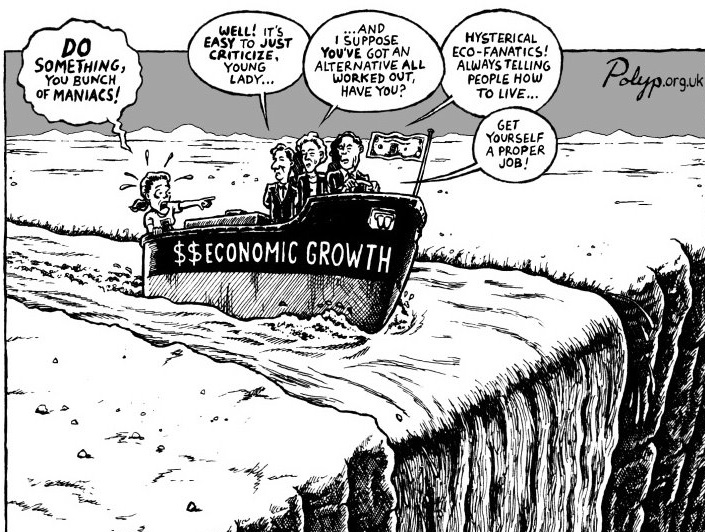
In the past, action to combat climate change was viewed largely as running counter to economic growth, with “going green” implying a sacrifice of prosperity for the sake of the environment. Today, we know better. By taking action to mitigate climate change, companies are promoting sustainable growth and creating high-quality employment.

The United States, for example, has added 1.2 million “clean” jobs to the economy since January.  Since last year, employment has risen by more than 115% in the solar industry, and jobs related to energy efficiency have increased by over 50%.

In China,  more than 1.7 million people are already employed in the renewable-energy sector. And the Global Climate Network that seven million additional jobs could be created if government targets for wind, solar, and hydropower are met. Worldwide, an estimated 5.7 million people were employed directly or indirectly in the global renewable-energy industry in 2012 – a figure that could triple by 2030.

Likewise, India’s Mahatma Gandhi National Rural Employment Guarantee Act aims to ensure livelihood security in rural areas by providing at least 100 days of guaranteed wage employment in a financial year to every household whose adult members volunteer to perform unskilled manual labor. The lion’s share of this work involves projects that can boost environmental resilience, from soil and water conservation to flood protection, reforestation, and small-scale irrigation.

In Brazil, the green program, which offers incentives to poor families to carry out conservation work in local nature reserves, provided monthly payments of $35 to more than 16,600 families in its first year. There are plans to extend the program to 300,000 families, and to add other climate-friendly projects, such as renewable-energy schemes. Colombia and Mexico have introduced similar initiatives.

Achieving a meaningful global climate agreement at next year’s United Nation’s Global Change Conference would substantially boost the potential to create high-quality green jobs. The alternative – continued growth of global CO2 emissions – would not only limit this potential; it would undermine economic output and, according to estimates by the International Labor Organization (ILO), reduce productivity by more than 7%, on average, worldwide.

The fact that two of today’s most pervasive challenges – climate change and unemployment (especially among the young and the unskilled) – can be addressed simultaneously, with mutually reinforcing policies, leaves governments and international institutions with no excuse for inaction. The ILO and the UN climate convention recognize this, but they cannot do it alone.


We Need Green and Jobs


Upcoming G 20 Meeting

Wayne Swan writes:  One structural reform that could drive global growth is substantial infrastructure investment in developing and developed countries alike. Unfortunately, no G-20 leader has seriously articulated this need, let alone lobbied for a solution. Apart from a World Bank presentation for a possible pilot infrastructure program, there is little to suggest how the 2% target could be met over the medium term.

The G-20’s upcoming meeting in Brisbane, Australia, comes at a time when a precarious global economy requires big decisions to be made. But it is far from clear who will provide the decisive voice needed to set a bold agenda – and then shepherd its implementation.     G 20 in Brisbane

Economies

Can Technology Change the Real You?

Vivian Giang writes:  If you want to lose weigh or free yourself of a Facebook habit, there
s an app for it. But it probably won’t break a habit.  Many technology companies are teaming up with psychologists to figure out how to make apps more effective.
.Rewards are key to long-lasting behavior changes. What we’ve learned in the last 10 to 15 years is that there’s an automatic behavior and then there’s a reward after, which is really important because that’s how our brains latch on to behaviors.To change a behavior, you need to receive an even greater reward than the one you get with the old habit. For example, when you exercise and you give yourself a reward like a piece of chocolate, that behavior, after some time, becomes automatic. But if your schedule changes and exercise makes you late, then the reward of not exercising (not being late) becomes greater than the reward of exercising. They’re not changing you. They’re training you to do something differently, so once you’ve trained yourself, you can stop using the app.

If technology can provide the rewards needed to change your behavior, what happens to your behavior after you stop using the app or program?

There are three kinds of behavior changes:

  • The first includes changing behaviors that you learned through experience, such as the way you manage your time.
  • The second involves retraining your biomechanical system to behave differently, such as not pressing the breaks constantly while you’re driving.
  • The third has to do with physiological behaviors such as smoking and exercising.

The behaviors that have the highest chance of changing even after app usage are the second and third. Why? “Because they’re not changing you. They’re training you to do something differently, so once you’ve trained yourself, you can stop using [the app],” says Sundararajan. When it comes to learned behavior (the first one), there’s a greater chance you’ll revert back to your old behavior after using the app.”

If the app only changes your reaction to feedback, such as reprimanding you for checking your social media, then there’s a good chance you’re only changing your behavior because you’re using the app. When it comes to changing, Sundararajan says your best bet is to not put too much stock in the digital and technology.

“Over the last decade, we’ve started to overestimate the power of technology and we reduce the importance of things like community,” he says. “A big part of behavior change has to do with changing the environment that you’re in and changing the interactions that you have with people.”

There’s no pill or app that will stop you from gambling or stop you from checking Facebook every hour. Technology can certainly help you track your progress and remind you when things need to be done, but, at the end of the day, we’re complex people and the only way you can really change is to do it yourself.

'Keep your head down... we seem to have blundered into a vendor crossfire!'

The Tobacco Settlement Cash in the US

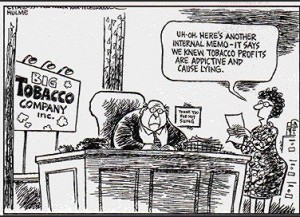
An updated tally by ProPublica shows that tobacco bondholders are due $2.6 billion of the $6 billion in this year’s payouts to state and local governments from Big Tobacco.

Each April, cigarette manufacturers pay states billions of dollars to reimburse them for the health-care costs of smoking. About $100 billion has been paid so far, all under a landmark 1998 legal settlement with Big Tobacco. The payments are to go on forever as long as people smoke.  Tobacco Cash

Tobacco Cash

Where Do Economic Events Originate?

Michael Pettis writes:  Because the US economy and its financial markets are so large and flexible, and because many other economies have large players – usually the state – whose behavior can drive deep domestic imbalances, it is often the US that responds to events driven abroad. For example after the 1997 Asian external debt crisis, a number of Asian countries began to accumulate US dollar reserves, and this accumulation accelerated in the next decade. It is purely an accounting identity that if other countries become next exporters of capital to the US, they must run current account surpluses (although not necessarily bilateral surpluses, which are in fact unlikely) and the US must run current account deficits (although not necessarily bilateral deficits, of course), and it is also purely an accounting identity that if the US runs a current account deficit, its domestic savings must be lower than its domestic investment.

Every economist knows this, or should know this, and yet to say that the surge in the US current account deficit during the decade before the 2007-8 crisis was a necessary adjustment to Asian reserve accumulation policies of the last decade is considered an extremely political statement. Some economists in the US counter this claim by arguing that the US deficit cannot be caused by Asian reserve accumulation polices because it has bilateral deficits with many countries, or, what is even more absurd, because it has a low savings rate. It is true that in principle the capital-flow imbalances could have been caused by a decision by American households to reduce their savings rates sometime around 1997, which forced someone else – the East Asians, for some reason – to raise their savings rate, but it is hard to explain why excess US demand for foreign savings, and not excess supply of foreign savings, would have been accommodated by declining, not rising, interest rates.

It seems so logical, and yet it has become such a politicized argument in which the balance or payments identities are almost never invoked. I suspect the prejudice that only Americans can act independently, and everyone else must respond, may exist at least in part because most economists have either studied in the US or have studied under US-trained economists, and so without realizing it have developed a US-centric view of the world that cannot posit an alternative world.

America 1, 2, 3